
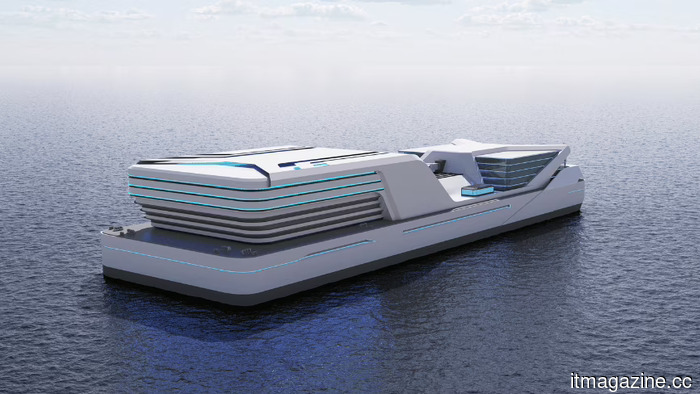
Samsung intends to establish a floating AI data center by 2028.
As data centers face opposition from local communities and limitations on water usage, Samsung is looking to deploy them offshore. According to the Seoul Economic Daily, Samsung Heavy Industries intends to introduce its first floating data center by 2028, which will be a specially designed barge located near the coast.
The design is tailored specifically for this purpose. Rather than repurposing an outdated vessel, Samsung is constructing a new 50MW barge equipped with a server hall, onboard power generation, and liquefied natural gas fuel tanks. The initial model will be “nearshore,” positioned close to the land and drawing some electricity from the grid as a cautious preliminary step before moving further into open waters.
The rationale for situating a data center on water addresses an escalating challenge on land. Data centers require large areas, affordable energy, and significant amounts of water for cooling, but communities are increasingly reluctant to compromise on all three. By floating offshore, these centers can avoid land scarcity and lengthy planning disputes, while the ocean provides natural cooling.
However, the economic viability remains uncertain. Saltwater poses corrosion risks, storms threaten stability, and providing fiber and power to a barge incurs additional costs and dangers. Samsung believes that this investment could be worthwhile, especially as AI demand surpasses the capabilities of many existing power grids and towns.
This initiative also signals a shift in the shipbuilding industry. Samsung’s shipyards are seeking new projects, and “data centers at sea” will utilize their excess hull-building capacity for AI infrastructure. According to Samsung Heavy Industries' CEO, Sung-an Choi, “floating data centers present a significant new opportunity for the shipbuilding and offshore sectors.”
Other companies are exploring similar concepts. A Japanese collaboration between Mitsui OSK Lines and Hitachi is retrofitting existing ships for data center use, with plans to launch in 2027. Additionally, China has advanced even further by establishing a data center underwater.
Samsung is collaborating with partners as well. At the Posidonia maritime exhibition, it formed partnerships with Greece’s Capital Clean Energy Carriers and the classification society Lloyd’s Register. It also made an agreement with Supermicro to test AI servers at sea, according to The Register. The American Bureau of Shipping and Lloyd’s Register have provided approval in principle for these ventures.
The significance of this development is that floating data centers are still speculative rather than established. However, a shipbuilder planning such projects illustrates the lengths the industry will go to avoid resistance on land. If communities refuse to accommodate the power-intensive facilities that AI demands, the solution may well lie just offshore.
Other articles
 HubSpot retracts its decision on utilizing customer data for AI purposes.
HubSpot has abandoned its proposal to consolidate customer data for an AI feature following a four-day wave of criticism, highlighting how sensitive the issue of AI and data collection has become.
HubSpot retracts its decision on utilizing customer data for AI purposes.
HubSpot has abandoned its proposal to consolidate customer data for an AI feature following a four-day wave of criticism, highlighting how sensitive the issue of AI and data collection has become.
 Venus Aerospace secures $91 million for its detonation engine.
Venus Aerospace has secured $91 million in a Series B funding round to develop its rotating detonation rocket engine into physical technology for missiles and high-speed space vehicles.
Venus Aerospace secures $91 million for its detonation engine.
Venus Aerospace has secured $91 million in a Series B funding round to develop its rotating detonation rocket engine into physical technology for missiles and high-speed space vehicles.
 A professor at Brown has demonstrated evidence of widespread cheating using artificial intelligence.
A professor at Brown shifted his exam to an in-person format, resulting in the class average plummeting from 96 to 48, transforming a vague concern regarding AI-assisted cheating into a concrete statistic.
Fi places Starlink satellites within a dog collar.
Fi's latest product, the Fi Ultra, is the first dog collar to utilize Starlink's direct-to-cell satellites, enabling pet tracking beyond the reach of traditional phone towers, according to a report by Fortune.
A professor at Brown has demonstrated evidence of widespread cheating using artificial intelligence.
A professor at Brown shifted his exam to an in-person format, resulting in the class average plummeting from 96 to 48, transforming a vague concern regarding AI-assisted cheating into a concrete statistic.
Fi places Starlink satellites within a dog collar.
Fi's latest product, the Fi Ultra, is the first dog collar to utilize Starlink's direct-to-cell satellites, enabling pet tracking beyond the reach of traditional phone towers, according to a report by Fortune.
 A Brown University professor's evidence of widespread cheating using mass AI.
A professor at Brown changed his exam to an in-person format, causing the class average to drop from 96 to 48, transforming a vague concern about AI cheating into an undeniable statistic.
A Brown University professor's evidence of widespread cheating using mass AI.
A professor at Brown changed his exam to an in-person format, causing the class average to drop from 96 to 48, transforming a vague concern about AI cheating into an undeniable statistic.
 Adult content creators targeted by scammers are having government websites taken down.
Fraudsters are exploiting the names of adult creators to infect reputable government and university websites, as copyright claims discreetly drive thousands of harmful pages out of Google's search results.
Adult content creators targeted by scammers are having government websites taken down.
Fraudsters are exploiting the names of adult creators to infect reputable government and university websites, as copyright claims discreetly drive thousands of harmful pages out of Google's search results.
Samsung intends to establish a floating AI data center by 2028.
Samsung Heavy Industries intends to develop a specialized 50MW floating data center by 2028, as onshore AI projects face challenges related to land, water, and community opposition.