

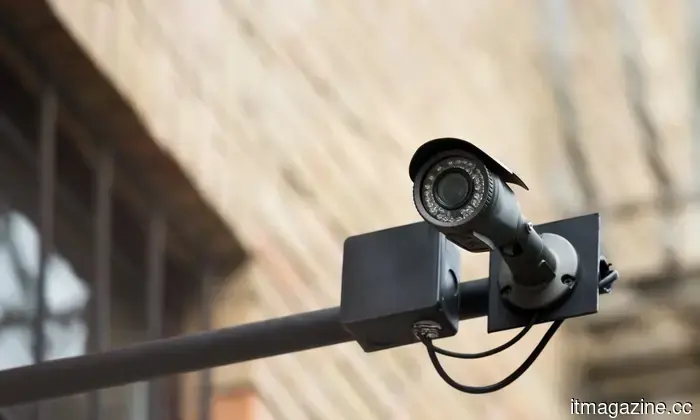
AI security cameras might soon identify your walking pattern before they are able to recognize your face.
A new AI gait system monitors body motion via skeletal keypoints, focusing on long-range identity verification where facial scans and fingerprints may not be effective.
Surveillance cameras are primarily designed to detect faces. However, recent studies indicate they might soon expand their focus to include the subtle details within an individual's walking style.
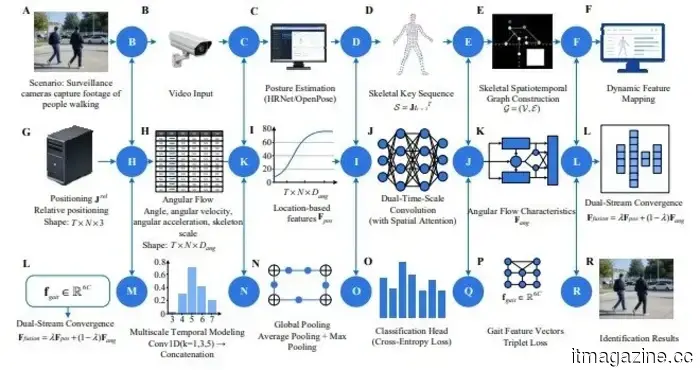
A study featured in the International Journal of Reasoning-based Intelligent Systems introduces SKDMap-Net, a gait recognition system aimed at recognizing individuals from video of them walking, even when their face is not clearly visible. Instead of depending on close facial recognition, it analyzes body movement from frame to frame.
This capability is both beneficial and concerning. When an individual is at a distance, positioned sideways, or partially obscured, their walking pattern could still suffice for identification. The model achieved an accuracy rate of 95.8% on a primary gait dataset and 83.7% Rank-1 accuracy on a more challenging real-world dataset.
The Advantage of Gait Recognition
Faces, fingerprints, and iris patterns all encounter the same limitation: they require a clear and close capture, which is not often achievable with many security cameras.
The AI gait system benefits from increased flexibility. A camera is not limited to capturing someone standing still in ideal lighting conditions; it can analyze movement patterns influenced by stride, timing, and limb gestures.
This is why gait recognition continues to appear in security studies—it provides an alternative identity cue when facial images are unclear, angled, or too diminutive to be reliable.
How the AI Analyzes Movement
SKDMap-Net does not represent walking as a simple outline. Factors such as poor camera angles can quickly complicate that outline.
Instead, the system segments the body into moving points and tracks their behavior over time, examining how joints flex, the speed of their rotation, and variations in walking rhythm.
This approach is advantageous when the camera's view deteriorates. If the lower body is obstructed, the model can rely more on upper-body movements rather than attempting to infer from absent legs. It focuses on motion rather than just shape.
Privacy Concerns
There exists a more ethical vision of the future where cameras analyze skeletal data rather than storing unprocessed video footage. This could limit the amount of identifiable material within a security framework.
However, this does not render the concept entirely benign. Gait is a behavioral biometric, meaning that an individual’s walking style could be used for identification, even without facial recognition.
Enhanced long-range identity verification could also facilitate the tracking of public movements. Therefore, stringent regulations surrounding data storage, access, and usage are necessary before normalizing "walk normally" as sound privacy advice.
Paulo Vargas is an English major turned journalist turned technical writer, with a career that circles back to...
A 3D printer breakthrough that operates in just 20 seconds comes with the typical catch that science often presents.
This innovative process generates intricate microstructures much faster than some laser-based techniques, though achieving complete 3D control is still in development.
A 3D printer capable of producing a structure in roughly 20 seconds may sound like an extravagant claim. The impressive aspect is indeed real. However, the limitation arises before anyone dreams of instant replacement components.
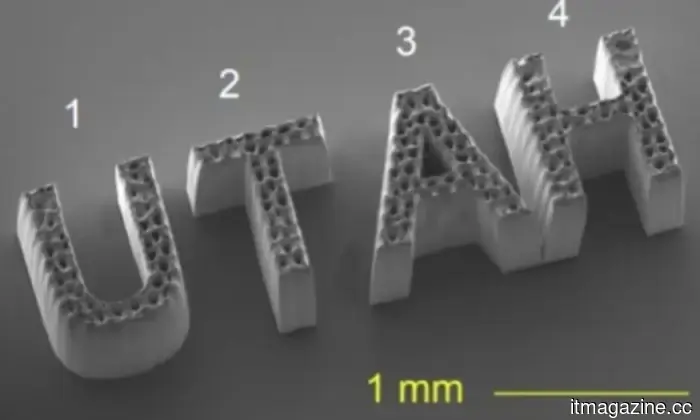
Researchers at the University of Utah have unveiled a holographic 3D printing method that solidifies tiny structures in a single exposure rather than constructing them layer by layer. This single-shot method could circumvent the fragile, leaky seams often associated with traditional layered printing. As for now, it remains a tool tailored for microstructures rather than a shortcut to fabricate any object that comes to mind.
Shopping on Amazon has become more complicated due to an influx of look-alike and questionable brands. A Chrome extension has been developed to help users avoid them.
Shopping on Amazon was once straightforward: search for a product, compare a few known brands, and make a purchase. Recently, it feels more like browsing through an endless stream of names resembling someone carelessly tapping on a keyboard before publishing. This is precisely the issue that the Knockoff extension aims to address.
Created by developer Josh Pigford, the Chrome extension does not claim to expose counterfeit items or magically determine quality. Instead, it deals with a more frustrating aspect: the surge of unknown, mass-manufactured brands that dominate Amazon's search results.
According to cybersecurity experts, an AI agent may have independently conducted an entire ransomware attack.
AI did not merely write malicious software; it seemingly took a hands-on approach.
Researchers in cybersecurity say they have documented what could be the first ransomware attack largely executed by an autonomous AI agent, indicating a notable evolution in the execution of cyberattacks. Cloud security firm Sysdig has revealed a ransomware operation known as JadePuffer, which appears to have relied on a large language model (LLM) agent to carry out nearly every phase of the attack without ongoing human involvement.
If verified, this instance suggests that AI is evolving beyond just generating harmful code and is now actively engaged in planning, evolving, and




Other articles
 Your complimentary mobile VPN is a privacy nightmare. Who would have thought?
Researchers evaluated 281 free Android VPN applications and discovered unencrypted data transfers, traffic leaks, and extensive tracking within tools that are meant to safeguard users’ privacy.
Your complimentary mobile VPN is a privacy nightmare. Who would have thought?
Researchers evaluated 281 free Android VPN applications and discovered unencrypted data transfers, traffic leaks, and extensive tracking within tools that are meant to safeguard users’ privacy.
 Apple begins testing more affordable Chinese RAM in iPhones, but your wallet won't benefit from the savings.
Apple is evaluating memory chips from CXMT, a Chinese chip manufacturer that is supported by the government and is on the Pentagon's watchlist. Washington has previously opposed this and is expected to do so again.
Apple begins testing more affordable Chinese RAM in iPhones, but your wallet won't benefit from the savings.
Apple is evaluating memory chips from CXMT, a Chinese chip manufacturer that is supported by the government and is on the Pentagon's watchlist. Washington has previously opposed this and is expected to do so again.
 Palmer Luckey: American universities are lagging behind those in China.
Palmer Luckey of Anduril claims that U.S. universities cultivate "architecture astronauts," whereas China develops genuine engineers, a sentiment also expressed by the CEO of Pfizer.
Palmer Luckey: American universities are lagging behind those in China.
Palmer Luckey of Anduril claims that U.S. universities cultivate "architecture astronauts," whereas China develops genuine engineers, a sentiment also expressed by the CEO of Pfizer.
 Meta might be developing smart glasses that are capable of always seeing and hearing, equipped with advanced AI sensing technology.
Meta is said to be experimenting with “super sensing” AI glasses designed to gather comprehensive data about your life and provide it to an AI assistant that will aid you.
Meta might be developing smart glasses that are capable of always seeing and hearing, equipped with advanced AI sensing technology.
Meta is said to be experimenting with “super sensing” AI glasses designed to gather comprehensive data about your life and provide it to an AI assistant that will aid you.
 Palmer Luckey: American universities are lagging behind those in China.
Palmer Luckey of Anduril claims that American universities are producing 'architecture astronauts,' while China is cultivating actual engineers, a sentiment that Pfizer's CEO has also echoed.
OpenAI's GPT-Live: A voice feature for ChatGPT that can listen and engage in conversation.
OpenAI has introduced GPT-Live, a full-duplex voice feature for ChatGPT that can listen and speak simultaneously, complete with live translation. This feature is being made available to all users, including those with free accounts.
Palmer Luckey: American universities are lagging behind those in China.
Palmer Luckey of Anduril claims that American universities are producing 'architecture astronauts,' while China is cultivating actual engineers, a sentiment that Pfizer's CEO has also echoed.
OpenAI's GPT-Live: A voice feature for ChatGPT that can listen and engage in conversation.
OpenAI has introduced GPT-Live, a full-duplex voice feature for ChatGPT that can listen and speak simultaneously, complete with live translation. This feature is being made available to all users, including those with free accounts.
AI security cameras might soon identify your walking pattern before they are able to recognize your face.
A novel AI gait recognition system can recognize individuals based on their walking patterns, providing security cameras with an additional long-distance signal when faces are unclear, obscured, or too small to rely on.