
Romania spearheads its inaugural private ESA mission through the launch of CyberCUBE.
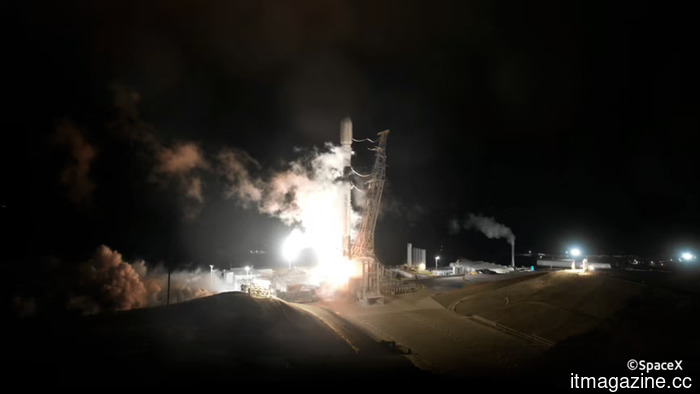
A Falcon 9 rocket took off from Vandenberg Space Force Base in California on the morning of July 7, carrying a satellite about the size of a loaf of bread that will spend the next year exploring how European spacecraft can be vulnerable to attacks. The payload, known as CyberCUBE, is the first mission of the European Space Agency (ESA) that is entirely managed by a private company based in Romania.
This designation is significant in a field where ESA missions have historically been led by larger member states. It arrives as private space technology investments across Europe reach unprecedented levels, and as Brussels becomes increasingly concerned about the security of the orbital systems it relies on.
GMV Romania, the local branch of the Spanish technology firm, acted as the prime contractor and directed the mission from design and integration to launch and in-orbit validation. This achievement makes CyberCUBE the first ESA satellite overseen by a Romanian company, as noted by GMV.
"We have proven that Romanian specialists can manage an ESA mission from beginning to end," stated Cristian Chițu, space director at GMV Romania. He presented the launch as a landmark for the broader Romanian space sector rather than a victory for a single business.
Romanian engineers also selected the launch provider and assisted in integrating the satellite into Exolaunch’s EXOpod deployment system, from which SpaceX’s Falcon 9 deployed it into orbit. The team monitored the launch operations on-site in California.
The flight hardware consists of a 3U CubeSat developed by Alén Space, the Spanish small satellite expert acquired by GMV in 2023. It features reprogrammable onboard processing and a payload dedicated to monitoring cyber threats while in orbit.
The goal is to provide ESA with a secure, reconfigurable testbed for security technologies before they are used in operational missions. Planned experiments will include detecting unauthorized access to command systems and validating post-quantum cryptography, designed to withstand future quantum computers.
Two primary threats are central to the mission: jamming, which disrupts a signal with intentional interference, and spoofing, which provides a spacecraft with misleading yet convincing data. Both have transitioned from theoretical concerns to verified tactics as Europe increasingly relies on its satellites.
The mission has a budget of approximately €1.9 million and an expected operational lifespan of at least twelve months, according to GMV. ESA has issued an open invitation for external researchers to conduct their own experiments on the platform, reflecting the agency’s eagerness for ESA-supported satellite work in collaboration with commercial partners.
The satellite's main user will be ESA’s Cybersecurity Operations Centre, which will coordinate experiment requests and analyze the data received. Daily operations will take place at the agency’s center in Redu, Belgium, with high-speed communications managed from its operations hub in Darmstadt.
On the ground, GMV Spain provided essential components of the control segment, including a mission control center built on the company’s commercial FocusSuite software. Engineers also created a flatsat, a simplified version of the satellite that allows operators to practice commands on the ground before sending them to the actual spacecraft.
“The successful launch highlights the increasing maturity of Romania’s space ecosystem and the benefits of ongoing participation in ESA programs,” remarked Daniel-Eugeniu Crunțeanu, director general of the Romanian Space Agency. He linked future ambitions to Romania’s capacity to continue contributing to ESA’s optional programs.
This launch occurs within a larger European initiative to strengthen digital defenses, from NATO’s cyber partnerships with private companies to national space strategies. Space, once seen as a distant and relatively untouchable domain, is now increasingly viewed as another area that requires protection.
GMV will oversee several weeks of in-orbit validation before transferring control to ESA for the mission’s operational phase. The insights gained are intended to inform how the agency safeguards the satellites it launches in the future.
Other articles
 This VR empathy game might just be the beginning of something far more unsettling.
Rekindle employs facial recognition biometrics to transform emotions into gameplay, but this concept could ultimately advance emotion-sensitive technology in therapy, safety systems, and interfaces that monitor more than just clicks.
This VR empathy game might just be the beginning of something far more unsettling.
Rekindle employs facial recognition biometrics to transform emotions into gameplay, but this concept could ultimately advance emotion-sensitive technology in therapy, safety systems, and interfaces that monitor more than just clicks.
 Quaise secures $134 million for superhot geothermal drilling.
Geothermal startup Quaise Energy has secured a $134 million initial close of its Series B funding round, with Prelude Ventures leading the investment, to drill into superhot rock using millimeter-wave beams.
Quaise secures $134 million for superhot geothermal drilling.
Geothermal startup Quaise Energy has secured a $134 million initial close of its Series B funding round, with Prelude Ventures leading the investment, to drill into superhot rock using millimeter-wave beams.
 Data from Estonia's Odience reveals that niche creator communities are surpassing mass reach in sales.
Data from Odience, based in Estonia, indicates that nano and micro creators with closely connected niche audiences consistently exceed mass-reach influencer campaigns in terms of clicks, leads, and conversion rates.
Data from Estonia's Odience reveals that niche creator communities are surpassing mass reach in sales.
Data from Odience, based in Estonia, indicates that nano and micro creators with closely connected niche audiences consistently exceed mass-reach influencer campaigns in terms of clicks, leads, and conversion rates.
 Quaise secures $134 million to explore ultra-high-temperature geothermal drilling.
The geothermal startup Quaise Energy has secured a $134 million first close of its Series B funding round, with Prelude Ventures at the helm, to drill superhot rock using millimetre-wave beams.
Quaise secures $134 million to explore ultra-high-temperature geothermal drilling.
The geothermal startup Quaise Energy has secured a $134 million first close of its Series B funding round, with Prelude Ventures at the helm, to drill superhot rock using millimetre-wave beams.
 Virtual taekwondo may seem like a novelty, but it has the potential to address the most significant concern in combat sports.
Virtual taekwondo may seem like a VR novelty, but its non-contact style could make martial arts more accessible for children, hesitant newcomers, women, and older participants.
Virtual taekwondo may seem like a novelty, but it has the potential to address the most significant concern in combat sports.
Virtual taekwondo may seem like a VR novelty, but its non-contact style could make martial arts more accessible for children, hesitant newcomers, women, and older participants.
 Victims of Predatorgate file a lawsuit against the spyware company Intellexa.
Eight victims of Greece's Predatorgate scandal are taking legal action against spyware company Intellexa and 13 individuals, seeking €1 million each due to phone hacking incidents that occurred in 2020–2021.
Victims of Predatorgate file a lawsuit against the spyware company Intellexa.
Eight victims of Greece's Predatorgate scandal are taking legal action against spyware company Intellexa and 13 individuals, seeking €1 million each due to phone hacking incidents that occurred in 2020–2021.
Romania spearheads its inaugural private ESA mission through the launch of CyberCUBE.
CyberCUBE, an orbital cybersecurity testbed operated by GMV Romania, has been launched aboard a Falcon 9. This marks the first ESA mission led by a Romanian firm.