
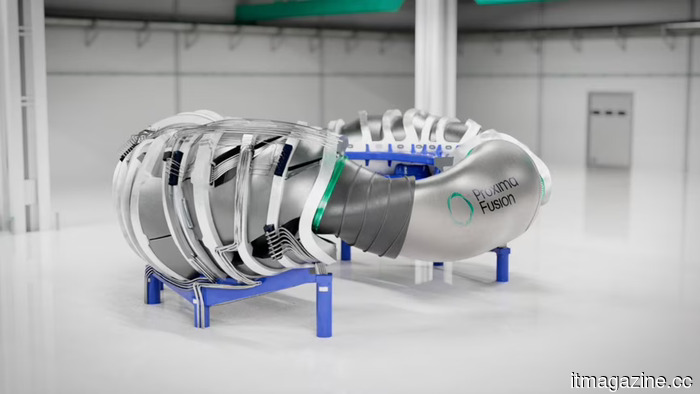
Google and RWE support Proxima Fusion in a historic €411 million funding round.
Munich-based Proxima Fusion has secured €411 million ($468 million) in funding, marking the largest private fusion financing round in Europe to date and a significant endorsement for a technology that has yet to generate any commercial energy. This deal values the stellarator company at €2.4 billion and attracts strategic investments from Google and German utility RWE.
Leading the funding round were XTX Ventures and East X Ventures, the investment arms of two quantitative trading firms increasingly interested in hard science, with East X managing Starmaker One, Europe’s first fund focused on fusion and supported by the UK Atomic Energy Authority.
Returning investors Plural, Balderton, Cherry Ventures, Lightspeed, and DST Global Partners rejoined the round, accompanied by new investors KfW Capital, SPRIND, and Burda Principal Investments. This follows closely on Proxima's record €130 million Series A less than a year ago, which was co-led by Cherry Ventures and Balderton.
For Google, this investment signifies its first venture into a European fusion company, expanding its interest that already includes several developers in the US, according to TechFundingNews. RWE’s involvement is more substantial: the utility contributed around €25 million and previously committed to assisting in the construction of the first stellarator plant at a decommissioned fission reactor site in Gundremmingen, Bavaria.
In just under three years, Proxima has raised over €650 million, including approximately €95 million from public grants. The recent funding round exceeded its own target, which aimed to match Bavaria’s €400 million public investment in the company’s roadmap. Founder and CEO Francesco Sciortino highlighted the funding as a demonstration that Europe can “not only invent groundbreaking technologies but also establish globally competitive companies around them.”
The funds will be used for Alpha, a net-energy demonstrator that Proxima aims to have operational near Munich in the early 2030s. Developed alongside the state of Bavaria, the Max Planck Institute for Plasma Physics, and RWE, Alpha represents a link between decades of laboratory research and a functioning power station. Successful operation of Alpha would lead to Stellaris, proposed as the world’s first commercial stellarator plant, later in the decade.
Supporting this initiative is the Alpha Alliance, a consortium comprising over 50 industrial partners. Proxima is pursuing fusion via the stellarator, a reactor that shapes plasma with a structure of external magnets rather than passing a current through it, as is typical with the more common tokamak design.
While the engineering is notably complex, the design is ideally more stable and less prone to interruptions. The company originated from the Max Planck Institute for Plasma Physics and builds upon the Wendelstein 7-X, a German experiment that demonstrated the viability of maintaining plasma stability.
In the short term, the funds will go toward essential but less glamorous hardware: completing the Stellarator Model Coil, increasing the production of high-temperature superconducting cables and magnets, and expanding recruitment in engineering and manufacturing across locations in Germany, Switzerland, and the UK.
Currently employing around 200 people, Proxima plans to hire many more as part of a vertical integration strategy that keeps coil and magnet production in-house rather than outsourcing it to suppliers.
This funding timing is intentional. European fusion companies have been rapidly securing financial backing as governments begin to view the technology as crucial for energy security rather than a distant academic endeavor. Proxima now ranks among the most well-funded fusion companies globally.
Fusion has a history of promising endless clean energy while frequently postponing timelines, and Proxima’s ambitious goals for the 2030s are notable. However, the financial commitment of €411 million, supplemented by Bavaria’s public investment, indicates that investors are willing to support the substantial, capital-intensive aspects of the endeavor, rather than just the theoretical physics. The crucial question remains whether the scientific breakthroughs can be achieved, an outcome that no amount of funding can guarantee.
Other articles
 TechEx Europe 2026: eight events, 8,000 technology leaders, a unified enterprise agenda.
TechEx Europe 2026 will take place at the RAI Amsterdam on October 19-20, combining eight co-located events into a unified enterprise agenda focused on execution.
TechEx Europe 2026: eight events, 8,000 technology leaders, a unified enterprise agenda.
TechEx Europe 2026 will take place at the RAI Amsterdam on October 19-20, combining eight co-located events into a unified enterprise agenda focused on execution.
 WiseTech co-founder Richard White resigns from his role as chair, yet retains his position on the board.
Richard White, co-founder of WiseTech, has resigned from his position as executive chair during a police investigation but will remain on the board as chief innovation officer. Shares increased.
WiseTech co-founder Richard White resigns from his role as chair, yet retains his position on the board.
Richard White, co-founder of WiseTech, has resigned from his position as executive chair during a police investigation but will remain on the board as chief innovation officer. Shares increased.
 Nscale secures a $900 million revolving credit facility to finance its data center expansion.
Nscale has finalized a $900 million revolving credit facility, which has been syndicated among 12 banks, enhancing its flexible liquidity for the development of AI data centers.
Nscale secures a $900 million revolving credit facility to finance its data center expansion.
Nscale has finalized a $900 million revolving credit facility, which has been syndicated among 12 banks, enhancing its flexible liquidity for the development of AI data centers.
 According to sources, the US cyber agency is utilizing Anthropic's Mythos to examine government code.
According to sources, CISA is said to be employing Anthropic’s Mythos AI to examine government code for vulnerabilities, just months following a confrontation with the White House.
According to sources, the US cyber agency is utilizing Anthropic's Mythos to examine government code.
According to sources, CISA is said to be employing Anthropic’s Mythos AI to examine government code for vulnerabilities, just months following a confrontation with the White House.
 Why CNAPP is Becoming Crucial for Cloud-Native Security
Grasping the contemporary demands of online security. Previously, cloud-native security appeared to be an issue solely for highly technical teams operating within intricate systems. This perspective has evolved. As organizations adopt containers, Kubernetes, APIs, serverless functions, and rapid deployment cycles, security teams require a method to monitor risk throughout all these elements without having to assemble […]
Why CNAPP is Becoming Crucial for Cloud-Native Security
Grasping the contemporary demands of online security. Previously, cloud-native security appeared to be an issue solely for highly technical teams operating within intricate systems. This perspective has evolved. As organizations adopt containers, Kubernetes, APIs, serverless functions, and rapid deployment cycles, security teams require a method to monitor risk throughout all these elements without having to assemble […]
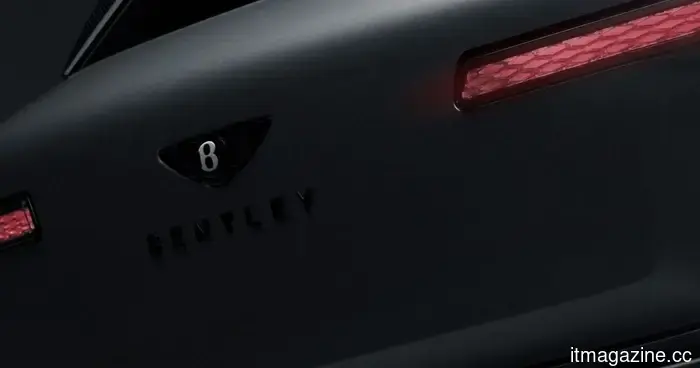 Bentley's inaugural fully electric SUV will be named Torcal.
Bentley has introduced the Torcal, its inaugural electric SUV, focusing on high-quality craftsmanship and rapid charging, even as demand within the luxury EV market shows signs of decline.
Bentley's inaugural fully electric SUV will be named Torcal.
Bentley has introduced the Torcal, its inaugural electric SUV, focusing on high-quality craftsmanship and rapid charging, even as demand within the luxury EV market shows signs of decline.
Google and RWE support Proxima Fusion in a historic €411 million funding round.
Proxima Fusion in Munich has secured €411 million in funding from investors such as Google and RWE, marking the largest private fusion funding round in Europe to date.