
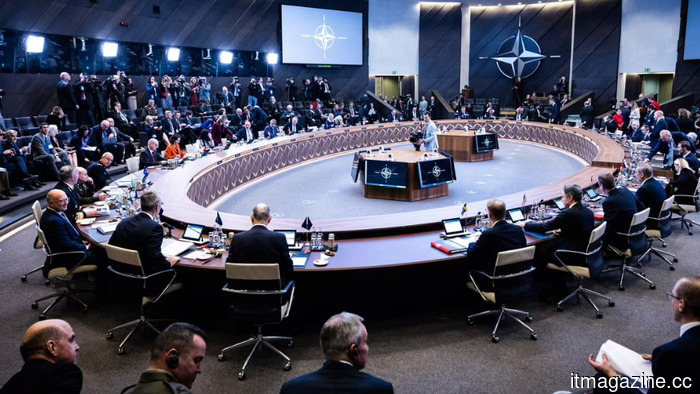
US dominance in frontier AI casts a shadow over the NATO summit.
**TL;DR** The US's influence over top cyber-capable AI models, particularly Anthropic’s Claude Mythos, casts a shadow over the NATO summit in Ankara on July 7-8. Washington has been inconsistent with export controls and expanding allied access through Project Glasswing, causing frustration among European allies who seek access while developing their own defense AI. Officially, the summit will not address this significantly.
Donald Trump heads to next week’s NATO summit in Ankara with considerable leverage, as the US controls access to the world's most advanced AI, according to Politico. The alliance convenes on July 7 and 8 with AI security concerns looming over the agenda.
New models from Anthropic and OpenAI can locate and utilize security vulnerabilities more effectively than most human experts. During a governmental test, Anthropic’s Claude Mythos identified weaknesses in classified US systems in just hours.
“AI is fundamentally altering the threat landscape, and NATO must adapt as necessary,” stated Estonian cyber ambassador Helen Popp to Politico. She contended that every capability accessible to adversaries is also available to allies, assuming they act first.
Recent developments in the EU tech sector, a report from our founder Boris, and some questionable AI art are all included in our weekly newsletter. It’s free! Sign up now! US agencies like the NSA and CISA have been evaluating Mythos for cyber defense and digital espionage. European allies have demanded access, and EU institutions have voiced their requests, with only a few countries, including the UK, granted initial evaluation permissions.
In June, Anthropic broadened its Project Glasswing initiative to around 150 organizations across more than 15 countries, including the EU, following weeks of confusion from Washington.
In early June, the Trump administration enacted export controls on Anthropic’s leading cyber models, prohibiting foreign nationals from utilizing them and enforcing a global shutdown. These controls were lifted on June 30 after an 18-day period.
The White House has also restricted the distribution of OpenAI’s latest model to a limited number of approved US companies, as noted by Politico. This back-and-forth has frustrated allies, led to a rare Five Eyes alert on AI cyber threats, and resulted in leading models shifting between governments more rapidly than regulators can keep up with.
**Quiet corridors, loud subtext**
The summit’s agenda includes a session on emerging and disruptive technologies, but an official told Politico that AI and cyber issues will only receive brief mentions in the closing statement. Former NATO cyber policy leader Heli Tiirmaa-Klaar remarked that allies tend to avoid formally discussing subjects that lack consensus, suggesting that discussions will occur informally.
The US State Department’s cyber bureau will not be represented due to internal restructuring, according to Politico. Senator Jeanne Shaheen mentioned she would attend to assure allies that the US will not “alienate them” concerning AI model access.
Separately, Trump signed NSPM-11, directing the US military to adopt AI more swiftly and shield models from China. Europe is countering by developing its own capabilities, notably through a defense AI partnership between Helsing and Mistral.
The ongoing war in Ukraine, now in its fourth year, heightens the stakes, with allies committing 1.5% of GDP to safeguard critical infrastructure. Laura Galante from the Center for European Policy Analysis referred to Ukraine as a model for operating in warfare driven by AI.
A spokesperson for the State Department stated that all allies must adopt “trusted leading-edge AI capabilities.” However, the criteria for what constitutes trusted capabilities and who determines this trust is precisely what Ankara may not fully address.
Other articles
 Hon Hai reports a 40% increase in sales driven by demand for AI servers.
Foxconn's parent company, Hon Hai, exceeded expectations with a 40% increase in quarterly sales, driven by rising demand for Nvidia AI racks, and stated that this momentum is expected to persist.
Hon Hai reports a 40% increase in sales driven by demand for AI servers.
Foxconn's parent company, Hon Hai, exceeded expectations with a 40% increase in quarterly sales, driven by rising demand for Nvidia AI racks, and stated that this momentum is expected to persist.
 I’ve allowed the Radial menu to take control of my Mac, and I have no intention of reverting.
I dedicated a week to testing Radial, a Mac application that places your shortcuts, scripts, and automations directly at your cursor, and it has already transformed my usage of the Mac.
I’ve allowed the Radial menu to take control of my Mac, and I have no intention of reverting.
I dedicated a week to testing Radial, a Mac application that places your shortcuts, scripts, and automations directly at your cursor, and it has already transformed my usage of the Mac.
 The Android desktop mode made me long for my laptop in no time at all.
The Android desktop mode can transform a phone into a fairly functional workstation; however, after spending a workday using WordPress, browser tools, and numerous accessories, the laptop seemed refreshingly straightforward.
The Android desktop mode made me long for my laptop in no time at all.
The Android desktop mode can transform a phone into a fairly functional workstation; however, after spending a workday using WordPress, browser tools, and numerous accessories, the laptop seemed refreshingly straightforward.
 China's regulations on AI companions lead to the shutdowns of Doubao and Qwen.
Doubao and Qwen are withdrawing user-generated agents ahead of Beijing's regulations on humanlike AI interaction set to take effect on July 15, marking the first framework of its kind in the world.
China's regulations on AI companions lead to the shutdowns of Doubao and Qwen.
Doubao and Qwen are withdrawing user-generated agents ahead of Beijing's regulations on humanlike AI interaction set to take effect on July 15, marking the first framework of its kind in the world.
 Spotify's streaming fraud problem is so significant that Kalshi traders are benefiting from manipulated charts.
According to a report by the Financial Times, Spotify has taken down over half a million streams from Malcolm Todd's song "Earrings" due to suspected bot activity. The track, which was initially released in 2024, unexpectedly surged to the top spot on Spotify's daily U.S. chart after a significant increase in its streams. Concurrently, traders on prediction [...]
Spotify's streaming fraud problem is so significant that Kalshi traders are benefiting from manipulated charts.
According to a report by the Financial Times, Spotify has taken down over half a million streams from Malcolm Todd's song "Earrings" due to suspected bot activity. The track, which was initially released in 2024, unexpectedly surged to the top spot on Spotify's daily U.S. chart after a significant increase in its streams. Concurrently, traders on prediction [...]
 UK parents cautioned about the risk of AI-generated child abuse images.
The NCA and IWF urge parents to cease publicly sharing photos of their children, as the number of AI-generated abuse videos skyrocketed from 13 to 3,440 within a year.
UK parents cautioned about the risk of AI-generated child abuse images.
The NCA and IWF urge parents to cease publicly sharing photos of their children, as the number of AI-generated abuse videos skyrocketed from 13 to 3,440 within a year.
US dominance in frontier AI casts a shadow over the NATO summit.
Washington determines which NATO allies are granted access to cyber-capable AI such as Claude Mythos. During the Ankara summit, discussions remain confined to the hallways.