

Citi's CEO: Two AI competitions will shape the future of banking.
TL;DR: Citi's CEO Jane Fraser informed the South China Morning Post that the financial sector is engaged in two AI races: leveraging technology to boost revenue and protecting the financial system from AI-driven fraud and cyber threats. She acknowledged that job displacements are on the horizon, evidenced by Citi's own reduction of 3,500 tech positions in China.
Fraser emphasized that the financial industry is simultaneously tackling two AI challenges, as she shared with the South China Morning Post. The first challenge involves integrating AI into business operations to drive revenue growth, expedite product development, and enhance customer service.
The second challenge is defensive in nature. Fraser pointed out that Citi's responsibility is to ensure the safety of the bank, its clients, and the broader financial ecosystem through significant investments, preventing fraud, money laundering, and cyber threats from escalating into serious issues.
This defensive stance is not merely theoretical; criminals already utilize advanced technology for laundering operations. In particular, deepfakes pose a risk to the trust that underpins the financial sector.
Citi is directly involved in the ongoing AI expansion. In March, the bank updated its forecast for global AI capital spending from 2026 to 2030 to $8.9 trillion, up from $8 trillion, due to accelerated enterprise adoption and the emergence of agentic systems. According to consultancy McKinsey, agentic advisers are expected to take over many client interactions in retail and private banking. Fraser, however, takes a cautious view of what this means for employees, acknowledging that while “job dislocations” will occur, new roles will also be created.
Reflecting on her earlier days as an analyst, where she spent time photocopying microfiche and sending faxes to New York, she noted that while jobs evolve, new opportunities arise. She admitted that the shift will not be perfectly synchronized but advised employees to embrace new tools.
Displacements have already begun, as Citi laid off 3,500 technology staff in Shanghai and Dalian last year as part of a global cost-cutting initiative. Morgan Stanley estimates that AI could potentially eliminate up to 400,000 banking jobs in Europe by 2030.
Competitors are navigating a similar path, with Starling cutting 130 positions while still recruiting AI engineers. Meanwhile, startups like Taktile, which raised $110 million to implement AI in banking decisions, are contributing to the industry's transformation.
For years, the financial industry has debated the future of jobs in an AI-driven landscape. The notable shift now is that CEOs are openly addressing the potential job dislocations.
Fraser believes that the two races have a shared objective. The bank that can grow faster than the emerging threats will ultimately prevail.
Other articles
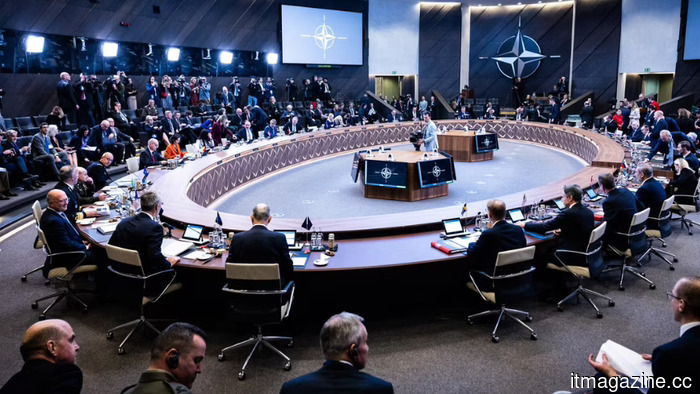 US dominance in frontier AI casts a shadow over the NATO summit.
Washington determines which NATO partners can utilize cyber-capable AI such as Claude Mythos. During the summit in Ankara, the discussions remain confined to the hallways.
US dominance in frontier AI casts a shadow over the NATO summit.
Washington determines which NATO partners can utilize cyber-capable AI such as Claude Mythos. During the summit in Ankara, the discussions remain confined to the hallways.
 China's regulations on AI companions lead to the shutdowns of Doubao and Qwen.
Doubao and Qwen are withdrawing user-generated agents ahead of Beijing's regulations on humanlike AI interaction set to take effect on July 15, marking the first framework of its kind in the world.
China's regulations on AI companions lead to the shutdowns of Doubao and Qwen.
Doubao and Qwen are withdrawing user-generated agents ahead of Beijing's regulations on humanlike AI interaction set to take effect on July 15, marking the first framework of its kind in the world.
 South Korea intends to create a future fund utilizing the revenue from the chip tax.
According to Yonhap, Seoul aims to utilize the record profits from Samsung and SK Hynix to finance AI investments and address inequality through a new "future response fund."
South Korea intends to create a future fund utilizing the revenue from the chip tax.
According to Yonhap, Seoul aims to utilize the record profits from Samsung and SK Hynix to finance AI investments and address inequality through a new "future response fund."
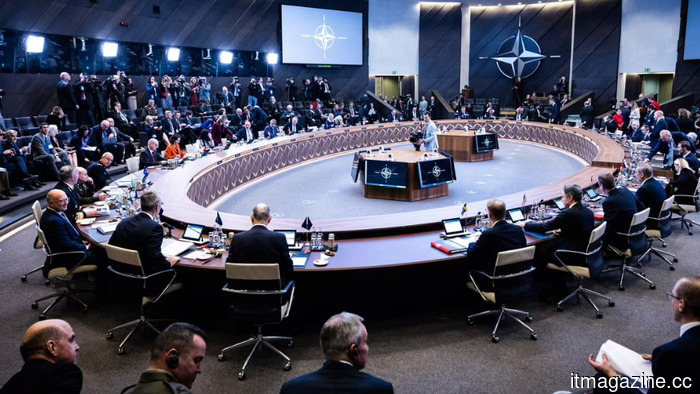 US dominance in frontier AI casts a shadow over the NATO summit.
Washington determines which NATO allies are granted access to cyber-capable AI such as Claude Mythos. During the Ankara summit, discussions remain confined to the hallways.
US dominance in frontier AI casts a shadow over the NATO summit.
Washington determines which NATO allies are granted access to cyber-capable AI such as Claude Mythos. During the Ankara summit, discussions remain confined to the hallways.
 Mistral's CEO: Proprietary AI models grant an advantage to providers.
Arthur Mensch encourages businesses to adopt open source solutions, cautioning that closed AI providers keep data and vie with their own clients. The message culminates at Mistral.
Mistral's CEO: Proprietary AI models grant an advantage to providers.
Arthur Mensch encourages businesses to adopt open source solutions, cautioning that closed AI providers keep data and vie with their own clients. The message culminates at Mistral.
 NHS App receives AI triage in £10 billion technology revamp.
The NHS App's AI feature will guide patients to GPs, pharmacies, or accident and emergency services, aiming to assist 200,000 individuals in the first year. However, health leaders are raising concerns about the evidence supporting this initiative.
NHS App receives AI triage in £10 billion technology revamp.
The NHS App's AI feature will guide patients to GPs, pharmacies, or accident and emergency services, aiming to assist 200,000 individuals in the first year. However, health leaders are raising concerns about the evidence supporting this initiative.
Citi's CEO: Two AI competitions will shape the future of banking.
Jane Fraser emphasizes that banks need to quickly monetize AI while safeguarding the financial system and acknowledges that job displacements are already occurring.