

Mistral's CEO: Proprietary AI models grant an advantage to providers.
TL;DR: Mistral's CEO Arthur Mensch emphasized in a LinkedIn post that businesses should embrace open-source models, open data systems, and self-managed training processes, cautioning that closed providers can gain significant power over clients. While his points about data retention and customer competition have some validity, they come with caveats and also serve as a promotion for Mistral’s Studio and Forge offerings.
Arthur Mensch, co-founder and CEO of the French AI lab Mistral, called on enterprise leaders to move away from closed AI models. In his LinkedIn post, he highlighted how such providers are imposing data retention policies and acquiring “immense leverage” over their clients’ operations.
Mensch explained that as businesses integrate AI models into their internal processes, these providers can observe and learn from their data, even targeting their most successful clients. However, he did not provide evidence for his claim that these providers use customer information to select their targets.
His assertion regarding data retention does hold some truth, though with limitations. A US court required OpenAI to keep ChatGPT logs during a copyright case involving The New York Times, but this did not apply to enterprise and zero-data-retention API clients, and the order was eventually rescinded.
Concerns about competition with customers are better documented; for example, Anthropic cut access for the coding startup Windsurf while developing its own competing model Claude Code. Similarly, Brookings has indicated that model providers are increasingly competing against their own customers for application-layer revenue.
Mensch advocates for a strategy that includes open models, accessible data stores, stringent access controls, and a continuous training cycle based on internal interactions. The aim, he stated, is to transform the operational boundaries of a business into AI systems that are unreplicable by vendors and competitors.
He candidly noted that this approach necessitates a fundamental reorganization of IT and a shift in business practices. He emphasized that access control is particularly challenging, as AI models can reveal information that employees should not access.
Training proprietary models is becoming a more widely accepted practice. For instance, the British startup Cosine has collaborated with BT, HSBC, and BAE Systems to create a sovereign UK model, while Palantir has released an AI sovereignty manifesto targeting larger labs.
Mensch’s cautionary message notably aligns with Mistral’s own products, which include Studio, a platform for managing AI systems, and Forge, a custom model training service introduced in March.
Mistral operates on clients’ infrastructure or offers hosted services that it claims do not store data. This approach appeals to European companies concerned about reliance on American providers, contributing to the continent’s push for sovereignty and to Mistral’s growth.
Based in Paris, the lab is reportedly in discussions for funding at a valuation of €20bn and has recently introduced an industrial AI stack with Airbus, BMW, and EDF as initial users. If businesses accept his argument, it stands to benefit Mistral directly, but this does not undermine the validity of his points.
Mensch concluded by warning that frontier AI can only enhance growth when it is controlled by the business itself. For Europe’s leading open-weight lab, the alignment of their approach and business model is evident.
Other articles
 South Korea intends to create a future fund utilizing the revenue from the chip tax.
According to Yonhap, Seoul aims to utilize the record profits from Samsung and SK Hynix to finance AI investments and address inequality through a new "future response fund."
South Korea intends to create a future fund utilizing the revenue from the chip tax.
According to Yonhap, Seoul aims to utilize the record profits from Samsung and SK Hynix to finance AI investments and address inequality through a new "future response fund."
 I’ve allowed the Radial menu to take control of my Mac, and I have no intention of reverting.
I dedicated a week to testing Radial, a Mac application that places your shortcuts, scripts, and automations directly at your cursor, and it has already transformed my usage of the Mac.
I’ve allowed the Radial menu to take control of my Mac, and I have no intention of reverting.
I dedicated a week to testing Radial, a Mac application that places your shortcuts, scripts, and automations directly at your cursor, and it has already transformed my usage of the Mac.
 Spotify's streaming fraud problem is so significant that Kalshi traders are benefiting from manipulated charts.
According to a report by the Financial Times, Spotify has taken down over half a million streams from Malcolm Todd's song "Earrings" due to suspected bot activity. The track, which was initially released in 2024, unexpectedly surged to the top spot on Spotify's daily U.S. chart after a significant increase in its streams. Concurrently, traders on prediction [...]
Spotify's streaming fraud problem is so significant that Kalshi traders are benefiting from manipulated charts.
According to a report by the Financial Times, Spotify has taken down over half a million streams from Malcolm Todd's song "Earrings" due to suspected bot activity. The track, which was initially released in 2024, unexpectedly surged to the top spot on Spotify's daily U.S. chart after a significant increase in its streams. Concurrently, traders on prediction [...]
 Here’s a list of all the games available for download on Xbox next week.
The release calendar for Xbox next week features 24 games, ranging from AAA pre-orders such as Assassin's Creed Black Flag Resynced to the highly anticipated 1.0 launch of Palworld on Game Pass.
Here’s a list of all the games available for download on Xbox next week.
The release calendar for Xbox next week features 24 games, ranging from AAA pre-orders such as Assassin's Creed Black Flag Resynced to the highly anticipated 1.0 launch of Palworld on Game Pass.
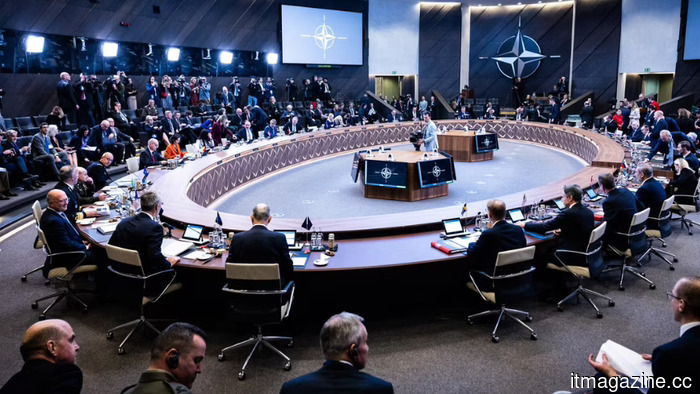 US dominance in frontier AI casts a shadow over the NATO summit.
Washington determines which NATO partners can utilize cyber-capable AI such as Claude Mythos. During the summit in Ankara, the discussions remain confined to the hallways.
US dominance in frontier AI casts a shadow over the NATO summit.
Washington determines which NATO partners can utilize cyber-capable AI such as Claude Mythos. During the summit in Ankara, the discussions remain confined to the hallways.
 UK parents cautioned about the risk of AI-generated child abuse images.
The NCA and IWF urge parents to cease publicly sharing photos of their children, as the number of AI-generated abuse videos skyrocketed from 13 to 3,440 within a year.
UK parents cautioned about the risk of AI-generated child abuse images.
The NCA and IWF urge parents to cease publicly sharing photos of their children, as the number of AI-generated abuse videos skyrocketed from 13 to 3,440 within a year.
Mistral's CEO: Proprietary AI models grant an advantage to providers.
Arthur Mensch encourages businesses to adopt open source solutions, cautioning that closed AI providers keep data and vie with their own clients. The message culminates at Mistral.