
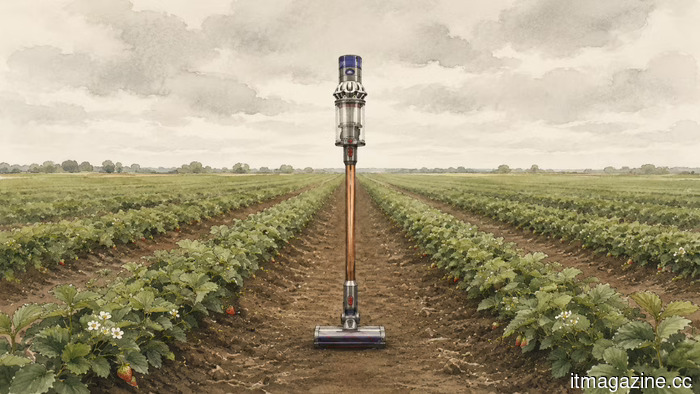
The alternate Dyson empire, calculated in acres.
Inside a greenhouse approximately the size of 20 football pitches, located on the flat black soil of Lincolnshire, strawberry plants are arranged on a Ferris wheel. These wheels rise about 5.5 meters high and each weighs nearly half a tonne. They rotate slowly throughout the day, transporting rows of fruit through the light like rides at a fair, ensuring that no leaf stays in the shade for long. As a strawberry ripens, no hands are used to pick it.
Instead, sixteen robotic arms are responsible for the harvest, directed by cameras that assess each strawberry's color, size, and shape before the secateurs activate. At night, after human harvesters leave, other robots traverse the aisles beneath ultraviolet light, eliminating mold without any chemicals.
In a month, the machines managed to collect 200,000 strawberries. The company that developed this technology is also the manufacturer of the vacuum in your home.
This is typically where the narrative concludes, captivated by the novelty of a billionaire and his robotic fruit, serving as a trivia point for dinner conversations. However, this is not the appropriate stopping point. The vacuum and the strawberries are not mere coincidences, nor are they truly separate enterprises; ultimately, they represent the same machine working in two capacities.
**The heart of EU tech**
The latest updates from the EU tech scene, insights from our knowledgeable founder Boris, and some questionable AI-generated art. It's free and delivered to your inbox every week. Sign up now!
Most people associate Dyson primarily with gadgets. From bagless vacuum cleaners to bladeless fans and hairdryers that cost as much as a weekend getaway. However, fewer realize that Sir James Dyson, the engineer behind the brand, is also one of the largest landowners in British agriculture.
His agricultural division, Dyson Farming, spans around 36,000 acres across Lincolnshire, Oxfordshire, Gloucestershire, and Somerset. The business describes itself as the largest farming operation in the country. Understanding why a man known for suction ventured into this field requires examining three aspects simultaneously: engineering, finance, and a deep, almost obsessive desire to control the entire system.
**The same machine, but cultivating fruits**
We begin with engineering, as Dyson always does. The company is not fundamentally a vacuum manufacturer; it specializes in digital motors, batteries, filtration, thermal management, and increasingly, vision and robotics. The vacuum is merely the most recognizable product of these capabilities.
In 2019, Dyson invested about £500 million in an attempt to create an electric car but ultimately abandoned the project, deeming it commercially unfeasible. He redirected his ambitions, along with £2.75 billion in investment, towards artificial intelligence, robotics, and solid-state batteries. Essentially, he could not create a self-driving car, so he focused on building other autonomous technologies.
Looking at the greenhouse with this context, consider the sixteen robotic arms equipped with machine vision, the nighttime robots identifying mold under UV light, the digital motors propelling half-tonne wheels, and the on-site power generation facility.
Each component represents a Dyson capability adapted for agriculture. The greenhouse is arguably the most sophisticated product the company has ever produced, functioning as a unified machine that generates its own electricity, regulates its climate, and harvests its yield. It just happens to cultivate fruits instead of being stored away. The farm acts as a robotics and energy laboratory funding its own research in strawberry production, which is a more advantageous arrangement compared to most research and development departments.
Agriculture has quietly emerged as one of the most active sectors for robotics, from AI cameras mounted on tractors to vertical farms designed for space; Dyson merely has the financial resources to construct the entire system simultaneously.
**But first came the land**
The land acquisition began around 2012 when Dyson Farming was established, accelerating the following year with the purchase of the Nocton Estate in Lincolnshire and the Churn Estate in Oxfordshire, but it did not stop there. Field by field, farm by farm, the family’s holding company, trading as Beeswax Farming, invested tens of millions of pounds to buy prime agricultural land as it became available. In 2017, the transparency initiative Who Owns England? posed a pertinent question: why was Dyson acquiring so much countryside?
The answer lies in scale; that is what matters most. Dyson Farming claims to be among the top five producers of malting barley, wheat, oilseeds, and potatoes in the UK, generating over 100,000 tonnes of food annually. This is not a leisurely estate or a vanity project. Dyson Farming operates as an industrial venture driven by the same instinct that produced the vacuum: identify the problem, engineer the solution, and then scale it larger than anyone else would dare.
A strawberry, it turns out, has a backstory. It is cultivated in a season designed to last all year, with heat sourced from grains, light managed by a wheel, water derived from Lincolnshire rain,
Other articles
 Anthropic – Pentagon emails expose the true conflict.
Emails released by the court, exchanged between Dario Amodei of Anthropic and Pentagon undersecretary Emil Michael, reveal that the dispute centered around AI regulations rather than access.
Anthropic – Pentagon emails expose the true conflict.
Emails released by the court, exchanged between Dario Amodei of Anthropic and Pentagon undersecretary Emil Michael, reveal that the dispute centered around AI regulations rather than access.
 Weave Robotics Isaac 1: a home robot priced at $7,999
Weave Robotics' Isaac 1 is a fingerless, wheeled home robot priced at $7,999, designed to fold laundry and clean up, offering a more affordable option compared to humanoid competitors like 1X's Neo.
Weave Robotics Isaac 1: a home robot priced at $7,999
Weave Robotics' Isaac 1 is a fingerless, wheeled home robot priced at $7,999, designed to fold laundry and clean up, offering a more affordable option compared to humanoid competitors like 1X's Neo.
 Chip industry cautions the US against interfering in the memory market.
The semiconductor group SEMI has cautioned the Trump administration that steps taken to address the AI-related memory shortage could exacerbate the supply constraints.
Chip industry cautions the US against interfering in the memory market.
The semiconductor group SEMI has cautioned the Trump administration that steps taken to address the AI-related memory shortage could exacerbate the supply constraints.
 Currys alerts that a shortage of memory will lead to an increase in gadget prices.
Currys, the largest electrical retailer in Britain, has cautioned that the prices of phones, laptops, and TVs are set to increase in 2026 due to AI data centers consuming a significant amount of memory chips.
Currys alerts that a shortage of memory will lead to an increase in gadget prices.
Currys, the largest electrical retailer in Britain, has cautioned that the prices of phones, laptops, and TVs are set to increase in 2026 due to AI data centers consuming a significant amount of memory chips.
 Weave Robotics Isaac 1: a home robot priced at $7,999
Weave Robotics' Isaac 1 is a $7,999 wheeled home robot without fingers that can fold laundry and organize spaces, offering a more affordable option compared to humanoid competitors like 1X's Neo.
Weave Robotics Isaac 1: a home robot priced at $7,999
Weave Robotics' Isaac 1 is a $7,999 wheeled home robot without fingers that can fold laundry and organize spaces, offering a more affordable option compared to humanoid competitors like 1X's Neo.
 Investors are filing a lawsuit against Oracle regarding its $300 billion deal with OpenAI.
A pension fund from Michigan is filing a lawsuit against Oracle, claiming that the company concealed risks related to its $300 billion deal with OpenAI prior to a $25 billion note sale, as part of a class action under the Securities Act.
Investors are filing a lawsuit against Oracle regarding its $300 billion deal with OpenAI.
A pension fund from Michigan is filing a lawsuit against Oracle, claiming that the company concealed risks related to its $300 billion deal with OpenAI prior to a $25 billion note sale, as part of a class action under the Securities Act.
The alternate Dyson empire, calculated in acres.
Dyson’s robotic strawberry farm and its renowned vacuum cleaner are essentially the same device: they share the same engineering, the same financial investment, and the same desire for precision.