

Brave's new Container feature is a game changer for those managing several accounts.
With this feature, you won't have to open three separate browsers.
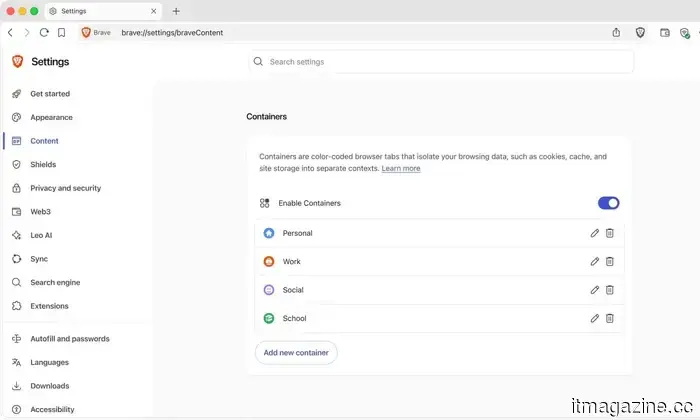
Brave has introduced Containers to its desktop browser, providing users with an integrated method to keep various accounts, sessions, and browsing activities distinct. This feature is available in Brave 1.92 for Windows, macOS, and Linux, and will be rolled out in stages over the next few days.
Containers have been a highly sought-after feature, particularly for individuals who frequently switch between work, personal, developer, or creator accounts. Once activated, they allow users to open tabs in unique spaces where cookies and site storage are not shared outside that container.
By popular demand: Brave now offers Containers! In Brave for desktop, users can now separate their browsing sessions with just a few clicks. Here’s what this means… pic.twitter.com/GSWQb8QoUL— Brave (@brave) July 2, 2026.
What Containers are beneficial for
The feature primarily focuses on separating different browsing identities. For instance, someone managing social media accounts can remain logged into two accounts on the same site simultaneously. A developer can test an application as an administrator in one tab and as a regular user in another. A person logged into a work Google account can access YouTube in a separate container so that the activity is not associated with that work session.
Brave states that Containers should be considered more of a convenience and workflow enhancement rather than a significant new privacy feature. The browser already employs storage partitioning to segregate sites and third-party requests, which helps reduce cross-site tracking. Containers are designed to give users more control over how individual sites perceive them across different tabs. Users can enable this feature from Brave’s settings page. Afterward, they can right-click a tab, select “Open in container,” and choose a container category.
Firefox also offers something similar
Brave is not the first browser to provide this type of tab isolation. Firefox has long provided Multi-Account Containers through an official extension, while other Firefox-based browsers, such as LibreWolf, Floorp, and Zen Browser, also support container-style workflows.
The more significant aspect is that Brave is introducing Containers to a Chromium-based browser. Previously, users looking for this type of tab isolation often had to rely on Firefox or Firefox-based alternatives. This has been frustrating for users who appreciate Containers but prefer Chromium since many websites are primarily designed and tested for Chrome-like browsers.
I have roughly four years of experience, mostly focused on gaming, PC hardware, and smartphones. In my spare time, I enjoy…
Valve just released the blueprint for its most impressive Steam Machine mod.
Rather than offering the finished product, Valve is providing the recipe, and honestly, we're fine with that.
Although Valve’s Steam Machine debuted at a higher-than-anticipated price due to shortages in AI-driven chips, it appears the company is not resting on its laurels and continues to improve the product's appeal to users. One of the standout features of the Steam Machine is its customizable front faceplate, and Valve has just enhanced it. The company has open-sourced its "Inkterface" project, enabling users to create their own e-ink faceplate for the Steam Machine.
Intel might revive older desktop CPUs as DDR5 prices rise.
Older Intel Core CPUs from the 10th to 14th generations might be getting a second chance.
Intel could be planning an unusual reaction to the ongoing memory shortage. According to reports from Chinese outlet ITHome, referencing ChannelGate, the company’s latest manufacturing strategy includes restarting production of 13th and 14th generation Core processors. This move is anticipated to boost supply across Intel’s 10th, 12th, 13th, and 14th generation CPU families, particularly in mainland China. For DIY PC builders, the timing is crucial. The sharp increase in DDR5 memory prices has made newer platforms harder to justify for those aiming to build an affordable gaming PC.
Amazon intends to develop in-house chips for Kindles, Fire TV, and Echo speakers.
Apple took the lead, and now Amazon is following suit, starting with 40 million chips annually and partnering with a lesser-known company.
Apple's decision to design its own chips revolutionized the consumer electronics market. Amazon seems poised to make a similar move, nearly twenty years later. Analyst Ming-Chi Kuo has reported that Amazon is planning to abandon externally sourced processors for its consumer electronics lineup, marking what he describes as the company's first major change in processor procurement in two decades. This transition is expected to commence in 2027.






Other articles
 Brave's latest Container feature is a game-changer for those managing several accounts.
Brave now allows desktop users to open tabs in different Containers, enabling them to use multiple accounts of the same website simultaneously.
Brave's latest Container feature is a game-changer for those managing several accounts.
Brave now allows desktop users to open tabs in different Containers, enabling them to use multiple accounts of the same website simultaneously.
 Samsung's Galaxy S27 Pro and Ultra might finally replace that outdated selfie camera.
Samsung's Galaxy S27 Pro and Ultra could replace the aging 12MP front camera with a more detailed 16MP sensor, along with enhanced telephoto and ultra-wide lenses.
Samsung's Galaxy S27 Pro and Ultra might finally replace that outdated selfie camera.
Samsung's Galaxy S27 Pro and Ultra could replace the aging 12MP front camera with a more detailed 16MP sensor, along with enhanced telephoto and ultra-wide lenses.
 Anduril rocket engine detonates at testing facility in Mississippi.
A solid rocket motor detonated at Anduril's testing facility in Mississippi. The $61 billion defense startup refers to it as a standard occurrence, but sources suggest that the timeline is slipping.
Anduril rocket engine detonates at testing facility in Mississippi.
A solid rocket motor detonated at Anduril's testing facility in Mississippi. The $61 billion defense startup refers to it as a standard occurrence, but sources suggest that the timeline is slipping.
 Amazon Leo possesses a sufficient number of satellites to rival Starlink.
Amazon states that its recent launch has brought the total number of Amazon Leo satellites to approximately 396, which is sufficient to initiate commercial internet services this year, aiming to compete with Starlink.
Amazon Leo possesses a sufficient number of satellites to rival Starlink.
Amazon states that its recent launch has brought the total number of Amazon Leo satellites to approximately 396, which is sufficient to initiate commercial internet services this year, aiming to compete with Starlink.
 Amazon's competitor to Starlink is expected to roll out satellite internet service later this year.
Amazon intends to introduce its inaugural Leo satellite internet service later this year following the deployment of nearly 400 satellites into orbit, presenting a greater challenge to SpaceX's Starlink.
Amazon's competitor to Starlink is expected to roll out satellite internet service later this year.
Amazon intends to introduce its inaugural Leo satellite internet service later this year following the deployment of nearly 400 satellites into orbit, presenting a greater challenge to SpaceX's Starlink.
 Meta has just introduced a vibe-coding application for games, named Pocket.
Meta has discreetly introduced Pocket, a new app powered by AI that enables users to create, play, and share mini-games just by describing them in straightforward English.
Meta has just introduced a vibe-coding application for games, named Pocket.
Meta has discreetly introduced Pocket, a new app powered by AI that enables users to create, play, and share mini-games just by describing them in straightforward English.
Brave's new Container feature is a game changer for those managing several accounts.
Brave now allows desktop users to open tabs in individual Containers, enabling multiple accounts from the same website to operate simultaneously.