

Brave’s new Container feature is a game-changer for anyone managing several accounts.
With this feature, you won’t have to open three separate browsers.
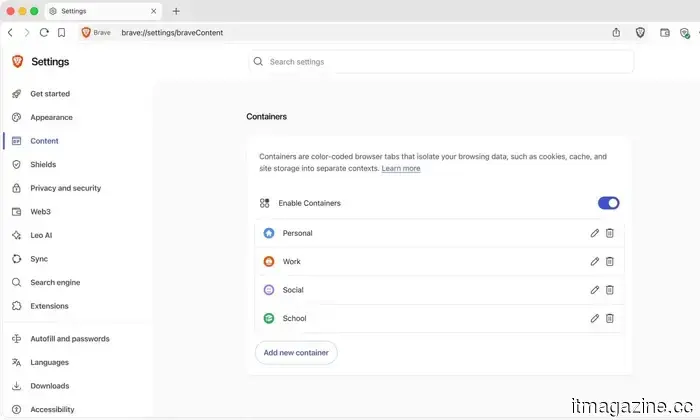
Brave has introduced Containers in its desktop browser, allowing users to easily manage different accounts, sessions, and browsing activities independently. This feature is available in Brave 1.92 for Windows, macOS, and Linux, and will be rolled out in phases over the next few days.
Containers were highly requested, particularly by users who frequently switch between work, personal, developer, or creator accounts. Once activated, they enable users to open tabs in distinct spaces where cookies and site storage are exclusive to that container.
By popular request: Brave now supports Containers! In Brave for desktop, you can now compartmentalize your browsing sessions with just a few clicks. Here’s what this entails… pic.twitter.com/GSWQb8QoUL— Brave (@brave) July 2, 2026
Benefits of Containers
This feature is primarily designed to keep different browsing identities separate. For instance, someone managing social media can remain logged into two accounts on the same platform simultaneously. A developer can test an application as an administrator in one tab and as a regular user in another. A user logged into a work Google account can access YouTube in a different container, ensuring that activity is not associated with their work session.
Brave
Brave
Brave emphasizes that Containers should be regarded as a convenience and workflow enhancement rather than a significant new privacy tool. The browser already employs storage partitioning to isolate sites and third-party requests, assisting in reducing cross-site tracking. Containers are intended to offer users more autonomy over how individual sites perceive them across various tabs. Users can activate this feature via Brave’s settings page, and afterward, they can right-click a tab, select “Open in container,” and choose a container category.
Firefox already offers something similar
Brave is not the first browser to feature this type of tab isolation. Firefox has long provided Multi-Account Containers through an official extension, while several Firefox-based browsers like LibreWolf, Floorp, and Zen Browser also support container-based workflows.
The notable aspect is that Brave is introducing Containers to a Chromium-based browser. Until now, users seeking this type of tab isolation often had to depend on Firefox or its derivatives, which has been frustrating for those who favor Containers yet prefer Chromium due to the design and testing of many websites around Chrome-like browsers.
I have approximately four years of experience, primarily focusing on gaming, PC hardware, and smartphones. In my leisure time, I enjoy…
Valve just released the blueprint for its most innovative Steam Machine modification.
Valve is providing the recipe rather than the actual dish, and we’re fine with that.
Although Valve's Steam Machine debuted at a higher-than-anticipated price largely due to the AI-driven chip shortage, it appears that the company is actively working to enhance the product's appeal. One of the most exciting features of the Steam Machine is the user-customizable front faceplate, and Valve has recently improved this by open-sourcing its "Inkterface" project, letting users create their own e-ink faceplate for the Steam Machine.
Intel may reintroduce older desktop CPUs due to escalating DDR5 prices.
Older Intel Core CPUs from the 10th to 14th generation might see a resurgence.
Intel is reportedly planning an unconventional response to the current memory crisis. As per the Chinese outlet ITHome, citing ChannelGate, the company's latest production strategy includes reinstating production of 13th and 14th generation Core processors. This initiative is expected to boost the availability of Intel’s 10th, 12th, 13th, and 14th generation CPU families, especially in mainland China. For DIY PC builders, the timing is crucial as DDR5 memory prices have surged, making newer platforms less justifiable for those aiming to build budget-friendly gaming PCs.
Amazon aims to create its own chips for Kindles, Fire TV, and Echo speakers.
Apple pioneered this initiative, and now Amazon is following suit, starting with 40 million chips annually in collaboration with a lesser-known partner.
Apple’s shift to designing its own chips transformed the consumer electronics sector. Amazon may be preparing to make a similar move nearly two decades later. Supply chain analyst Ming-Chi Kuo indicates that Amazon is planning to move away from externally sourced processors for its consumer electronics range, marking what he describes as the company’s first significant processor procurement alteration in 20 years. This transition is anticipated to begin in 2027.






Other articles
 ElevenLabs is in discussions regarding a tender offer that values the company at $22 billion, essentially doubling its valuation from February.
ElevenLabs is said to be in initial discussions regarding an employee tender offer that would value the voice AI startup at around $22 billion, which is twice its valuation from February.
ElevenLabs is in discussions regarding a tender offer that values the company at $22 billion, essentially doubling its valuation from February.
ElevenLabs is said to be in initial discussions regarding an employee tender offer that would value the voice AI startup at around $22 billion, which is twice its valuation from February.
 India extends its crackdown on usernames to include Telegram and Signal.
A day after directing WhatsApp to halt its usernames feature, India's IT ministry has issued comparable notices to Telegram and Signal, according to a government source.
India extends its crackdown on usernames to include Telegram and Signal.
A day after directing WhatsApp to halt its usernames feature, India's IT ministry has issued comparable notices to Telegram and Signal, according to a government source.
 Crusoe is said to be in discussions to secure $3 billion, which would triple its valuation.
According to Bloomberg, AI infrastructure firm Crusoe is in discussions to secure approximately $3 billion in funding, which could elevate its valuation to around $30 billion.
Crusoe is said to be in discussions to secure $3 billion, which would triple its valuation.
According to Bloomberg, AI infrastructure firm Crusoe is in discussions to secure approximately $3 billion in funding, which could elevate its valuation to around $30 billion.
 Amazon Leo possesses a sufficient number of satellites to rival Starlink.
Amazon states that its recent launch has brought the total number of Amazon Leo satellites to approximately 396, which is sufficient to initiate commercial internet services this year, aiming to compete with Starlink.
Amazon Leo possesses a sufficient number of satellites to rival Starlink.
Amazon states that its recent launch has brought the total number of Amazon Leo satellites to approximately 396, which is sufficient to initiate commercial internet services this year, aiming to compete with Starlink.
 Amazon's competitor to Starlink plans to launch satellite internet services later this year.
Amazon intends to roll out its first Leo satellite internet service later this year, having successfully positioned nearly 400 satellites in orbit, which poses a significant challenge to SpaceX's Starlink.
Amazon's competitor to Starlink plans to launch satellite internet services later this year.
Amazon intends to roll out its first Leo satellite internet service later this year, having successfully positioned nearly 400 satellites in orbit, which poses a significant challenge to SpaceX's Starlink.
 Spotify contests Kalshi and Polymarket following suspicions that a song's chart performance appeared manipulated.
Spotify removed 500,000 fraudulent streams from a song by Malcolm Todd and instructed Kalshi and Polymarket to eliminate its logo after bettors seemed to manipulate its charts.
Spotify contests Kalshi and Polymarket following suspicions that a song's chart performance appeared manipulated.
Spotify removed 500,000 fraudulent streams from a song by Malcolm Todd and instructed Kalshi and Polymarket to eliminate its logo after bettors seemed to manipulate its charts.
Brave’s new Container feature is a game-changer for anyone managing several accounts.
Brave now allows desktop users to open tabs in individual Containers, enabling different accounts of the same website to function simultaneously.