

WhatsApp is suspending usernames for hundreds of millions of users due to concerns about fraud.
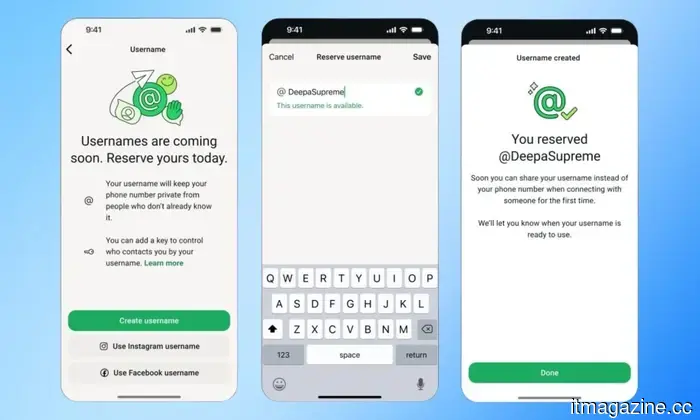
WhatsApp's initiative to allow users to utilize usernames instead of phone numbers has faced challenges in India, its largest market. This newly launched feature aims to enhance privacy by enabling users to connect without immediately disclosing their phone numbers. However, Indian authorities are concerned that this feature might complicate the control of scams and impersonation.
The Ministry of Electronics and Information Technology (MeitY) in India has requested WhatsApp to halt the rollout of usernames until discussions with the government conclude. This is a significant measure, considering WhatsApp serves over 500 million users in India who depend on the app for everyday personal and professional communications.
Concerns from India
WhatsApp has begun allowing users to reserve usernames in advance of a broader launch. Once the feature is in effect, it will enable individuals to connect through a handle rather than a phone number, which may be beneficial in large groups, business conversations, creator pages, and discussions where users prefer not to share their personal numbers.
Meta
According to WhatsApp, usernames will be optional, not searchable by the public, and secured with protective measures. Users will need to be aware of the exact username to initiate a chat, and an optional key can provide an additional layer of security.
The worry lies in the possibility that scammers could still adopt familiar-looking handles, display names, and profile pictures to impersonate others. This concern is particularly pronounced in India, where WhatsApp-related scams are prevalent. In "digital arrest" schemes, criminals pose as police, CBI officials, RBI representatives, telecom employees, or Enforcement Directorate agents, then pressure victims over WhatsApp or video calls to remit money.
There is also the everyday issue of impersonation. Scammers frequently impersonate friends or family, claiming there is an emergency to hasten money transfers. WhatsApp's introduction of creator subscriptions adds another dimension, as fraudulent or similar creator accounts could mislead followers, collect payments, or exploit the trust associated with public figures.
Expert Opinions
Apar Gupta from the Internet Freedom Foundation notes that usernames present both privacy advantages and safety challenges. On one hand, they can help users avoid disclosing phone numbers, which can lead to harassment, unwanted outreach, and cross-platform identification. On the other hand, the use of usernames could increase impersonation risks if someone claims a recognizable name and uses a familiar profile photo.
Gupta also emphasizes that WhatsApp’s privacy assurances should be approached cautiously, highlighting prompts that encourage users to connect their Instagram and Facebook accounts while reserving a username. The Internet Freedom Foundation has contended that MeitY has not clearly specified the legal basis for pausing the rollout of a software feature prior to its launch.
At present, WhatsApp’s username feature navigates between two significant concerns. It has the potential to lessen phone number exposure for typical users, but with India's ongoing fraud issue, WhatsApp must demonstrate that the feature cannot be readily exploited on a large scale.
Other articles
 AI aims to condense everything. TripAdvisor's deceptive reviews indicate that AI could also spoil your travel arrangements.
TripAdvisor's AI-generated review summaries are describing unsafe hotels as "spotless" and "friendly." Here’s why you should be cautious about relying on that AI summary before making a reservation.
AI aims to condense everything. TripAdvisor's deceptive reviews indicate that AI could also spoil your travel arrangements.
TripAdvisor's AI-generated review summaries are describing unsafe hotels as "spotless" and "friendly." Here’s why you should be cautious about relying on that AI summary before making a reservation.
 Boeing's autonomous air taxi division is confronting a whistleblower lawsuit regarding expedited software testing.
A lawsuit claims that Wisk Aero reduced the necessary software testing mandated by the FAA in order to meet a deadline, and subsequently terminated the manager who raised the issue internally.
Boeing's autonomous air taxi division is confronting a whistleblower lawsuit regarding expedited software testing.
A lawsuit claims that Wisk Aero reduced the necessary software testing mandated by the FAA in order to meet a deadline, and subsequently terminated the manager who raised the issue internally.
 Anthropic is negotiating with Samsung to produce a specialized AI chip.
Anthropic is in talks with Samsung regarding a partnership for a custom chip, although the project is still in its early stages and the company has not yet made a commitment to a specific design.
Anthropic is negotiating with Samsung to produce a specialized AI chip.
Anthropic is in talks with Samsung regarding a partnership for a custom chip, although the project is still in its early stages and the company has not yet made a commitment to a specific design.
 A hijacked Kia exposes the concealed boundaries of connected car technology.
Ian Fogg had a doorbell camera, an AirTag, and access to Kia Connect when his vehicle was stolen. Despite eight location requests, the car remains missing.
A hijacked Kia exposes the concealed boundaries of connected car technology.
Ian Fogg had a doorbell camera, an AirTag, and access to Kia Connect when his vehicle was stolen. Despite eight location requests, the car remains missing.
 Boeing's subsidiary that develops autonomous air taxis is facing a whistleblower lawsuit regarding expedited software testing.
A lawsuit claims that Wisk Aero shortened the necessary software testing mandated by the FAA to meet a deadline, and subsequently dismissed the manager who raised the issue internally.
Boeing's subsidiary that develops autonomous air taxis is facing a whistleblower lawsuit regarding expedited software testing.
A lawsuit claims that Wisk Aero shortened the necessary software testing mandated by the FAA to meet a deadline, and subsequently dismissed the manager who raised the issue internally.
 Your Living Room Smart TV Has Received a Privacy Enhancement with MacPaw’s ClearVPN.
Smart TVs have evolved beyond merely streaming shows; they are now as connected as your smartphone. MacPaw is expanding its ClearVPN service to Apple TV and Android TV, offering privacy protection for the device you use most in your living room.
Your Living Room Smart TV Has Received a Privacy Enhancement with MacPaw’s ClearVPN.
Smart TVs have evolved beyond merely streaming shows; they are now as connected as your smartphone. MacPaw is expanding its ClearVPN service to Apple TV and Android TV, offering privacy protection for the device you use most in your living room.
WhatsApp is suspending usernames for hundreds of millions of users due to concerns about fraud.
WhatsApp's username feature has encountered issues in India, as authorities are worried about impersonation scams and counterfeit accounts.