
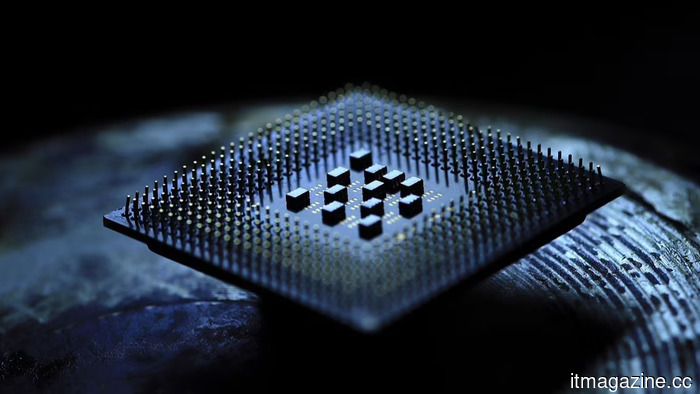
A report warns that the chip industry in Europe is confronting a grim future due to the risks associated with China and the United States.
A recent report from the EU Institute for Security Studies (EUISS) and the French think tank Institut Montaigne highlights the dire outlook for Europe's semiconductor industry, which is caught between Chinese export restrictions and increasing reliance on US technology. The study, released on Thursday, is part of an 18-month EU-funded project named the Chips Diplomacy Support Initiative.
The authors indicate that the dangers facing Europe’s chip sector have notably evolved over the last year, with the influence of Washington weighing nearly as heavily on Brussels as that of Beijing. Joris Teer, a policy analyst at EUISS and one of the report's co-authors, conveyed to Reuters that “while Beijing still seems to pose the greatest threat, reliance on Washington has escalated as a significant issue under the second Trump administration.”
The report emphasizes China's readiness to limit the export of crucial minerals and rare-earth magnets, vital materials for chip manufacturing equipment, presenting an ongoing and immediate risk. It also highlights the possibility that tensions in the Taiwan Strait could disrupt Taiwan’s significant position in advanced chip production at any time.
On the other hand, the risk from Washington is described as more structural. A considerable portion of the software and design tools essential for European chip development originates from the US. The report mentions the MATCH Act, a bill progressing through Congress that would enable Washington to impose export controls unilaterally on allies not aligning their China policies within a specified timeframe.
This situation is particularly significant for the Netherlands’ ASML, now the most valuable publicly listed company in Europe, whose lithography exports to China have become a recurring source of tension in transatlantic trade relations. Teer's recommendation is more focused than the threat itself; he stated to Reuters that Europe’s “only viable path” is to leverage its existing strengths, specifically naming ASML, rather than pursuing the broad chip self-sufficiency that Brussels has previously sought.
This perspective reflects a shift already apparent in EU policy. The bloc's Chips Act 2.0 proposal, unveiled in June, emphasizes demand-side incentives, as opposed to the now-abandoned goal of achieving a 20% global market share by 2030 that was part of the original Chips Act.
The report arrives weeks after the EU officially became part of Pax Silica, a US-led chip agreement that France has publicly criticized as a form of technological colonization. The tension between needing access to US-aligned supply chains while resenting the power Washington gains through that access runs through much of the report’s narrative.
The authors point out Europe’s high energy costs, limited private risk capital, and a decreasing base of chip-consuming industries as structural vulnerabilities that exacerbate external threats. The report does not suggest that Europe should outright choose a side; instead, it portrays Europe as caught between two dependencies that are difficult to escape—on Taiwan for advanced manufacturing and on the US for design software—while the threat of Chinese retaliation over materials persists.
Progress in this area is tangible but gradual: Infineon’s new €5 billion factory in Dresden, touted as the first major success of the Chips Act, underscores the extent of investment required just to stay competitive. China's leveraging power is characterized as blunt and immediate, deployable within weeks through export licensing of materials that Europe cannot easily obtain from alternative sources.
Conversely, Washington's influence is slower to materialize but could be more damaging, rooted in decades of dependency on American design software and manufacturing tools that European firms have had little motivation to replace. A sudden halt in Chinese material supplies would necessitate emergency stockpiling measures that the EU has already begun to practice through its critical raw materials strategy. Meanwhile, a gradual tightening of US technology access would require the kind of steady industrial policy that Europe has historically struggled to maintain through political transitions.
The report does not determine which threat requires more immediate attention, only affirming that policymakers can no longer regard one as hypothetical and the other as a reality.
Other articles
 The M6 chip from Apple hasn't been released yet, but M7 Macs are expected to arrive in early 2027.
According to Mark Gurman, Apple plans to introduce its initial M7-powered devices in early 2027, in conjunction with an updated iPad Pro range and a reimagined entry-level MacBook Pro.
The M6 chip from Apple hasn't been released yet, but M7 Macs are expected to arrive in early 2027.
According to Mark Gurman, Apple plans to introduce its initial M7-powered devices in early 2027, in conjunction with an updated iPad Pro range and a reimagined entry-level MacBook Pro.
 The entry-level MacBook Pro may undergo a design update in 2027, and it's certainly due for one.
Apple was recognized for redesigning its OLED MacBook Pro. Bloomberg now indicates that the base-level 14-inch model is also receiving a new design.
The entry-level MacBook Pro may undergo a design update in 2027, and it's certainly due for one.
Apple was recognized for redesigning its OLED MacBook Pro. Bloomberg now indicates that the base-level 14-inch model is also receiving a new design.
 Shares of BYD and Xiaomi soar as June delivery figures indicate sustained momentum.
BYD rose by 9% and Xiaomi increased by 5% in Hong Kong following June's figures. BYD reported sales of 403,472 units, while Xiaomi achieved over 30,000 deliveries for the third consecutive month.
Shares of BYD and Xiaomi soar as June delivery figures indicate sustained momentum.
BYD rose by 9% and Xiaomi increased by 5% in Hong Kong following June's figures. BYD reported sales of 403,472 units, while Xiaomi achieved over 30,000 deliveries for the third consecutive month.
 Beatbot's AI pool cleaners are designed to extend your summer festivities throughout the peak season by offering significant discounts.
Beatbot's AI-driven robotic pool cleaner is created to make summer pool upkeep and hosting easier.
Beatbot's AI pool cleaners are designed to extend your summer festivities throughout the peak season by offering significant discounts.
Beatbot's AI-driven robotic pool cleaner is created to make summer pool upkeep and hosting easier.
 Ubisoft enlists former Amazon Games leader to oversee its Tom Clancy studio.
Ubisoft has appointed former Amazon Games VP Christoph Hartmann to lead Creative House 2, the branch responsible for The Division, Ghost Recon, and Splinter Cell.
The upcoming redesigns of Apple's iPad Pro and MacBook Pro are expected to be released in 2027.
Bloomberg has revealed that Apple is evaluating new iPad Pro models and a revamped entry-level MacBook Pro for the first half of 2027.
Ubisoft enlists former Amazon Games leader to oversee its Tom Clancy studio.
Ubisoft has appointed former Amazon Games VP Christoph Hartmann to lead Creative House 2, the branch responsible for The Division, Ghost Recon, and Splinter Cell.
The upcoming redesigns of Apple's iPad Pro and MacBook Pro are expected to be released in 2027.
Bloomberg has revealed that Apple is evaluating new iPad Pro models and a revamped entry-level MacBook Pro for the first half of 2027.
A report warns that the chip industry in Europe is confronting a grim future due to the risks associated with China and the United States.
A recent report from EUISS and Institut Montaigne highlights that Europe's semiconductor industry is increasingly at risk due to China's export restrictions and reliance on US technology.