
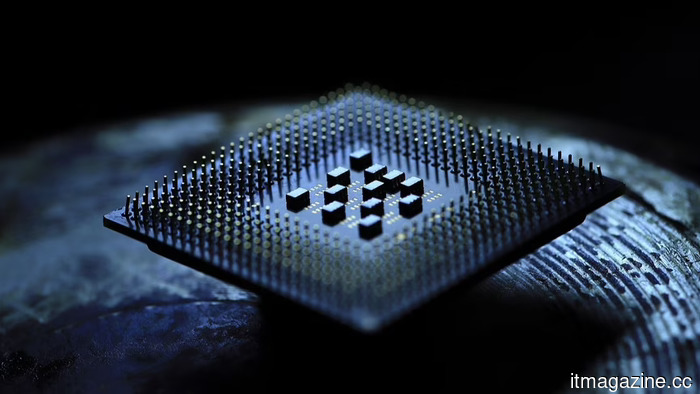
A report warns that the chip industry in Europe is confronted with a grim outlook due to the risks posed by China and the US.
A recent report from the EU Institute for Security Studies (EUISS) and the French think tank Institut Montaigne indicates that the future of Europe’s semiconductor industry is grim, caught between Chinese export restrictions and an increasing reliance on US technology. Published on Thursday, the study is part of an 18-month EU-funded initiative known as the Chips Diplomacy Support Initiative.
The authors assert that the threats to Europe’s chip sector have evolved significantly over the past year, with concerns about Washington now weighing nearly as heavily on Brussels as those regarding Beijing. Policy analyst Joris Teer from EUISS, one of the report's co-authors, told Reuters that “while Beijing still seems to be the primary threat, dependence on Washington has risen substantially, particularly during the second Trump administration.”
The report highlights China’s readiness to limit exports of essential minerals and rare-earth magnets, which are critical for chip manufacturing equipment, as a constant and immediate risk. This risk is compounded by the possibility that tensions in the Taiwan Strait could disrupt the island's leading role in advanced chip production at any time.
In contrast, the risks from Washington are more structural than those from China. Much of the software and design tools that support European chip design come from the US. The report points out a bill in Congress, the MATCH Act, which could enable Washington to unilaterally impose export controls on allies that do not align their China policies within a specified timeframe. This situation is particularly significant for ASML, the Netherlands' leading listed company, which has faced ongoing trade tensions over its lithography exports to China.
Teer offers a more limited solution than the perceived threat, stating to Reuters that Europe’s “only viable path” is to leverage existing strengths, specifically mentioning ASML instead of advocating for Brussels’ previous goal of broad chip self-sufficiency.
This perspective resonates with a noticeable shift in EU policy. The bloc’s Chips Act 2.0 proposal, unveiled in June, focuses on demand-side incentives rather than the original goal of achieving a 20% share of the global market by 2030, which has since been abandoned.
The report was released shortly after the EU officially joined Pax Silica, a US-led chip alliance that France has openly criticized as a form of technological colonization. The report discusses the tension between the desire for access to US-aligned supply chains and the resentment over the power that such access grants Washington.
The authors identify Europe’s high energy costs, limited private risk capital, and a decreasing number of chip-consuming industries as structural vulnerabilities exacerbating external threats. However, this is not presented as a call for Europe to take a definitive side.
Rather, the report portrays Europe as trapped between two dependencies that are difficult to break: dependence on Taiwan for advanced manufacturing and on the US for design software, while continuous threats from China regarding raw materials loom. Progress has been tangible but slow; Infineon’s new €5 billion factory in Dresden is cited as the first significant success of the Chips Act, emphasizing the substantial investment needed just to maintain pace.
China’s leverage is depicted as immediate and blunt, easily deployable within weeks through export licensing of materials that Europe cannot easily obtain elsewhere. Conversely, Washington's influence is more gradual but potentially more damaging, rooted in decades of reliance on American design and manufacturing tools that European firms have rarely replaced.
A sudden disruption of materials from China would require the kind of emergency stockpiling that the EU is already practicing through its critical raw materials strategy. In contrast, a gradual tightening of US technology access would necessitate the kind of consistent industrial policy that Europe has historically struggled to maintain across different political administrations.
The report does not determine which threat requires more urgent attention, but it highlights that policymakers can no longer regard one as hypothetical while treating the other as a reality.
Other articles
 Beatbot's AI pool cleaners are designed to extend your summer festivities throughout the peak season by offering significant discounts.
Beatbot's AI-driven robotic pool cleaner is created to make summer pool upkeep and hosting easier.
Beatbot's AI pool cleaners are designed to extend your summer festivities throughout the peak season by offering significant discounts.
Beatbot's AI-driven robotic pool cleaner is created to make summer pool upkeep and hosting easier.
 A report warns that the chip industry in Europe is confronting a grim future due to the risks associated with China and the United States.
A recent report from EUISS and Institut Montaigne highlights that Europe's semiconductor industry is increasingly at risk due to China's export restrictions and reliance on US technology.
A report warns that the chip industry in Europe is confronting a grim future due to the risks associated with China and the United States.
A recent report from EUISS and Institut Montaigne highlights that Europe's semiconductor industry is increasingly at risk due to China's export restrictions and reliance on US technology.
 SK Hynix plans to invest $51 billion in a new NAND factory to capitalize on the growing demand for AI memory.
SK Hynix plans to invest $51.46 billion in a new NAND fabrication plant in Cheongju by 2029, as part of a larger $64 billion investment aimed at addressing the increased demand for memory driven by AI.
SK Hynix plans to invest $51 billion in a new NAND factory to capitalize on the growing demand for AI memory.
SK Hynix plans to invest $51.46 billion in a new NAND fabrication plant in Cheongju by 2029, as part of a larger $64 billion investment aimed at addressing the increased demand for memory driven by AI.
 Cinder City requires 64GB of RAM, and the rest of its PC specifications are equally unusual.
Cinder City's suggested PC specifications include 64GB of RAM paired with an RTX 4060, leading gamers to question whether these requirements are an error or an indication of future developments.
Cinder City requires 64GB of RAM, and the rest of its PC specifications are equally unusual.
Cinder City's suggested PC specifications include 64GB of RAM paired with an RTX 4060, leading gamers to question whether these requirements are an error or an indication of future developments.
 SK Hynix plans to invest $51 billion in a new NAND factory to capitalize on the demand for AI memory.
SK Hynix plans to invest $51.46 billion in a new NAND fabrication facility in Cheongju by 2029, as part of a larger $64 billion initiative to address the supply pressures caused by increasing demand for AI-driven memory.
SK Hynix plans to invest $51 billion in a new NAND factory to capitalize on the demand for AI memory.
SK Hynix plans to invest $51.46 billion in a new NAND fabrication facility in Cheongju by 2029, as part of a larger $64 billion initiative to address the supply pressures caused by increasing demand for AI-driven memory.
 Ubisoft appoints former Amazon Games head to lead its Tom Clancy studio.
Ubisoft has recruited Christoph Hartmann, the former VP of Amazon Games, to lead Creative House 2, the division responsible for The Division, Ghost Recon, and Splinter Cell.
Ubisoft appoints former Amazon Games head to lead its Tom Clancy studio.
Ubisoft has recruited Christoph Hartmann, the former VP of Amazon Games, to lead Creative House 2, the division responsible for The Division, Ghost Recon, and Splinter Cell.
A report warns that the chip industry in Europe is confronted with a grim outlook due to the risks posed by China and the US.
A recent report from EUISS and Institut Montaigne cautions that Europe's semiconductor industry is increasingly vulnerable due to China's export restrictions and reliance on US technology.