
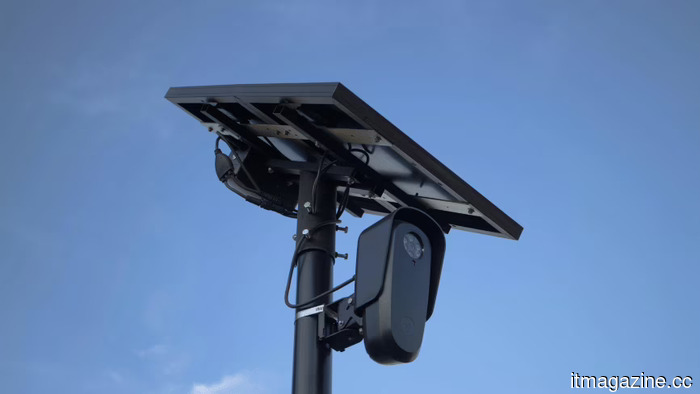
Flock surveillance cameras are being deployed throughout the United States.
Most individuals refer to them as automated license plate readers, or ALPRs. Positioned alongside roadways, they document every vehicle that passes. Flock Safety leads the market, with Engadget reporting that the company produces the vast majority of the more than 100,000 readers currently spread across the United States.
Labeling them as license plate readers minimizes their capabilities. While reading plates is their primary function, the system can detect nearly anything.
Beyond license plate readers
Each Flock camera operates as a small computer using a modified version of Android. It streams video footage to a database, where AI categorizes everything for natural-language search. An officer can enter “green sedan with an American flag bumper sticker” and receive results in seconds.
Flock also offers AI cameras that monitor individuals, mobile camera trailers, and quadcopter drones. Many police departments join a national network, allowing a department in Texas to access footage collected in Massachusetts. Immigration and Customs Enforcement frequently obtains access via data-sharing agreements with local police. In Denver, the ACLU discovered that local officers had conducted over 1,400 searches on behalf of ICE. This model resembles other private camera networks that support law enforcement, such as Amazon's Ring.
A series of security vulnerabilities
Flock claims its cameras are secure, but the evidence suggests otherwise. Benn Jordan, a musician and YouTuber with no formal security expertise, identified several significant vulnerabilities.
In December 2025, Jordan discovered that at least 70 Flock cameras were exposed to the internet. Anyone could view live feeds of children in parks and individuals in private situations without a password. With physical access, he and a fellow researcher were able to connect via Wi-Fi, gain root access, and even install malware. Instead of thanking him, Flock discredited such researchers, labeling them as activists aiming to “defund the police.”
Misuse by law enforcement
The greater concern may be from those with legitimate access. As reported by 404 Media, officers have utilized Flock numerous times to track former partners and other private individuals. Victims often only discovered this after checking their own license plate in a tool called HaveIBeenFlocked.
Flock acknowledged only “15 incidents of abuse,” attributing it to its own accountability measures. The reported cases reflect only those officers who were caught. In one instance, Flock employees monitored children at a Jewish community center pool and used the footage in a sales presentation.
Innocent individuals affected
Even in the absence of misuse, the cameras can make errors. In Denver, which installed many readers, police issued a summons for package theft to financial advisor Chrisanna Elser. She proved her innocence only because her Rivian truck recorded her driving directly through the area.
Others have been pulled over as suspects due to a camera misreading a zero as the letter O. One driver stated that police were unable to remove him from their alert list, resulting in a camera notifying officers each time it detected his vehicle. “You can’t get a breath of fresh air in or out of that place without us knowing,” one officer remarked.
Unexpected installations
The reach continues to expand, sometimes overnight. Kat Vaughn of Roanoke, Virginia, returned home to find a Flock audio-detection pole placed in front of her house without prior notice. According to WSLS 10, she received neither a letter nor an email.
The device was identified as a Flock Raven, the company’s response to ShotSpotter gunshot sensors. As noted by Futurism, even the officer on-site was uncertain about its purpose. The city had authorized 75 such sensors, but her location was not listed, and the units were not scheduled to go live until July. The police department's only response was: “we are working on this.”
Challenges in removal
Disassembling the cameras presents its own challenges. When Dayton, Ohio, and Evanston, Illinois, wanted to withdraw, they were uncertain if removing the cameras would violate their contracts. Both cities opted to cover the cameras with garbage bags instead.
Denver eventually terminated its contract after a crowded town hall meeting, subsequently awarding the contract to Axon, the body-camera company. There is little concrete evidence that the cameras reduce crime, yet they continue to proliferate. A pervasive feeling of being observed is becoming the norm in American towns, and residents seldom have a say in the matter. For the time being, the most straightforward way to locate a reader nearby is through a map created by campaigners called DeFlock.
Other articles
 Google earthquake alerts notified 11.4 million people in Venezuela.
Google's earthquake alerts notified 11.4 million Android users just seconds before the earthquakes in Venezuela, transforming phone sensors into a network for seismic warnings.
Google earthquake alerts notified 11.4 million people in Venezuela.
Google's earthquake alerts notified 11.4 million Android users just seconds before the earthquakes in Venezuela, transforming phone sensors into a network for seismic warnings.
 South Korea's investment in AI: $880 billion for semiconductors and robotics.
South Korea's AI investment strategy allocates $880 billion towards chip manufacturing facilities, 18.4GW of data centers, and robotics, as Samsung and SK Hynix compete for leadership in the field.
South Korea's investment in AI: $880 billion for semiconductors and robotics.
South Korea's AI investment strategy allocates $880 billion towards chip manufacturing facilities, 18.4GW of data centers, and robotics, as Samsung and SK Hynix compete for leadership in the field.
 OpenAI might postpone its IPO until 2027 in pursuit of a $1 trillion valuation.
OpenAI is said to be considering postponing its IPO until 2027 as Sam Altman aims for a $1 trillion valuation, a decision that has impacted SoftBank and the banks.
OpenAI might postpone its IPO until 2027 in pursuit of a $1 trillion valuation.
OpenAI is said to be considering postponing its IPO until 2027 as Sam Altman aims for a $1 trillion valuation, a decision that has impacted SoftBank and the banks.
 Trump warns of imposing 100% tariffs in response to digital services taxes.
Trump warns of imposing a 100% tariff on any nation that enacts digital services taxes targeting US tech companies, just a day after the EU finalized a trade agreement. Brussels remains steadfast.
Trump warns of imposing 100% tariffs in response to digital services taxes.
Trump warns of imposing a 100% tariff on any nation that enacts digital services taxes targeting US tech companies, just a day after the EU finalized a trade agreement. Brussels remains steadfast.
 China's increase in AI investment creates a unicorn every five days.
China's investment in AI is skyrocketing: DeepSeek has achieved a record fundraise of $7.4 billion, there are now 381 unicorns, and two new robot unicorns indicate that the pressure from the US is driving this surge.
China's increase in AI investment creates a unicorn every five days.
China's investment in AI is skyrocketing: DeepSeek has achieved a record fundraise of $7.4 billion, there are now 381 unicorns, and two new robot unicorns indicate that the pressure from the US is driving this surge.
Flock surveillance cameras are being deployed throughout the United States.
More than 100,000 Flock surveillance cameras are currently keeping an eye on drivers in the US, raising concerns about security vulnerabilities, misuse by law enforcement, and the unexpected installation of poles in residential yards.