
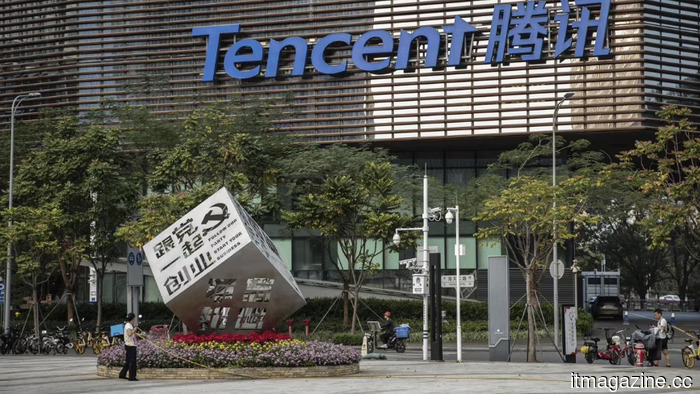
China's CXMT reportedly secures a $3 billion memory contract with Tencent.
ChangXin Memory Technologies (CXMT) has reportedly reached an agreement to provide Tencent with approximately $3 billion worth of memory chips, according to two individuals familiar with the situation who spoke to Reuters. This deal would strengthen ties between one of China's largest cloud service providers and its leading domestic DRAM manufacturer.
Neither Tencent nor CXMT has publicly verified the agreement, and the reported amount is based on sourcing instead of an official statement or filing. Reuters covered this development on June 29, crediting the report to unnamed sources.
This figure should be interpreted with caution. However, the nature of the relationship between the two companies is established. CXMT has included Tencent among its end clients, along with other major firms such as Alibaba, ByteDance, Lenovo, and Xiaomi, although sales typically go through distributors rather than direct transactions.
The companies have partnered in a critical but low-key area: validation. Tencent has been assessing CXMT's domestically manufactured DDR5 chips for server applications, which are essential for AI computing. If confirmed, this multibillion-dollar supply agreement would be a significant result of their testing efforts.
The agreement comes amid an unusual boom in the memory market. In the first quarter of 2026, CXMT reported revenues of 50.8 billion yuan (approximately $7.4 billion), reflecting an increase of over 700% compared to the previous year, alongside a quarterly net profit reaching into the billions after years of losses.
This surge is driven by the industry-wide demand for DRAM, particularly fueled by AI infrastructure, which has consumed memory faster than production can keep up, causing prices to rise significantly. As a result, chips that were traditionally used in consumer devices are increasingly being redirected to data centers.
For Tencent, securing a large-scale domestic supply serves as a strategy to mitigate scarcity and address political concerns. The primary memory suppliers are based in South Korea and the United States, and U.S. export controls have led Chinese buyers to be cautious about relying on chips that might become harder to procure. By sourcing from CXMT, Tencent aims to keep its supply chain within China's borders, aligning with the country's goal of self-sufficiency in memory production.
For CXMT, having a prominent client of this magnitude serves as both commercial and technical validation. The company has been offering DDR5 chips at competitive prices to Western brands like Corsair, while also reallocating some production capacity to high-bandwidth memory due to favorable profit margins. A sizable domestic contract would provide a stable demand base as it scales operations.
This rapid growth has raised concerns among Western buyers and garnered attention from suppliers. CXMT's swift ascent has led international companies to begin lobbying for access, with Apple seeking U.S. approval to procure from the company amidst skyrocketing memory prices. The prospect of a Chinese manufacturer that poses a challenge to Washington while attracting interest from Cupertino represents a unique position.
The reported deal does not clarify several key aspects. Details such as the agreement's duration, the balance of chip types between DDR5 and other grades, and the delivery schedule remain undisclosed, with neither CXMT nor Tencent commenting on these points.
While the headline figure has gained traction, the specifics of the contract, pending confirmation from either party, will provide deeper insights into the rapid development of China's memory industry.
Other articles
 The upcoming Mac Studio from Apple may feature a new M5 Ultra chip and an improved cooling system.
Recent reports suggest that Apple is set to launch an M5 Ultra Mac Studio this year, while an M7 Ultra model and enhanced cooling features are in the works for future release.
The upcoming Mac Studio from Apple may feature a new M5 Ultra chip and an improved cooling system.
Recent reports suggest that Apple is set to launch an M5 Ultra Mac Studio this year, while an M7 Ultra model and enhanced cooling features are in the works for future release.
 SpaceX's Starpipe: a natural gas pipeline for Starship
SpaceX is proposing Starpipe, an 8-mile natural gas pipeline to Starbase, to facilitate a quicker Starship launch rate and gain greater control over its supply chain.
SpaceX's Starpipe: a natural gas pipeline for Starship
SpaceX is proposing Starpipe, an 8-mile natural gas pipeline to Starbase, to facilitate a quicker Starship launch rate and gain greater control over its supply chain.
 Australia plans to increase fines for Big Tech companies and empower its regulator regarding the ban on individuals under 16.
Australia's proposed legislation would increase fines for Big Tech to A$99 million and grant the eSafety Commissioner the authority to request board meeting minutes and internal emails.
Australia plans to increase fines for Big Tech companies and empower its regulator regarding the ban on individuals under 16.
Australia's proposed legislation would increase fines for Big Tech to A$99 million and grant the eSafety Commissioner the authority to request board meeting minutes and internal emails.
 Germany is promoting its AI implementation as a solution to its labor shortages.
Germany is presenting the rapid adoption of AI as a partial solution to its shortage of skilled workers, which amounts to hundreds of thousands annually.
Germany is promoting its AI implementation as a solution to its labor shortages.
Germany is presenting the rapid adoption of AI as a partial solution to its shortage of skilled workers, which amounts to hundreds of thousands annually.
 OpenAI has appointed Paul Meade, the head of Apple’s Vision Pro division.
Paul Meade, the head of Apple’s Vision Pro, is departing to join OpenAI’s hardware team, marking the highest-profile departure from Apple in the competition for AI devices.
OpenAI has appointed Paul Meade, the head of Apple’s Vision Pro division.
Paul Meade, the head of Apple’s Vision Pro, is departing to join OpenAI’s hardware team, marking the highest-profile departure from Apple in the competition for AI devices.
 AWS GPU prices rise by 20% due to memory shortages.
AWS GPU prices have increased by approximately 20%, marking the second increase this year, as the AI memory shortage impacts the cloud and provides hyperscalers with pricing leverage.
AWS GPU prices rise by 20% due to memory shortages.
AWS GPU prices have increased by approximately 20%, marking the second increase this year, as the AI memory shortage impacts the cloud and provides hyperscalers with pricing leverage.
China's CXMT reportedly secures a $3 billion memory contract with Tencent.
CXMT has reached an agreement to provide Tencent with approximately $3 billion worth of memory chips, according to two sources who spoke to Reuters, further advancing China's goal for self-sufficiency in memory production.