
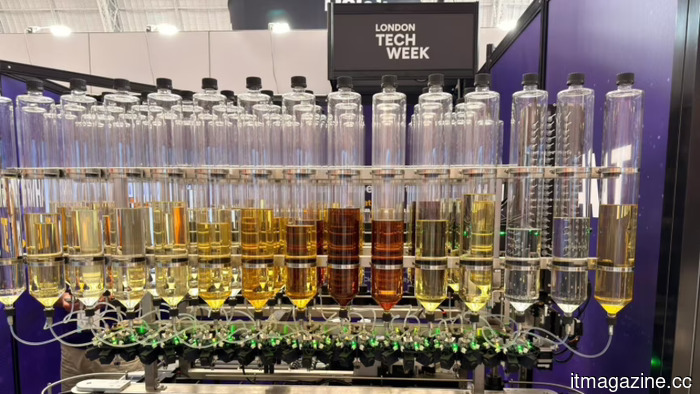
The algorithm now has a sense of smell, and the fragrance has improved because of it.
In a former shop on Ginnekenstraat, a pedestrian street in Breda, Netherlands, you can complete a brief questionnaire about yourself and leave less than an hour later with a custom perfume that wasn’t available when you arrived.
The questions differ from typical sales inquiries. They include: What color best represents you? If you could go anywhere right now, where would you go? How would you define your style?
After you respond, a set of algorithms analyzes your answers, and a machine in the room creates a fragrance to match, filling and labeling the bottle while you wait.
The company behind this process is called Scentronix, and for nearly a decade, it has contended that the perfume purchasing process is more peculiar than we acknowledge.
The founders, Dutch artist and filmmaker Frederik Duerinck and scent designer Anahita Mekanik, frame this peculiarity as a question: Why should approximately 800 individuals determine how 8 billion people smell?
They are referring to the small group of master perfumers, the "noses," who craft nearly every fragrance found on shelves.
This notion is a provocation, and like the most effective provocations, it contains a valid concept. Historically, perfume has been a closed art, both beautiful and distant. Software is gradually opening it up.
Statements like this often make people uneasy because we have been conditioned to fear the worst when technology intersects with artisanal crafts.
The common concern involves some version of replacement: the arrival of algorithms leading to the dismissal of artists. However, in the realm of perfume, that isn’t the case, and a closer examination of those developing these tools reveals the opposite scenario.
Major players in the industry reached similar conclusions years ago. In 2019, the German fragrance house Symrise partnered its perfumers with an AI system it created with IBM Research, named Philyra after a figure from Greek mythology.
Philyra had been trained on an extensive archive of formulas and performance data, enabling it to propose pairings that humans might overlook, unencumbered by established habits or preferences.
Working alongside it, Symrise perfumer David Apel developed two scents for the Brazilian brand O Boticário, released as the Egeo line in time for Valentine’s Day in Brazil.
These were arguably the first AI-generated perfumes available for purchase anywhere.
Others soon followed suit with their own machines. Givaudan, the world’s largest fragrance house, created Carto, a touchscreen system that presents a formula as a visual map and directs a robot to mix a physical sample in seconds, allowing a perfumer to test an idea nearly as swiftly as it occurs.
Calice Becker, who crafted Dior’s J’adore and heads Givaudan’s perfumery school, mentioned that the purpose of the tool is to encourage perfumers to experiment and try combinations that might not have been immediately apparent.
Firmenich, now part of DSM-Firmenich, took a different approach with Scentmate, a service aimed at helping small brands and individual entrepreneurs—those without labs or in-house expertise—create fragrances.
Not everyone is enthused about these developments, and dissent should be taken seriously. Jean-Claude Ellena, the former in-house perfumer at Hermès and a highly regarded nose, has argued that a machine cannot understand the thought process guiding a perfumer through a composition.
With some melancholy, he has expressed sympathy for the junior perfumer who may one day be presented with a machine's draft to refine.
Coming from someone who views perfume as a form of literature, this objection carries weight. There is a legitimate risk that automation could reduce a craft to mere workflows, potentially eliminating the unique, intuitive insights that define it.
However, this concern assumes a competition between humans and machines, which is not what these tools represent. Each of them involves the perfumer in the process.
Symrise describes Philyra as an apprentice rather than a replacement, and it appears to genuinely mean it. Carto displays the formula on a screen, with a person still determining what constitutes beauty.
Even Scentronix, the most automated of the bunch, refers about one in fifty customers to a human perfumer to address any mistakes made by the algorithm. The software expands the possibilities rather than dictates the final outcome.
Beneath the commercial aspect, something genuinely innovative is emerging, which should intrigue anyone who cares about both technology and perfume.
Smell has always been the sense most resistant to machinery. While we've taught computers to see and hear for decades, odors—composed of complex molecules binding to receptors in ways we only partially comprehend—have remained stubbornly analog.
That is changing. Google researchers have trained neural networks to predict a molecule's scent based solely on its structure, marking an initial step toward a machine olfactory system.
The European initiative Odeuropa has employed AI to revive
Otros artículos
 These Viaim Prime Day offers might transform how you participate in meetings and jot down notes.
Frustrated with dividing your focus between the conversation and your notes? Viaim's AI-powered devices are designed to record the details for you, and this Prime Day sale offers them at unprecedented prices.
These Viaim Prime Day offers might transform how you participate in meetings and jot down notes.
Frustrated with dividing your focus between the conversation and your notes? Viaim's AI-powered devices are designed to record the details for you, and this Prime Day sale offers them at unprecedented prices.
 From Morning Blowouts to Evening Cleans: Enhance Your Daily Routine with Laifen’s Special Prime Day Event.
Prime Day is not solely focused on finding amazing deals. It's also about fostering the habits that enhance your appearance, well-being, and performance, from smoother beginnings with the Laifen SE Lite to more efficient brushing with the newly introduced Wave Pro, now available with limited-time discounts of up to 40%.
Claude's outage: A recent stumble for Anthropic
Claude outage: Anthropic's recent instability follows model suspensions and multiple error reports from the company.
From Morning Blowouts to Evening Cleans: Enhance Your Daily Routine with Laifen’s Special Prime Day Event.
Prime Day is not solely focused on finding amazing deals. It's also about fostering the habits that enhance your appearance, well-being, and performance, from smoother beginnings with the Laifen SE Lite to more efficient brushing with the newly introduced Wave Pro, now available with limited-time discounts of up to 40%.
Claude's outage: A recent stumble for Anthropic
Claude outage: Anthropic's recent instability follows model suspensions and multiple error reports from the company.
 Luminvera focuses on immersive software solutions for robotics.
Luminvera launched its AR wearable and shifted its focus from industrial engineering to robotics software right after graduating from the Founder Institute, believing that an AI-powered spatial design tool can compete with more well-financed competitors.
Luminvera focuses on immersive software solutions for robotics.
Luminvera launched its AR wearable and shifted its focus from industrial engineering to robotics software right after graduating from the Founder Institute, believing that an AI-powered spatial design tool can compete with more well-financed competitors.
 Luminvera focuses on immersive software for robotics.
Luminvera launched its AR wearable and shifted focus from industrial engineering to robotics software right after graduating from the Founder Institute, wagering that an AI-powered spatial design tool can compete with better-financed rivals.
Luminvera focuses on immersive software for robotics.
Luminvera launched its AR wearable and shifted focus from industrial engineering to robotics software right after graduating from the Founder Institute, wagering that an AI-powered spatial design tool can compete with better-financed rivals.
 From Morning Blowouts to Evening Cleans: Enhance Your Daily Routine with Laifen’s Exclusive Prime Day Event
Prime Day is not only about snagging excellent discounts. It's also about cultivating the routines that enhance how you look, feel, and perform at your peak, whether it’s starting your day smoothly with the Laifen SE Lite or brushing smarter with the newly introduced Wave Pro, which currently offers limited-time savings of up to 40%.
From Morning Blowouts to Evening Cleans: Enhance Your Daily Routine with Laifen’s Exclusive Prime Day Event
Prime Day is not only about snagging excellent discounts. It's also about cultivating the routines that enhance how you look, feel, and perform at your peak, whether it’s starting your day smoothly with the Laifen SE Lite or brushing smarter with the newly introduced Wave Pro, which currently offers limited-time savings of up to 40%.
The algorithm now has a sense of smell, and the fragrance has improved because of it.
From a living lab in Breda to major fragrance companies, software is expanding access to scent creation. This is something to celebrate.