
The algorithm now has a sense of smell, and the fragrance has improved as a result.
In a former shop located on Ginnekenstraat, a pedestrian street in Breda, Netherlands, visitors can complete a brief questionnaire about themselves and leave with a personalized perfume within an hour—a scent that wasn't available before their arrival.
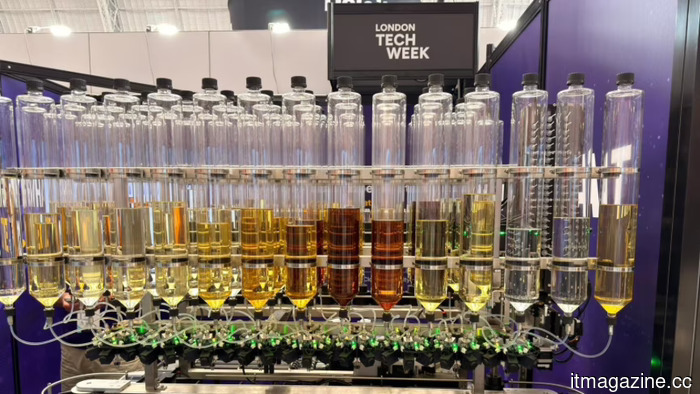
The questions asked are unique, unlike those you'd typically hear from a sales assistant. They inquire about what color best represents you, where you'd go if you could choose any destination, and how you would describe your personal style. After providing your answers, a series of algorithms evaluates your responses, and a machine in the shop creates a scent to match, filling and labeling the bottle as you wait.
The company behind this innovative experience is Scentronix. For nearly a decade, it has emphasized that the traditional way of purchasing perfume is stranger than we often acknowledge. Its founders, Dutch artist and filmmaker Frederik Duerinck and scent designer Anahita Mekanik, frame this peculiarity with a thought-provoking question: why should a small group of about 800 individuals determine how 8 billion people smell? This refers to the elite guild of master perfumers who craft nearly all fragrances found in stores.
This challenge provokes thought, as it contains a significant idea. Historically, the art of perfumery has been an exclusive and distant practice. However, software technology is beginning to open it up.
Such statements can make people uneasy since we've been conditioned to dread the potential downsides of technology encroaching on a craft rooted in human artistry. The predominant fear is centered around replacement—the arrival of an algorithm signaling the artist's dismissal. However, that isn't the case in the fragrance industry; a closer look at who is developing these tools reveals a contrasting scenario.
The leading names in the industry recognized this years ago. In 2019, German fragrance house Symrise collaborated with IBM Research to develop an AI system named Philyra, which was trained on an extensive archive of formulas and performance data, enabling it to suggest combinations that individuals might not typically consider, free from the confines of habit or preference.
Working alongside Philyra, Symrise perfumer David Apel created two fragrances for the Brazilian brand O Boticário, released as part of the Egeo line in time for Valentine’s Day in Brazil; these were among the first AI-generated perfumes available for purchase.
Other companies have followed suit with their own machines. Givaudan, the world's largest fragrance house, created Carto, a touchscreen system that visually maps out a formula and directs a robot to mix a physical sample in seconds, allowing perfumers to test their ideas almost instantaneously. Calice Becker, who created Dior’s J’adore and manages Givaudan’s perfumery school, stated that the goal of Carto is to encourage perfumers to experiment with combinations they wouldn’t typically consider.
Firmenich, now part of DSM-Firmenich, took a different approach with Scentmate, aiming to assist small brands and individual entrepreneurs—those without laboratories or in-house experts—in creating fragrances.
Not everyone embraces these advancements, and the criticism warrants serious consideration. Jean-Claude Ellena, a former in-house perfumer at Hermès and one of the most revered noses in the industry, argues that machines cannot grasp the thoughts that navigate a perfumer through the creative process. He expressed concern for junior perfumers who may eventually receive a machine's formulation and be expected to refine it.
This objection resonates, especially coming from someone who views perfumery as a literary art form. There is a genuine risk that automation could reduce the craft to a mere workflow, erasing the intuitive leaps that define artistry.
However, this concern assumes a direct competition between humans and machines, which is not the essence of these tools. Each one maintains the perfumer's involvement in the creative process. Symrise describes Philyra as an apprentice rather than a substitute, and it genuinely intends to uphold this distinction. Carto displays the formula visually, yet it is ultimately a person who determines what is beautiful.
Even Scentronix, the most automated option available, channels about one in every 50 customers to a human perfumer to correct any errors the algorithm may have made. The software expands the possibilities; it does not finalize the creation.
Beyond the commercial aspect, a genuine transformation is emerging, and this is what should pique the interest of anyone who values technology alongside fragrance. Smell is the one sense that has traditionally resisted mechanization. While we have trained computers to see and hear for decades, odor—complex molecules interacting with receptors in ways that remain partially understood—has remained largely analog.
That is changing, however. Google researchers have trained neural networks to predict a molecule's scent based solely on its structure, marking an initial step towards a machine's sense of smell. A European initiative named Odeuropa has utilized AI to recover scents from historical Europe based on centuries of texts. The realm of perfume is merely the most commercial aspect of a broader endeavor to endow
Other articles
 EU intensifies investigation into Meta's addictive design practices.
The EU is readying initial conclusions in its investigation into Meta's addictive design, which may result in a penalty of up to 6% of global revenue.
EU intensifies investigation into Meta's addictive design practices.
The EU is readying initial conclusions in its investigation into Meta's addictive design, which may result in a penalty of up to 6% of global revenue.
 EU intensifies investigation into Meta's addictive design practices.
The EU is working on initial findings in its investigation into Meta's addictive design, which may result in a penalty of up to 6% of global revenues.
EU intensifies investigation into Meta's addictive design practices.
The EU is working on initial findings in its investigation into Meta's addictive design, which may result in a penalty of up to 6% of global revenues.
 Meta was covertly monitoring its employees, but quickly discontinued the practice following an internal leak.
Meta has suspended its employee monitoring program that gathered keystrokes, screen activity, and mouse actions following an internal leak of sensitive information.
Meta was covertly monitoring its employees, but quickly discontinued the practice following an internal leak.
Meta has suspended its employee monitoring program that gathered keystrokes, screen activity, and mouse actions following an internal leak of sensitive information.
 EU intensifies investigation into Meta's addictive design practices.
The EU is working on initial conclusions in its investigation into Meta's addictive design, which could result in a penalty of up to 6% of global revenues.
EU intensifies investigation into Meta's addictive design practices.
The EU is working on initial conclusions in its investigation into Meta's addictive design, which could result in a penalty of up to 6% of global revenues.
 Luminvera is focusing on immersive software for robotics.
Luminvera released its AR wearable and shifted focus from industrial engineering to robotics software right after graduating from the Founder Institute, believing that an AI-driven spatial design tool can compete with more financially advantaged rivals.
Luminvera is focusing on immersive software for robotics.
Luminvera released its AR wearable and shifted focus from industrial engineering to robotics software right after graduating from the Founder Institute, believing that an AI-driven spatial design tool can compete with more financially advantaged rivals.
 A Samsung leak suggests a variety of stylish colors for the forthcoming Galaxy Z Fold 8 and Flip 8.
According to a recent leak, Samsung's upcoming foldables might be available in a variety of colors, such as Mint, Pink, Pistachio, Green Shadow, and Violet Shadow.
A Samsung leak suggests a variety of stylish colors for the forthcoming Galaxy Z Fold 8 and Flip 8.
According to a recent leak, Samsung's upcoming foldables might be available in a variety of colors, such as Mint, Pink, Pistachio, Green Shadow, and Violet Shadow.
The algorithm now has a sense of smell, and the fragrance has improved as a result.
From a living lab in Breda to major fragrance companies, software is expanding the opportunities for scent creation. This is something to celebrate.