

Luminvera is focusing on immersive software for robotics.
For much of Luminvera's brief existence, its pitch included an AR wearable. Founded in March 2026 and operating out of Silicon Valley, the company began as an experiment based on the belief that the right device could help an industrial engineer escape what Lu Yang, the founder, refers to as the “2D Stone Age.” A flat display represents a machine as lines on a surface, neglecting its true form. The wearable was intended to bridge that gap, allowing engineers to observe machinery in three dimensions, hands-free, right on the factory floor. Yang demonstrated it much like Tony Stark from Iron Man: presenting the two-dimensional drawing alongside the same part hovering in front of you.
Recently, she decided to abandon that approach.
“Following the pivot, we will focus exclusively on software for B2B customers in the robotics industry,” Yang states. This message is straightforward, but the reasoning behind it traces back nearly a decade, addressing a problem she has continually highlighted.
Yang’s background lies in the automotive sector, having worked at Bosch, the German industrial and electronics conglomerate, and Mercedes-Benz. As an IT project manager at Bosch, she oversaw digital transformation within engineering and quality management. Essentially, her role involved monitoring highly skilled engineers engaged in tasks that didn’t require their expertise.
That is the analogy she often references. “Imagine constructing a giant, impressive 3D LEGO set, but with instructions printed on 30,000 flat, tedious sheets of paper adorned with tiny text,” she explains. “It would be an absolute disaster. You would find yourself frustrated more often than you actually build.” Customer specifications arrive as thousands of pages of text. A senior member translates these, manually, into a design. Engineering centers and factories reconcile their work through physical printouts. Compliance documents are painstakingly compiled from three-dimensional systems into flat text and 2D images.
Her concern was never solely about the tools. “Technology is often designed in a way that requires humans to adapt to its limitations, rather than having the technology evolve to assist the human,” she notes. That perspective persisted through the pivot and likely contributed to it.
The initial Luminvera responded with hardware and an AI layer, attempting to carry the spatial context that traditional desktop screens disregard. The current version of Luminvera retains the core idea but eliminates the wearable. Now, it offers software, which Yang describes as “a magical, video-game-like environment where flat instructions seamlessly transform into tangible 3D objects you can interact with.” An AI component interprets the lengthy specification documents and converts them into structured parameters for engineers to design against. A spatial layer represents the result more like an object than a drawing, allowing the engineer to conceptualize in three dimensions rather than reconstructing them mentally from a flat display.
The focus has shifted specifically to robots. This shift from “industrial engineering” to “the robotics industry” is the most significant aspect of the pivot. Robotics is where new investments in manufacturing are directed, and where the gap between a CAD file and a completed machine is the broadest and most costly to bridge. A company promoting an immersive design environment has a clearer narrative to convey to those developing humanoid robots than to the broader scope of heavy engineering.
Eliminating the hardware aligns with this rationale, and the timing is crucial. Software can be integrated into existing customer machinery. Meanwhile, developing an AR wearable involves manufacturing, certification, support, and the need to be worn— and the market for such devices became precarious in late 2024 when Microsoft discontinued its HoloLens 2 without a successor and set a 2027 end-of-support date, leaving a generation of factory-floor AR dependent on it stranded. Placing a young company’s future on hardware that could be discontinued is a precarious strategy.
The challenge is that the software space Yang is venturing into is already competitive. PTC, a Boston-based industrial software company, offers Vuforia Expert Capture, an AR tool that converts 3D CAD files into guided work instructions along with AI-verified inspections; one industry analyst has consistently ranked PTC the leading AR provider for four consecutive years. Scope AR, a San Francisco enterprise-AR company with its WorkLink platform that overlays CAD files onto actual equipment, was recently acquired by Flatirons Solutions and absorbed into a larger technical content organization, highlighting the difficulties of remaining independent. Augmentir champions generative AI, with its Augie assistant transforming existing manuals and videos into digital processes. All three are more established, better financed, and already have a foothold in the factories Yang is targeting. However, none are centered on what Luminvera prioritizes: addressing the engineer during the design phase rather than the technician on the ground, specifically related to robots rather than manufacturing broadly. Whether this focus provides a true competitive advantage or is merely a narrow one remains to be seen.
Yang made her case publicly last week. On June 11, she was among the founders presenting at the
Other articles
 These Viaim Prime Day offers might transform how you participate in meetings and jot down notes.
Frustrated with dividing your focus between the conversation and your notes? Viaim's AI-powered devices are designed to record the details for you, and this Prime Day sale offers them at unprecedented prices.
These Viaim Prime Day offers might transform how you participate in meetings and jot down notes.
Frustrated with dividing your focus between the conversation and your notes? Viaim's AI-powered devices are designed to record the details for you, and this Prime Day sale offers them at unprecedented prices.
 This clever photo technique causes AI chatbots to bypass their safety protocols.
A recent exploit from Florida International University demonstrates how undetectable pixel-level alterations in an image can deceive AI chatbots into producing responses they typically prohibit.
This clever photo technique causes AI chatbots to bypass their safety protocols.
A recent exploit from Florida International University demonstrates how undetectable pixel-level alterations in an image can deceive AI chatbots into producing responses they typically prohibit.
 The algorithm now has a sense of smell, and the fragrance has improved because of it.
From a living lab in Breda to major fragrance companies, software is expanding access to scent creation. This is something to celebrate.
The algorithm now has a sense of smell, and the fragrance has improved because of it.
From a living lab in Breda to major fragrance companies, software is expanding access to scent creation. This is something to celebrate.
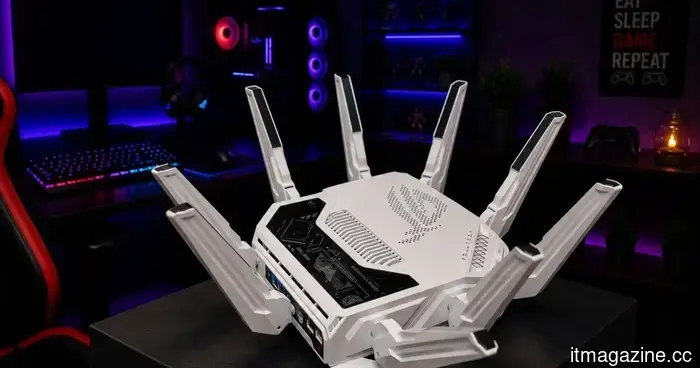 Asus ROG Rapture GT-BE19000AI Router Review: An Excellent, Future-Ready Upgrade
The Asus ROG Rapture GT-BE19000AI is an impressive Wi-Fi router equipped with significant features and avoids the need for a subscription. However, at a price of $899, you really need to desire it in order to purchase one.
Asus ROG Rapture GT-BE19000AI Router Review: An Excellent, Future-Ready Upgrade
The Asus ROG Rapture GT-BE19000AI is an impressive Wi-Fi router equipped with significant features and avoids the need for a subscription. However, at a price of $899, you really need to desire it in order to purchase one.
 Meta introduces its own smart glasses, one of which is designed in collaboration with Kylie Jenner.
Meta has introduced its inaugural self-branded smart glasses, featuring a unique edition by Kylie Jenner, along with the launch of the company's latest MuseSpark AI platform.
Meta introduces its own smart glasses, one of which is designed in collaboration with Kylie Jenner.
Meta has introduced its inaugural self-branded smart glasses, featuring a unique edition by Kylie Jenner, along with the launch of the company's latest MuseSpark AI platform.
 A Samsung leak suggests a variety of stylish colors for the forthcoming Galaxy Z Fold 8 and Flip 8.
According to a recent leak, Samsung's upcoming foldables might be available in a variety of colors, such as Mint, Pink, Pistachio, Green Shadow, and Violet Shadow.
A Samsung leak suggests a variety of stylish colors for the forthcoming Galaxy Z Fold 8 and Flip 8.
According to a recent leak, Samsung's upcoming foldables might be available in a variety of colors, such as Mint, Pink, Pistachio, Green Shadow, and Violet Shadow.
Luminvera is focusing on immersive software for robotics.
Luminvera released its AR wearable and shifted focus from industrial engineering to robotics software right after graduating from the Founder Institute, believing that an AI-driven spatial design tool can compete with more financially advantaged rivals.