
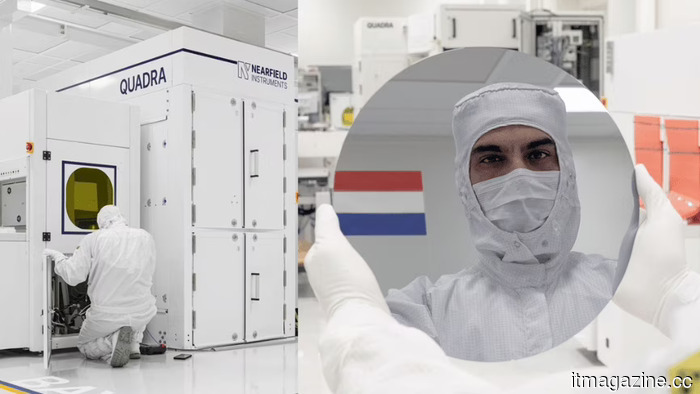
Nearfield Instruments achieves a record $380 million in chip funding.
Nearfield Instruments, a company based in Rotterdam that inspects chips at an atomic level, has successfully secured $380 million at a $1.6 billion valuation. This marks the largest deep-tech funding round in Dutch history, attracting significant attention from sovereign funds.
While the names associated with the AI chip boom, such as Nvidia, TSMC, and ASML, are widely recognized, Nearfield Instruments remains lesser known. Nevertheless, it has just completed the most substantial deep-tech funding round that the Netherlands has ever witnessed.
According to Reuters, the Rotterdam-based firm finalized a $380 million Series D funding round, achieving a valuation of $1.6 billion, driven by a demand that exceeded supply.
What Nearfield actually accomplishes is the production of tools that inspect chips after they exit the production line, specifically developing atomic force microscopes. These devices can measure features only a few atoms in height by dragging a fine probe across the surface, similar to how a needle moves over a vinyl record.
Chip manufacturers take measurements at numerous points along the production line, a field known as metrology, which has become a critical point as chips increase in complexity. Nearfield’s QUADRA platform manages this process without causing damage to the chip and can image intricate details such as deep trenches and layered structures that optical and electron-beam tools find challenging to resolve in large volumes.
The importance of the funding round is accentuated by the notable participants involved. Fidelity led the financing, with Singapore’s state fund Temasek, Walden Catalyst Ventures, Innovation Industries, M&G Investments, and the Dutch state investor Invest-NL also contributing, alongside new backer Qatar Investment Authority. Sovereign wealth funds rarely converge around an early-stage company by chance; their involvement represents a strategic investment in essential infrastructure rather than merely a promising startup.
A significant point of interest is that Walden Catalyst is associated with Intel's CEO Lip-Bu Tan, who is a founding managing partner.
Nearfield is not operating in isolation; it is part of an expanding Dutch chip ecosystem. The Netherlands is home to ASML, whose lithography systems are vital to chip manufacturing. A surge of startups is targeting various other aspects of the chip industry. For instance, Axelera AI focuses on low-power edge chips, and the ASML spinoff Invisix utilizes soft X-rays to identify production errors. Together, these efforts resemble a cohesive industrial strategy rather than random investments.
Many of these developments originate from TNO, the national research institute that established Nearfield in 2016, showcasing a successful pipeline from research to business that many European countries struggle to replicate.
The timing of this progress is significant, as the demand for increasingly complex chips driven by AI scaling creates a bottleneck in precise measurement at the nanometre scale. Nearfield’s tools are at the forefront, supporting advanced technologies such as High-NA EUV, gate-all-around transistors, and 3D-stacked chips. Currently, its larger competitors, led by KLA, dominate the market, which is projected to reach about $10.3 billion by 2025 and potentially $15 billion by 2031, according to industry estimates. The company intends to allocate the new funding towards increasing production capacity, establishing support centers, and collaborating on R&D with chip manufacturers.
Currently, Nearfield employs approximately 450 individuals in Taiwan, South Korea, Japan, Singapore, the US, and Belgium. Last year, it raised $148 million, and this latest funding round more than doubles that amount.
The pressing question remains whether Dutch companies can maintain their competitive edge against larger American and Asian firms. However, the $380 million investment, supported by sovereign funds and directed toward a chip inspection company in Rotterdam, reflects a pivotal part of Europe’s broader initiative for semiconductor independence.
Other articles
 Devil May Cry has just arrived on your Switch 2, and it’s priced at only $30 until July 7.
Devil May Cry 5: Devil Hunter Edition makes its debut on Switch 2, marking its first appearance on a portable Nintendo device, available for $30 until July 7.
Devil May Cry has just arrived on your Switch 2, and it’s priced at only $30 until July 7.
Devil May Cry 5: Devil Hunter Edition makes its debut on Switch 2, marking its first appearance on a portable Nintendo device, available for $30 until July 7.
 Akko Dash V9 Ultra review: I tried out this extremely lightweight gaming mouse, and it also made my work easier.
Akko's lightweight mouse features a top-tier sensor and offers 8K wireless polling all within a stylish design, and it doesn't come with an exorbitant price tag.
Akko Dash V9 Ultra review: I tried out this extremely lightweight gaming mouse, and it also made my work easier.
Akko's lightweight mouse features a top-tier sensor and offers 8K wireless polling all within a stylish design, and it doesn't come with an exorbitant price tag.
 Qualcomm's modular agreement is approaching a $4 billion value to compete with Nvidia.
The Qualcomm Modular agreement would assess the AI-infrastructure software startup at approximately $4 billion, as the chip manufacturer expands its competition against Nvidia.
Qualcomm's modular agreement is approaching a $4 billion value to compete with Nvidia.
The Qualcomm Modular agreement would assess the AI-infrastructure software startup at approximately $4 billion, as the chip manufacturer expands its competition against Nvidia.
 These Tineco offers include an additional discount that many buyers may overlook.
Prime Day discounts are coming early, and Tineco is providing reductions on several of its top floor care products from June 23 to June 26. Additionally, readers of Digital Trends can maximize their savings by applying the exclusive code DIGITALTRENDS to receive an extra 6% off all Tineco items (excluding […]
These Tineco offers include an additional discount that many buyers may overlook.
Prime Day discounts are coming early, and Tineco is providing reductions on several of its top floor care products from June 23 to June 26. Additionally, readers of Digital Trends can maximize their savings by applying the exclusive code DIGITALTRENDS to receive an extra 6% off all Tineco items (excluding […]
 The cybersecurity sector developed a $200 billion industry by selling you issues, while no one was compensated for resolving them.
The cybersecurity market has excelled in discovery but has overlooked remediation. Reclaim Security suggests that the next phase of the industry will be characterized by how effectively organizations address known risks, rather than the quantity they can uncover.
The cybersecurity sector developed a $200 billion industry by selling you issues, while no one was compensated for resolving them.
The cybersecurity market has excelled in discovery but has overlooked remediation. Reclaim Security suggests that the next phase of the industry will be characterized by how effectively organizations address known risks, rather than the quantity they can uncover.
 The cybersecurity sector has created a $200 billion industry by selling you problems, while no one has been compensated for resolving them.
The cybersecurity market has excelled in discovery but has overlooked remediation. Reclaim Security contends that the next stage of the industry will be characterized by the effectiveness with which organizations address known risks, rather than the quantity of risks they can identify.
The cybersecurity sector has created a $200 billion industry by selling you problems, while no one has been compensated for resolving them.
The cybersecurity market has excelled in discovery but has overlooked remediation. Reclaim Security contends that the next stage of the industry will be characterized by the effectiveness with which organizations address known risks, rather than the quantity of risks they can identify.
Nearfield Instruments achieves a record $380 million in chip funding.
Nearfield Instruments has secured $380 million at a valuation of $1.6 billion, marking the largest deep-tech funding round in Dutch history, driven by the increasing importance of AI in chip inspection.