
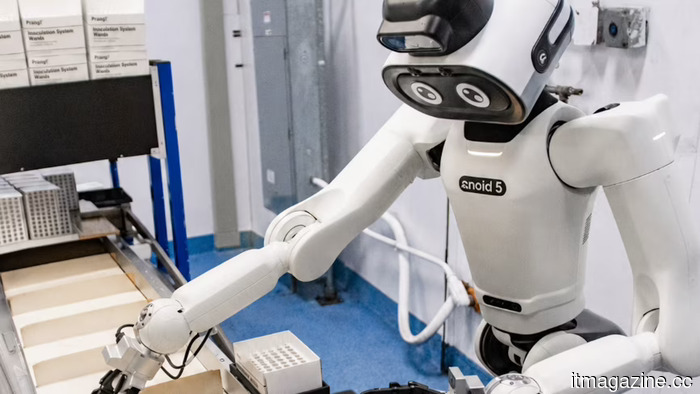
Delivery robot startup Robot.com is placing its next bet on wheeled humanoid robots designed for kitchens and warehouses.
TL;DRRobot.com has introduced R-noid, a wheeled humanoid robot designed for kitchen and warehouse tasks, utilizing Physical Intelligence’s AI model. The San Francisco startup, previously named Kiwibot, is transitioning from campus delivery robots to workplace humanoids. According to Business Insider, R-noid is engineered to package orders, load and unload boxes, and prepare workstations in food service, logistics, and healthcare sectors.
CEO Felipe Chavez mentioned that this shift has been in development for nearly two years. "We already have an established presence with our delivery robots," he stated, noting that expanding into manipulation solutions is a logical progression for a company with over 500 robots deployed and over two and a half million tasks completed.
R-noid does not aim to walk but uses a holonomic wheeled base instead of legs. It features dual seven-degree-of-freedom arms and an articulated torso that allows for vertical reach of nearly two meters. The robot is part of a growing trend among robotics companies that favor wheeled designs for practical workplace use, trading off stair-climbing abilities for enhanced stability, lower costs, and quicker time to market.
The dexterity of R-noid derives from Physical Intelligence, a prominent AI lab in robotics. The robot operates on the company's vision-language-action model, which interprets natural-language commands, observes its environment, and executes arm and hand movements to perform tasks. Chavez revealed that the company has been collaborating with Physical Intelligence to create custom models since last year.
A partnership with FieldAI supplies the navigation and autonomy capabilities. So far, fewer than 40 R-noids have been commercially deployed across around a dozen clients, including a verified installation at Harbor Links Golf Course in New York, where R-noid assists in loading food into delivery robots and aiding staff with order preparation.
Deployment is said to take between eight to 12 weeks, during which the team visits the client's facility to identify automatable tasks and gathers extensive robot data to refine the model prior to beginning on-site operations. Chavez explained that some tasks necessitate collecting up to 50 hours of data before the robot can function independently. Teleoperation and remote assistance are integral to their deployment approach, with expectations of roughly 70 percent autonomy during the initial implementation phases. The immediate aim, he added, is not to replace human workers but to prepare businesses for robotics while enhancing worker satisfaction by alleviating dull physical tasks.
R-noid will initially serve five specific functions: restaurant assistant, packer, picker, folder, and host. The overall humanoid market is unstable, with over 150 firms pursuing commercialization and reported buyer satisfaction rates as low as 23 percent in enterprise surveys.
The startup is presenting R-noid as a practical, task-focused tool instead of a general-purpose humanoid, a key distinction as the industry delineates between commercially viable products and those that are primarily venture-funded novelties. Founded in 2017 as Kiwibot, the company rebranded in October 2025 and has attracted investments from Backers such as Headline, Sodexo VC, and UC Berkeley SkyDeck Fund. R-noid will be featured at Automate 2026 in Chicago this week.
Other articles
 The CEO of Lovable states that the issue facing Europe's AI startups is a lack of confidence rather than a lack of talent.
Anton Osika from Lovable asserts that European entrepreneurs can establish global AI companies without relying on Silicon Valley, using his own startup with a $500 million ARR as evidence.
The CEO of Lovable states that the issue facing Europe's AI startups is a lack of confidence rather than a lack of talent.
Anton Osika from Lovable asserts that European entrepreneurs can establish global AI companies without relying on Silicon Valley, using his own startup with a $500 million ARR as evidence.
 Reviews of the Steam Machine commend Valve's hardware, but the main issue lies in its four-digit price.
The initial reviews for the Steam Machine have been released, and although critics commend Valve's hardware and SteamOS, many feel that its price of $1,049 is the main obstacle.
Reviews of the Steam Machine commend Valve's hardware, but the main issue lies in its four-digit price.
The initial reviews for the Steam Machine have been released, and although critics commend Valve's hardware and SteamOS, many feel that its price of $1,049 is the main obstacle.
 Instagram is making its debut on Samsung TVs, bringing episodic series and live TV to your screen shortly.
Meta is experimenting with channels based on user interests, casting from phone to TV, and a horizontal video hub as Instagram for TV grows beyond its initial launch on Samsung devices.
Instagram is making its debut on Samsung TVs, bringing episodic series and live TV to your screen shortly.
Meta is experimenting with channels based on user interests, casting from phone to TV, and a horizontal video hub as Instagram for TV grows beyond its initial launch on Samsung devices.
 A leak regarding the Galaxy S27 indicates that Samsung might reuse the same cameras once more.
A recent leak regarding the Galaxy S27 indicates that Samsung may continue using the same camera sensors previously seen in recent Galaxy S models. Although AI and image processing are advancing, some enthusiasts might be questioning how much longer software can manage the burden by itself.
A leak regarding the Galaxy S27 indicates that Samsung might reuse the same cameras once more.
A recent leak regarding the Galaxy S27 indicates that Samsung may continue using the same camera sensors previously seen in recent Galaxy S models. Although AI and image processing are advancing, some enthusiasts might be questioning how much longer software can manage the burden by itself.
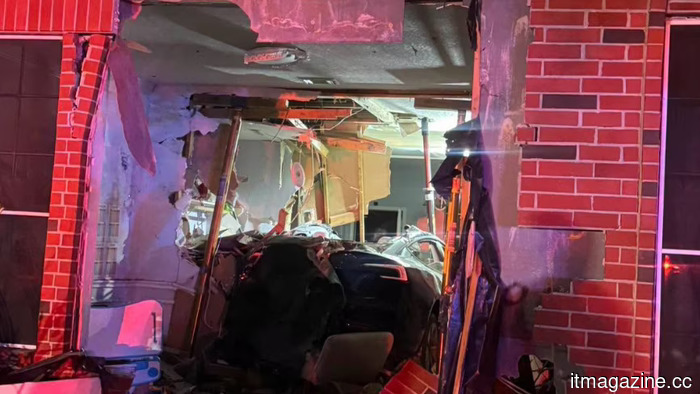 A Tesla operating on Autopilot crashed into a house in Texas. The woman inside did not make it.
A 76-year-old woman from Texas passed away after a Tesla Model 3, operated on Autopilot, collided with her house. The NHTSA is initiating a special investigation into the crash.
A Tesla operating on Autopilot crashed into a house in Texas. The woman inside did not make it.
A 76-year-old woman from Texas passed away after a Tesla Model 3, operated on Autopilot, collided with her house. The NHTSA is initiating a special investigation into the crash.
Delivery robot startup Robot.com is placing its next bet on wheeled humanoid robots designed for kitchens and warehouses.
Robot.com, previously known as Kiwibot, has introduced R-noid, a wheeled humanoid equipped with Physical Intelligence's AI, designed to pack orders and load boxes.