

Reviews of the Steam Machine commend Valve's hardware, but the main issue lies in its four-digit price.
Reviewers appreciate the design, SteamOS, and the overall experience, but many find it hard to justify paying more than $1,000 for it.
The review embargo for Valve’s Steam Machine has finally lifted, and a look at the feedback from leading publications reveals that the reviews are not as varied as social media suggests. In fact, there's notable agreement on what Valve has succeeded in and where it has faltered.
Here’s how key reviewers assessed the Steam Machine:
Digital Foundry: Called it “beautifully designed” and “virtually silent,” but emphasized that the high price is hard to overlook.
Rock Paper Shotgun: Described it as a “quiet triumph of hardware design” and appreciated its distinctive appeal despite the steep price.
IGN: Noted the compact form factor and capable hardware, but considered the starting price of $1,049 a “hard pill to swallow.”
Gizmodo: Commended it as a superb couch gaming device, but argued that inflated component costs have made it hard to recommend.
Aftermath: Called it user-friendly and enjoyable, but connected its recommendations to current PC component pricing issues.
PC Gamer: Observed that the console is “the biggest victim of the RAMpocalypse to date,” making it feel like an “expensive curio, rather than a gaming device for the masses.”
Linus Tech Tips: Bluntly titled their review “Even Valve is Disappointed,” highlighting how the poor price-to-performance ratio detracts from an otherwise excellent machine.
The Verge: Praised the refined SteamOS experience and high-quality design, yet questioned whether the entire package provides enough value for its price.
After reviewing these comments, it’s amusing to note that nearly no one appears to dislike the Steam Machine itself; in fact, the opposite is true.
SteamOS shines, and the hardware holds up well
Consistently, reviewers commend the industrial design, nearly silent operation, and particularly SteamOS. Valve’s operating system has evolved into arguably the smoothest console-style interface available on a PC today, featuring easy controller navigation, seamless UI transitions, and a polish that makes Windows-based gaming machines feel bulky by comparison. It offers the convenience of a console while providing access to the flexibility of the PC ecosystem, with many reviewers recognizing it as one of the hardware’s main strengths.
The admiration extends beyond the software. Reviewers also lauded the compact design of the Steam Machine, its premium quality, and its nearly silent cooling, with many describing it as a device that seamlessly blends into a living room environment. The redesigned Steam Controller has received positive feedback as well, thanks to its improved ergonomics and seamless integration with SteamOS, contributing to a package that feels less like a mini PC and more like a dedicated console experience.
Performance, too, is not the disappointment that some anticipated. Most outlets agree that the Steam Machine delivers on its promised specifications and provides a solid gaming experience for its target audience. To Valve’s credit, the company isn’t solely to blame for the steep price tag. The ongoing AI surge has increased memory and component costs throughout the industry, making compact PCs significantly more expensive to manufacture than they were just a few years ago.
The true discussion starts when examining the price tag
At $1,049, reviewers stop comparing the Steam Machine to a PlayStation 5 or Xbox Series X and instead compare it with gaming laptops and compact desktops. While new PC hardware has indeed become pricier due to soaring component costs and the AI-triggered memory shortage, that’s only part of the narrative. For shoppers today, there are numerous last-gen gaming laptops and pre-built PCs available at significant discounts, which can outperform the Steam Machine at the same or even lower prices. Suddenly, the competition seems much more challenging.
Ultimately, most critics concur that Valve has crafted a beautifully engineered gaming machine with an outstanding software experience and arguably the best couch-friendly PC interface available. However, the Steam Machine makes more sense when regarded as a premium, luxury gaming appliance rather than a conventional console substitute. The hardware isn’t what divides reviewers; it’s the four-figure price that causes contention.
Varun is a seasoned technology journalist and editor with over eight years of experience in consumer tech media. His work encompasses…
Devil May Cry has just arrived on your Switch 2 for only $30 until July 7.
Featuring all four characters, 60 FPS in handheld mode, and a $30 price that won't last after July 7, it's a great time for Switch 2 owners looking for an exciting hack-and-slash game to validate their purchase. Devil May Cry 5: Devil Hunter Edition will be available on the eShop starting June 23, 2026, at a limited-time discount. Given that it’s a title from a franchise that has sold over 38 million copies, this deal is worth considering.
Forget purchasing a Steam Machine; Valve encourages building one instead.
The company is enhancing desktop compatibility and closely collaborating with Nvidia for future support








Other articles
 Instagram is now available on Samsung TVs, bringing episodic series and live TV to your screen shortly.
Meta is experimenting with interest-based channels, phone-to-TV streaming, and a horizontal video hub as Instagram for TV grows beyond its initial launch on Samsung devices.
Instagram is now available on Samsung TVs, bringing episodic series and live TV to your screen shortly.
Meta is experimenting with interest-based channels, phone-to-TV streaming, and a horizontal video hub as Instagram for TV grows beyond its initial launch on Samsung devices.
 Valve clarifies the reasons behind the high cost of the Steam Machine, and the antagonist is all too recognizable.
Valve has stated that increasing costs of RAM and storage have made it unfeasible to achieve its initial pricing objective for the Steam Machines, which also restricted their availability at launch.
Valve clarifies the reasons behind the high cost of the Steam Machine, and the antagonist is all too recognizable.
Valve has stated that increasing costs of RAM and storage have made it unfeasible to achieve its initial pricing objective for the Steam Machines, which also restricted their availability at launch.
 Valve discloses the pricing for Steam Machines, and it's certainly not an inexpensive gaming console.
Valve has formally announced the pricing for Steam Machines, with the new gaming PC running on SteamOS starting at $1,049, just before reservations begin this week.
Anthropic's updated privacy policy gathers biometric information from identified Claude users.
Anthropic revised its privacy policy, necessitating certain Claude users to provide scans of government-issued IDs and selfies, which has raised concerns regarding biometric data.
Valve discloses the pricing for Steam Machines, and it's certainly not an inexpensive gaming console.
Valve has formally announced the pricing for Steam Machines, with the new gaming PC running on SteamOS starting at $1,049, just before reservations begin this week.
Anthropic's updated privacy policy gathers biometric information from identified Claude users.
Anthropic revised its privacy policy, necessitating certain Claude users to provide scans of government-issued IDs and selfies, which has raised concerns regarding biometric data.
 Cloudflare collaborates with Chrome, Firefox, and Edge to develop a privacy-centered anti-bot protocol.
Cloudflare, Mozilla, Google, and Microsoft are collaborating on PACT, a protocol designed to preserve privacy while verifying authentic web traffic without monitoring users.
Cloudflare collaborates with Chrome, Firefox, and Edge to develop a privacy-centered anti-bot protocol.
Cloudflare, Mozilla, Google, and Microsoft are collaborating on PACT, a protocol designed to preserve privacy while verifying authentic web traffic without monitoring users.
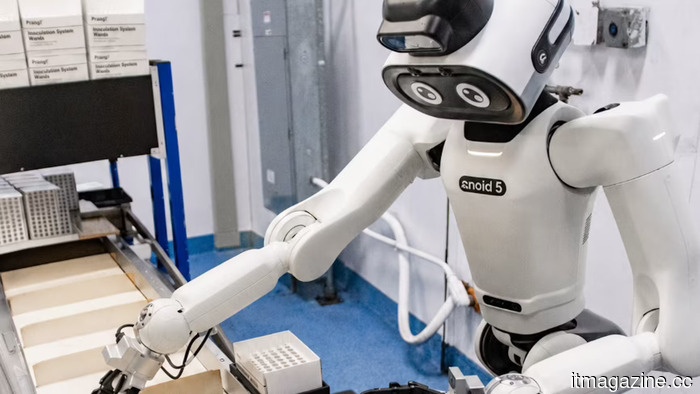 Delivery robot startup Robot.com is placing its future on wheeled humanoid robots designed for use in kitchens and warehouses.
Robot.com, previously known as Kiwibot, has introduced R-noid, a wheeled humanoid equipped with Physical Intelligence's AI that is capable of packing orders and loading boxes.
Delivery robot startup Robot.com is placing its future on wheeled humanoid robots designed for use in kitchens and warehouses.
Robot.com, previously known as Kiwibot, has introduced R-noid, a wheeled humanoid equipped with Physical Intelligence's AI that is capable of packing orders and loading boxes.
Reviews of the Steam Machine commend Valve's hardware, but the main issue lies in its four-digit price.
The initial reviews for the Steam Machine have been released, and although critics commend Valve's hardware and SteamOS, many feel that its price of $1,049 is the main obstacle.