

WeChat initiates tests of Xiaowei as Tencent targets an AI launch in Q3.
WeChat is a unique application that already offers nearly all functionalities. Users in China can message, make payments, book services, shop, and hail taxis without leaving the app. This is precisely what makes Tencent's upcoming move intriguing: instead of creating a standalone chatbot that competes for downloads, it is integrating an AI assistant within the already widely-used app, which a billion people access daily. Tencent has started testing this assistant, named Xiaowei, with a limited group of users.
According to a WeChat statement, the tool enables users to interact via text or voice and accomplish tasks by utilizing the app's extensive collection of mini-programs, which are lightweight apps functioning within WeChat.
In practice, Xiaowei serves as a command interface: you can request it to initiate a call, draft a message, or navigate to a service, and it will handle the navigation for you. It primarily leverages Weixin’s own large language model, occasionally consulting DeepSeek for certain queries.
The current test is limited, and Tencent has described it as a precursor to a fuller launch. The company aims for a public rollout in the third quarter, with the longer-term goal of transforming WeChat into something akin to a concierge that can manage payments, services, and financial tasks based on spoken or typed requests. Investors have responded positively, as Tencent shares increased in response to the expectations of having an AI agent integrated into the super app.
Xiaowei is not Tencent’s first initiative to incorporate AI into WeChat; earlier this year, it introduced Yuanbao, a standalone chatbot that users could interact with as a contact. However, Xiaowei represents a more ambitious concept: instead of being a bot that users converse with, it acts as a layer that operates throughout the app on their behalf. This distinguishes it from simply asking an assistant a question to delegating tasks for completion.
This strategy aligns with the evolving landscape across China’s largest platforms, from AI shopping assistants at Alibaba and Meituan to Tencent’s own enterprise agent platform. The underlying belief is that the agent will be a feature within an app that users already engage with, rather than an separate application they need to be convinced to visit. Few companies are better positioned to explore this than the owner of WeChat.
The extensive reach is a compelling argument. WeChat boasts approximately 1.4 billion users, a user base that most AI companies can only aspire to, and embedding the assistant within the platform allows Tencent to bypass the most challenging aspect of gaining users, which is convincing them to engage.
The key questions remaining are whether these users will desire an agent functioning on their behalf, and if Tencent’s models are trustworthy enough to handle payments and personal tasks, which will be evaluated during the upcoming testing period.
Other articles
 Hackers have released facial recognition data related to millions of visitors to Madison Square Garden.
A cybercriminal organization has released what it asserts are millions of records taken from Madison Square Garden Entertainment. This data breach is gaining attention not only due to its magnitude but also because it contains facial recognition information, internal threat evaluations, and comprehensive visitor profiles.
Hackers have released facial recognition data related to millions of visitors to Madison Square Garden.
A cybercriminal organization has released what it asserts are millions of records taken from Madison Square Garden Entertainment. This data breach is gaining attention not only due to its magnitude but also because it contains facial recognition information, internal threat evaluations, and comprehensive visitor profiles.
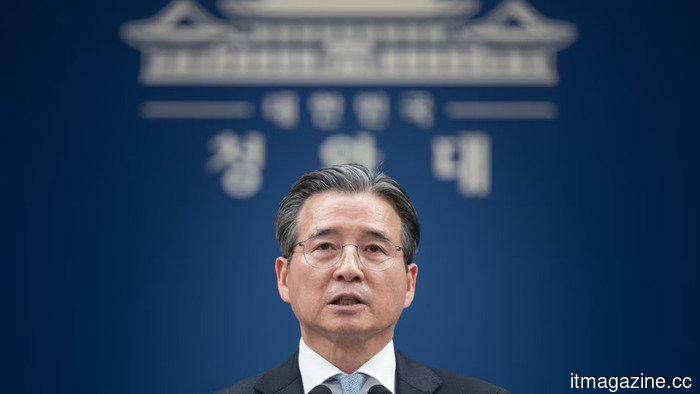 Korea's policy head cautions that the chip industry windfall might drive up housing prices.
Kim Yong-beom warns that the wealth generated by Korea’s semiconductor boom could become concentrated in real estate, and he is advocating for reforms in housing taxation.
Korea's policy head cautions that the chip industry windfall might drive up housing prices.
Kim Yong-beom warns that the wealth generated by Korea’s semiconductor boom could become concentrated in real estate, and he is advocating for reforms in housing taxation.
 A self-powered shaking capsule demonstrates the future of secure drinking water right at our fingertips.
Scientists have created a self-sustaining floating capsule that harnesses kinetic energy to identify contaminated water and purify it without the need for batteries or chemicals.
A self-powered shaking capsule demonstrates the future of secure drinking water right at our fingertips.
Scientists have created a self-sustaining floating capsule that harnesses kinetic energy to identify contaminated water and purify it without the need for batteries or chemicals.
 Canada purchases Australian Arctic radar in a historic A$2.5 billion defense export deal.
Canada will purchase Australia's JORN-derived radar for monitoring the Arctic in a deal valued at A$2.5 billion, marking Australia’s largest defence export to date.
Canada purchases Australian Arctic radar in a historic A$2.5 billion defense export deal.
Canada will purchase Australia's JORN-derived radar for monitoring the Arctic in a deal valued at A$2.5 billion, marking Australia’s largest defence export to date.
 Seedcamp secures $320 million and establishes a transatlantic connection.
Europe's pioneering first-check investor has secured $320 million through two funds and has grown its US team to support founders who are building globally from the outset.
Seedcamp secures $320 million and establishes a transatlantic connection.
Europe's pioneering first-check investor has secured $320 million through two funds and has grown its US team to support founders who are building globally from the outset.
 WeChat has initiated testing of Xiaowei as Tencent prepares for an AI launch in the third quarter.
Tencent has started testing Xiaowei, an AI assistant that functions through voice and text within WeChat, with plans for a complete public launch in the third quarter.
WeChat has initiated testing of Xiaowei as Tencent prepares for an AI launch in the third quarter.
Tencent has started testing Xiaowei, an AI assistant that functions through voice and text within WeChat, with plans for a complete public launch in the third quarter.
WeChat initiates tests of Xiaowei as Tencent targets an AI launch in Q3.
Tencent has started testing Xiaowei, a voice-and-text AI assistant integrated into WeChat, with plans for a complete public launch in the third quarter.