

A self-powered shaking capsule demonstrates the future of secure drinking water right at our fingertips.
Researchers have developed a battery-free device capable of detecting contamination and eliminating harmful microbes solely through motion.
Access to safe drinking water remains a significant issue for billions globally, but a new invention from South Korean researchers could simplify this process. A self-powered floating capsule, small enough to fit in a hand, can reportedly test water quality and purify unsafe water without relying on batteries, external power sources, or chemical treatments.
This water purification capsule only requires a simple shake.
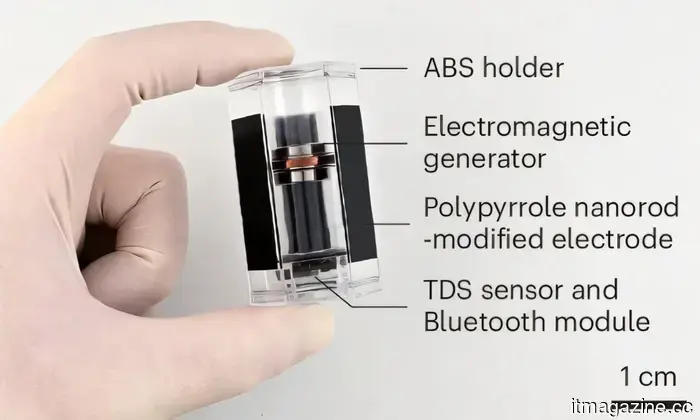
According to a recent article in Nature Water, the device, named the Floating-induced Detection-Guided Disinfection (FDGD) capsule, generates electricity when shaken. An internal magnet moves through a coil to produce sufficient energy to activate a built-in sensor that measures the water's electrical conductivity, allowing users to gauge its quality via a connected smartphone or smartwatch.
Construction of an FDGD capsule is detailed in Nature Water.
If the water passes the initial safety assessment, the capsule can remain floating within it. Gentle movements from waves or even the simple act of walking while holding the container generate static electricity that powers microscopic nanorods on the capsule’s surface. These rods create strong electrostatic forces that damage the membranes of surrounding bacteria and viruses through a method called electroporation, effectively neutralizing them without the need for chemicals.
Laboratory tests with containers holding up to four liters of water showed that the device successfully inactivated 99.9999% of bacteria and viruses, including E. coli, across a variety of water samples. This technology was outlined in the journal Nature Water, where researchers describe it as an affordable, decentralized solution for regions lacking conventional water treatment infrastructure.
The innovative aspect lies not just in the disinfection but in the absence of dependencies.
Interestingly, many portable water purifiers already exist, yet most rely on disposable filters, chemicals, UV lamps, or rechargeable batteries. This capsule avoids all of those requirements by generating energy through simple physical movement, making it especially advantageous for disaster relief, camping, remote communities, or humanitarian efforts where electricity is unreliable.
The FDGD capsule is still a prototype and has not yet demonstrated its effectiveness outside of controlled testing. However, if it can be commercialized at the low cost anticipated by its creators, it could provide a trustworthy water testing and purification device to millions. Sometimes, significant advancements are not found in large treatment plants or billion-dollar infrastructure projects. Sometimes, they are small enough to fit in your pocket.





Other articles
 Korea's policy head cautions that the chip industry windfall might drive up housing prices.
Kim Yong-beom warns that the wealth generated by Korea’s semiconductor boom could become concentrated in real estate, and he is advocating for reforms in housing taxation.
Korea's policy head cautions that the chip industry windfall might drive up housing prices.
Kim Yong-beom warns that the wealth generated by Korea’s semiconductor boom could become concentrated in real estate, and he is advocating for reforms in housing taxation.
 Forget about RTX filters. The gaming monitor from BenQ takes care of the visual enhancements on its own.
BenQ’s MOBIUZ gaming monitors feature AI-driven Smart Color and Color Shuttle that automatically adjust game visuals on the display, offering shareable presets without affecting GPU performance.
Forget about RTX filters. The gaming monitor from BenQ takes care of the visual enhancements on its own.
BenQ’s MOBIUZ gaming monitors feature AI-driven Smart Color and Color Shuttle that automatically adjust game visuals on the display, offering shareable presets without affecting GPU performance.
 Intel Core 3 test indicates it might provide Windows laptops a competitive edge against MacBook Neo.
The upcoming Intel Core i3-304 processor has surfaced in new benchmarks, showing PassMark scores that are unexpectedly near those of Apple's MacBook Neo powered by the A18 Pro.
Intel Core 3 test indicates it might provide Windows laptops a competitive edge against MacBook Neo.
The upcoming Intel Core i3-304 processor has surfaced in new benchmarks, showing PassMark scores that are unexpectedly near those of Apple's MacBook Neo powered by the A18 Pro.
 Isometric in London secures $40 million to validate the industrial sector using AI.
Isometric, based in London, has secured $40 million in a Series A funding round led by AVP to expand its AI certification platform throughout the broader industrial sector.
Isometric in London secures $40 million to validate the industrial sector using AI.
Isometric, based in London, has secured $40 million in a Series A funding round led by AVP to expand its AI certification platform throughout the broader industrial sector.
 WeChat has initiated testing of Xiaowei as Tencent prepares for an AI launch in the third quarter.
Tencent has started testing Xiaowei, an AI assistant that functions through voice and text within WeChat, with plans for a complete public launch in the third quarter.
WeChat has initiated testing of Xiaowei as Tencent prepares for an AI launch in the third quarter.
Tencent has started testing Xiaowei, an AI assistant that functions through voice and text within WeChat, with plans for a complete public launch in the third quarter.
 Canada purchases Australian Arctic radar in a groundbreaking A$2.5 billion defense export deal.
Canada will purchase Australia's JORN-derived radar system for monitoring the Arctic in a deal worth A$2.5 billion, marking Australia's biggest defence export to date.
Canada purchases Australian Arctic radar in a groundbreaking A$2.5 billion defense export deal.
Canada will purchase Australia's JORN-derived radar system for monitoring the Arctic in a deal worth A$2.5 billion, marking Australia's biggest defence export to date.
A self-powered shaking capsule demonstrates the future of secure drinking water right at our fingertips.
Scientists have created a self-sustaining floating capsule that harnesses kinetic energy to identify contaminated water and purify it without the need for batteries or chemicals.