

Intel Core 3 tests indicate that it may help Windows laptops compete with the MacBook Neo once more.
Recent PassMark scores indicate that Wildcat Lake is narrowing the performance gap with Apple's A18 Pro.
Apple’s MacBook Neo has disrupted the budget laptop sector with its $599 price point and surprisingly powerful A18 Pro chip. However, new benchmark data suggests that Intel may finally have a strong competitor. The upcoming Core 3 304 processor from Intel has appeared on PassMark, and its results indicate that entry-level Windows laptops could become significantly more competitive.
Intel’s Core 3 304 is reducing the performance gap with Apple’s A18 Pro.
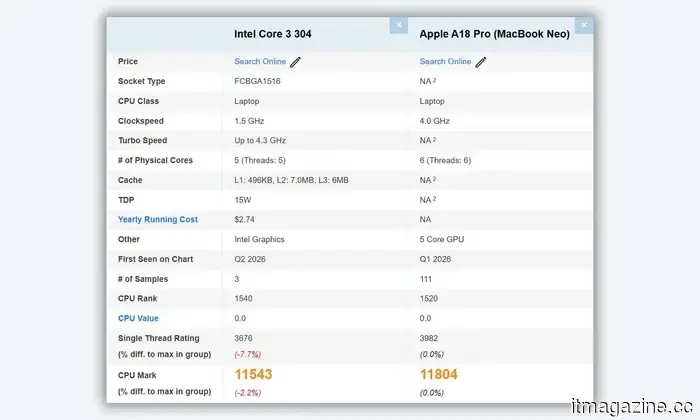
New PassMark data (via x86deadandback) shows that the Intel Core 3 304 achieved an average CPU Mark score of 11,543 points, which is only 2.2% lower than the Apple A18 Pro found in the MacBook Neo, which averages 11,804 points. In single-threaded performance, the Intel processor lags approximately 7.7% behind in average scores, although one benchmark instance even equaled the A18 Pro’s peak performance.
It's noteworthy that Intel has reached this performance level with a 5-core, 5-thread configuration, whereas the A18 Pro features a 6-core, 6-thread setup. The Core 3 304 is anticipated to be part of Intel’s low-power Wildcat Lake line targeting budget laptops, making the comparison especially pertinent for cost-conscious consumers.
Of course, synthetic benchmarks only provide a portion of the overall picture. Factors such as battery life, thermal performance, graphics capabilities, software optimization, and overall user experience will play crucial roles once products are released. Nonetheless, from a purely CPU perspective, Intel seems to be significantly closer to Apple’s latest budget-focused silicon than many had anticipated.
Perhaps the budget Windows laptop market is not finished yet.
Interestingly, the primary selling point of the MacBook Neo was never solely macOS or battery life. It revolved around the concept that consumers could experience flagship-level responsiveness at an entry-level price. Should Intel manage to provide similar everyday CPU performance with Wildcat Lake, it could diminish one of Apple’s main competitive advantages in this market segment.
However, it should be noted that benchmarks alone do not seal laptop sales. Factors like OEM pricing, display quality, memory configurations, and battery life will ultimately determine whether these upcoming Windows devices can truly rival the MacBook Neo. Still, if these initial figures are consistent, Intel might have just offered budget Windows laptops the leverage they need.
---
Madison Square Garden has reportedly been utilizing facial recognition technology to keep track of those entering its venues. Now, this same surveillance system has become the focus of what could potentially be one of the year's most concerning privacy violations. The cybercriminal group ShinyHunters has released a significant amount of data that was allegedly stolen from Madison Square Garden Entertainment after the company failed to meet a ransom deadline. Reports state that the leak contains facial recognition records, customer details, internal security evaluations, and other confidential information related to millions of visitors. While large data breaches have regrettably become commonplace, this incident feels distinct. Most data leaks typically involve passwords, email addresses, or financial data. This breach, however, reportedly includes something far more intimate: information related to how individuals were tracked and identified within physical locations.
---
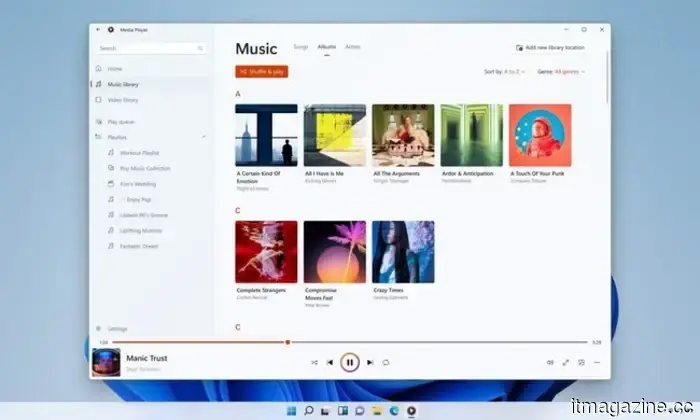
Microsoft has introduced a new Insider Preview update for the Windows 11 modern Media Player, but the app is facing backlash as tests have shown it is slower and utilizes more memory than the classic Windows Media Player from 17 years ago. The update brings some helpful fixes, including improved captions, clearer codec errors, and enhanced file recognition. However, the main complaints persist regarding increased RAM usage and the requirement for paid codec support for certain common video formats. This update is not yet available to all users; Media Player version 11.2605.14.0 has only been released for Experimental Insider builds as part of Microsoft’s June 12 Insider Preview updates.
---
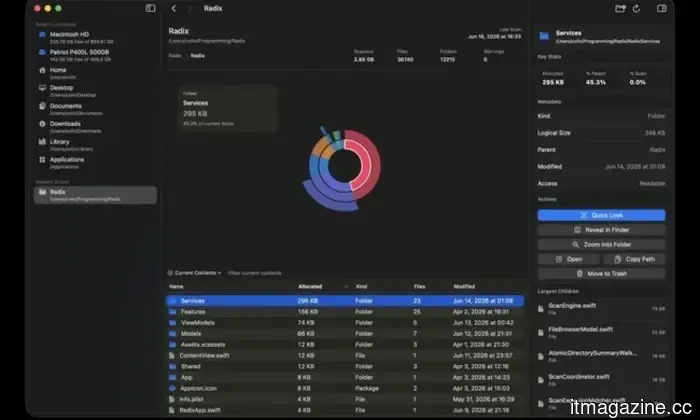
Running low on storage on a Mac is a frequent issue, but Apple's built-in tools do not always effectively show what is consuming space. You typically receive broad categorizations, but pinpointing the specific folders, downloads, app files, or old projects that are taking up space can be challenging. Radix is a free, open-source Mac application designed to simplify this process. It functions as a disk space analyzer, scanning a folder, drive, or volume and presenting the results in an interactive sunburst chart. Instead of sifting through folders manually, you can gain a visual overview of how storage is allocated across your drive.




Other articles
 Isometric, based in London, secures $40 million to validate the industrial economy using AI.
Isometric, based in London, has secured $40 million in Series A funding, led by AVP, to expand its AI certification platform throughout the broader industrial sector.
Isometric, based in London, secures $40 million to validate the industrial economy using AI.
Isometric, based in London, has secured $40 million in Series A funding, led by AVP, to expand its AI certification platform throughout the broader industrial sector.
 China's goal for green energy in AI data centers faces challenges with the power grid.
Beijing aims for renewable sources to provide 80% of the power for its AI data centres by 2030. However, challenges with forecasting and grid reliability are hindering progress.
China's goal for green energy in AI data centers faces challenges with the power grid.
Beijing aims for renewable sources to provide 80% of the power for its AI data centres by 2030. However, challenges with forecasting and grid reliability are hindering progress.
 A self-powered shaking capsule demonstrates the future of secure drinking water right at our fingertips.
Scientists have created a self-sustaining floating capsule that harnesses kinetic energy to identify contaminated water and purify it without the need for batteries or chemicals.
A self-powered shaking capsule demonstrates the future of secure drinking water right at our fingertips.
Scientists have created a self-sustaining floating capsule that harnesses kinetic energy to identify contaminated water and purify it without the need for batteries or chemicals.
 Forget about RTX filters. BenQ’s gaming monitor enhances visuals on its own.
BenQ's MOBIUZ gaming monitors leverage AI-driven Smart Color and Color Shuttle to automatically adjust game visuals on the display, featuring shareable presets without impacting GPU performance.
Forget about RTX filters. BenQ’s gaming monitor enhances visuals on its own.
BenQ's MOBIUZ gaming monitors leverage AI-driven Smart Color and Color Shuttle to automatically adjust game visuals on the display, featuring shareable presets without impacting GPU performance.
 Korea's policy head cautions that the chip industry windfall might drive up housing prices.
Kim Yong-beom warns that the wealth generated by Korea’s semiconductor boom could become concentrated in real estate, and he is advocating for reforms in housing taxation.
Korea's policy head cautions that the chip industry windfall might drive up housing prices.
Kim Yong-beom warns that the wealth generated by Korea’s semiconductor boom could become concentrated in real estate, and he is advocating for reforms in housing taxation.
 WeChat has initiated testing of Xiaowei as Tencent prepares for an AI launch in the third quarter.
Tencent has started testing Xiaowei, an AI assistant that functions through voice and text within WeChat, with plans for a complete public launch in the third quarter.
WeChat has initiated testing of Xiaowei as Tencent prepares for an AI launch in the third quarter.
Tencent has started testing Xiaowei, an AI assistant that functions through voice and text within WeChat, with plans for a complete public launch in the third quarter.
Intel Core 3 tests indicate that it may help Windows laptops compete with the MacBook Neo once more.
The new Core 3 304 processor from Intel has surfaced in recent benchmarks, achieving PassMark scores that are notably similar to those of the MacBook Neo powered by Apple's A18 Pro.