
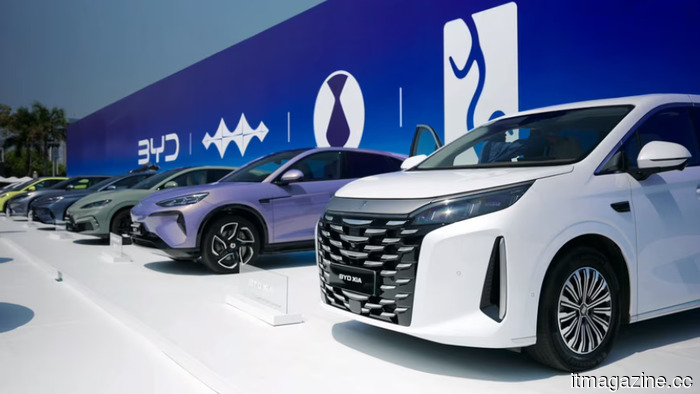
BYD has denied allegations that it breached Hungary's environmental regulations at its electric vehicle factory in Szeged.
TL;DR: BYD refutes claims of environmental violations at its Szeged facility as Hungarian authorities investigate allegations of toxic soil issues, while the company explores the establishment of a second European plant.
Stella Li, BYD's executive vice president, asserted that the Chinese automaker has adhered to all environmental laws at its Szeged factory in Hungary, countering accusations of non-compliance during construction. She made these remarks at a press conference in Belgrade on Friday, where she met with Serbian President Aleksandar Vucic to discuss the potential for a second production site in Europe.
This denial follows comments by Hungary’s environment minister in May, who stated that BYD had “seriously violated” environmental regulations at the Szeged location, which is currently being investigated by police for possible improper handling of toxic soil during construction. The government has levied a fine of 10 million forints, approximately $27,000, on the company due to this issue.
BYD commenced trial production at the Szeged factory in early 2026, with plans for full assembly operations to begin in the fourth quarter. This factory marks the first major production facility of a Chinese automaker in Europe, a significant achievement that has attracted both investment interest and political attention. Under former Prime Minister Viktor Orban, Hungary emerged as a key entry point for China into the EU, collecting 44% of all Chinese foreign direct investment into Europe in 2023.
The political climate has changed, however. Since Peter Magyar succeeded Orban earlier this year, he has adopted a stricter stance on environmental and labor standards regarding Chinese-supported projects. The investigation into BYD’s Szeged facility is part of a wider assessment that has also encompassed battery manufacturers CATL and Samsung SDI, both of which are either operating or constructing large facilities in Hungary.
Subsequent testing has complicated the initial accusations, as later examinations of nearby farmlands revealed no contamination levels exceeding regulatory limits. This distinction is crucial: the police inquiry focuses on whether soil from the construction site was improperly disposed of, rather than any ongoing pollution from the factory to the surrounding area.
Li's visit to Belgrade served two purposes. In addition to addressing the environmental concerns, she was also meeting to discuss BYD's search for a second production site in Europe. Bloomberg reported that BYD is considering purchasing an existing facility, partnering with another manufacturer, or constructing a new plant from the ground up.
During their meeting, Vucic proposed Serbia as a potential production location, highlighting the country's lower labor costs and proximity to EU markets. The search for the second plant has also included discussions with Stellantis, as the Franco-Italian automaker has excess manufacturing capacity across Europe. A partnership could provide BYD with immediate production capabilities, avoiding the lengthy timeline associated with building a new facility. Demand for electric vehicles in Europe surged in 2026, with battery-electric vehicle registrations increasing by 51% in March alone, creating a pressing need for Chinese manufacturers to localize production and circumvent EU import tariffs.
The Szeged situation is part of a broader pattern of scrutiny. Organizations like China Labor Watch have raised separate allegations regarding forced labor practices at the construction site, which BYD has denied. The European Parliament has also flagged labor conditions at Chinese-supported projects in Hungary, increasing the political pressure on Magyar’s administration to exhibit stricter oversight.
For BYD, the implications extend beyond the $27,000 fine. The company surpassed Tesla in 2025 to become the largest global seller of battery-electric vehicles, competing with other Chinese automakers to establish European manufacturing before tariff barriers increase. Any ongoing regulatory difficulties in Hungary could hinder its expansion plans in a market that is currently its fastest-growing opportunity.
Li mentioned to reporters in Belgrade that BYD will continue investing in Hungary and will fully cooperate with the investigation. Whether this cooperation will meet Magyar’s government's expectations, especially given its political motivations to distance itself from Orban’s lenient stance on Chinese investments, remains uncertain.
Other articles
 ShinyHunters released 45GB of data from Madison Square Garden, which features records from facial recognition surveillance.
ShinyHunters released 45GB of MSG data following a lapsed ransom deadline, resulting in the exposure of biometric surveillance records and the initiation of a class action lawsuit.
ShinyHunters released 45GB of data from Madison Square Garden, which features records from facial recognition surveillance.
ShinyHunters released 45GB of MSG data following a lapsed ransom deadline, resulting in the exposure of biometric surveillance records and the initiation of a class action lawsuit.
 Nothing has canceled its upcoming budget-friendly phone, and the issue is more significant than you might realize.
The RAM shortage that thwarted Nothing's upcoming budget phone could lead to a noticeable increase in the price of your next budget Android device.
Nothing has canceled its upcoming budget-friendly phone, and the issue is more significant than you might realize.
The RAM shortage that thwarted Nothing's upcoming budget phone could lead to a noticeable increase in the price of your next budget Android device.
 Researchers at Wharton introduced the term 'cognitive surrender' to characterize the phenomenon where individuals allow AI to take over their thinking.
A study from Wharton revealed that individuals accept incorrect AI responses 80% of the time, especially with applications like Moot that allow five AI personas to weigh in on personal decisions.
Researchers at Wharton introduced the term 'cognitive surrender' to characterize the phenomenon where individuals allow AI to take over their thinking.
A study from Wharton revealed that individuals accept incorrect AI responses 80% of the time, especially with applications like Moot that allow five AI personas to weigh in on personal decisions.
 Caviar's iPhone case costs three times more than the phone itself and features a genuine fragment of a T-Rex tooth.
Caviar’s Magnetic Custom Relict case for the iPhone 17 Pro Max, priced at $4,490, features aviation titanium, alligator leather, blue enamel, and a fragment of a Tyrannosaurus fossil.
Caviar's iPhone case costs three times more than the phone itself and features a genuine fragment of a T-Rex tooth.
Caviar’s Magnetic Custom Relict case for the iPhone 17 Pro Max, priced at $4,490, features aviation titanium, alligator leather, blue enamel, and a fragment of a Tyrannosaurus fossil.
 Caviar's iPhone case costs three times more than the phone itself and is embellished with a genuine fragment of a T-Rex tooth.
Caviar's Magnetic Custom Relict case for the iPhone 17 Pro Max, priced at $4,490, is crafted from aviation titanium, alligator leather, blue enamel, and includes a fragment of a Tyrannosaurus fossil.
Caviar's iPhone case costs three times more than the phone itself and is embellished with a genuine fragment of a T-Rex tooth.
Caviar's Magnetic Custom Relict case for the iPhone 17 Pro Max, priced at $4,490, is crafted from aviation titanium, alligator leather, blue enamel, and includes a fragment of a Tyrannosaurus fossil.
 Amazon steps back from the Sam Altman film 'Artificial' due to concerns that it might resonate too closely with its own situation.
Amazon's choice to discontinue Artificial comes a few months following its $50 billion investment in OpenAI, with the studio now seeking other possible distributors.
Amazon steps back from the Sam Altman film 'Artificial' due to concerns that it might resonate too closely with its own situation.
Amazon's choice to discontinue Artificial comes a few months following its $50 billion investment in OpenAI, with the studio now seeking other possible distributors.
BYD has denied allegations that it breached Hungary's environmental regulations at its electric vehicle factory in Szeged.
Stella Li, the executive VP of BYD, stated that the company has adhered to all local regulations at its plant in Szeged, where Hungarian authorities are investigating claims of toxic soil.