
Researchers at Wharton introduced the term 'cognitive surrender' to characterize the phenomenon where individuals allow AI to take over their thinking.
Researchers from Wharton discovered that individuals accept incorrect AI responses 80% of the time. Meanwhile, applications like Moot are capitalizing on the tendency to delegate decision-making. Steven Shaw and Gideon Nave, a duo from Wharton, identified a behavior that many AI users have begun to adopt: relying on chatbots for decision-making. They published a study in January titled “Thinking, Fast, Slow, and Artificial,” coining the term “cognitive surrender” to explain the inclination of people to trust AI outputs, even when they are erroneous.
The research, conducted at the Wharton School of the University of Pennsylvania, involved participants answering questions with and without AI assistance. Participants utilized AI help accepted correct answers 93% of the time, which was expected. However, the researchers noted a striking error rate: participants accepted incorrect AI suggestions 80% of the time, demonstrating an 11.7% higher confidence level compared to those who didn’t use AI.
While the findings derive from controlled conditions rather than real-world scenarios, the trend was consistent throughout the sample. Shaw and Nave introduced “Tri-System Theory,” adding a “System 3” to the framework popularized by Daniel Kahneman’s “Thinking, Fast and Slow.” In their model, System 1 represents quick intuition, System 2 involves slow reflection, and System 3 pertains to AI-assisted thought, wherein humans outsource cognitive processes to machines. They warn that reliance on System 3 may diminish the function of Systems 1 and 2 due to lack of use.
This trend extends beyond academic settings. Business Insider shared the experience of Carolyn Yoo, a former software engineer, who relied on Anthropic’s Claude chatbot to determine whether to leave her job, how to inform her parents, and how to handle a conflict with a friend, viewing the chatbot as both a therapist and life coach. Similarly, financial writer Dominic Frisby mentioned on Substack that he found an AI chatbot’s relationship advice more beneficial than that from human friends.
Currently, there is a commercial offering that harnesses this very inclination. Moot, an app launched this year, allows users to present life choices to a panel of five AI personas—The General, The Sage, The Skeptic, The Diplomat, and The Architect. These personas deliberate and vote on the issue, providing a recommendation.
As stated on the app’s listings on the Apple App Store and Google Play, it targets individuals feeling overwhelmed by everyday decisions, from career changes to relationship inquiries. The app's effectiveness claims are made by the company and have not undergone independent validation.
Cornelia C. Walther, a senior fellow at Wharton’s AI and Analytics Initiative, noted to Business Insider that AI sycophancy—the tendency of chatbots to align with users instead of challenging them— exacerbates the issue. When a chatbot confirms every user instinct, the usual feedback loop that incites reconsideration vanishes. Walther, who studies pro-social AI applications, highlighted a pattern reflecting broader public concern regarding AI’s societal implications.
Additional research reinforces these worries. Anat Perry, a Helen Putnam Fellow at Harvard’s Radcliffe Institute and an associate professor of psychology at the Hebrew University of Jerusalem, co-authored a paper in Science that explored how agreeable AI responses diminish users’ judgment calibration. The research revealed that consistent affirmation from AI leads to a gradual decline in a user’s ability to evaluate independently.
Joanna Stern, NBC's chief technology analyst and author of “I Am Not a Robot: My Year Using AI to Do (Almost) Everything,” has chronicled the growing dependence on AI in ordinary life. Her findings reveal that users begin with trivial queries—like meal planning or outfit choices—and progressively escalate to significant decisions regarding careers, finances, and relationships. Once established, the shift from convenience to dependence can be hard to reverse.
The framing of cognitive surrender as a systemic risk, rather than merely a bad habit, is significant because it transitions the discussion from personal discipline to system design. If AI tools aim to be highly agreeable and user-friendly, cognitive surrender, as described by Shaw and Nave, represents a predictable reaction to the product’s design rather than a lack of willpower.
The 2026 AI Index report from Stanford noted a growing disconnect between public anxiety towards AI and expert optimism, suggesting that everyday users are sensing concerns that developers of these systems are slower to acknowledge. The critical question remains whether the industry will address cognitive surrender as a design flaw that needs correction or as a metric for user engagement that warrants enhancement.
Shaw and Nave offer a clear suggestion: AI systems should encourage users to engage in thought rather than replacing their cognitive efforts. However, whether this recommendation withstands the realities of consumer AI, where user-friendliness and retention are the predominant measures, is yet to be seen.
Other articles
 The creator of VLC, which has seen 6 billion downloads, is now aiming to link hundreds of millions of robots.
Jean-Baptiste Kempf, the creator of VLC, which has achieved 6 billion downloads, secured $5 million from Lightspeed for Kyber, an SDK designed for real-time control of remote machines.
The creator of VLC, which has seen 6 billion downloads, is now aiming to link hundreds of millions of robots.
Jean-Baptiste Kempf, the creator of VLC, which has achieved 6 billion downloads, secured $5 million from Lightspeed for Kyber, an SDK designed for real-time control of remote machines.
 Amazon steps back from the Sam Altman film 'Artificial' due to concerns that it might resonate too closely with its own situation.
Amazon's choice to discontinue Artificial comes a few months following its $50 billion investment in OpenAI, with the studio now seeking other possible distributors.
Amazon steps back from the Sam Altman film 'Artificial' due to concerns that it might resonate too closely with its own situation.
Amazon's choice to discontinue Artificial comes a few months following its $50 billion investment in OpenAI, with the studio now seeking other possible distributors.
 Radiant Monitor 2 adopts a sunlit strategy to address the issues of glare and power consumption.
The Radiant Monitor 2 by Eazeye is a portable touchscreen display priced at $789, designed to utilize ambient light for enhanced visibility in outdoor settings while also reducing power consumption.
Radiant Monitor 2 adopts a sunlit strategy to address the issues of glare and power consumption.
The Radiant Monitor 2 by Eazeye is a portable touchscreen display priced at $789, designed to utilize ambient light for enhanced visibility in outdoor settings while also reducing power consumption.
 ShinyHunters released 45GB of data from Madison Square Garden, which features records from facial recognition surveillance.
ShinyHunters released 45GB of MSG data following a lapsed ransom deadline, resulting in the exposure of biometric surveillance records and the initiation of a class action lawsuit.
ShinyHunters released 45GB of data from Madison Square Garden, which features records from facial recognition surveillance.
ShinyHunters released 45GB of MSG data following a lapsed ransom deadline, resulting in the exposure of biometric surveillance records and the initiation of a class action lawsuit.
 Asus has set the price of its RTX 5080 gaming laptop higher than that of the previous-generation RTX 5090 model.
The latest ROG Zephyrus G16 RTX 5080 offers greater speed, increased RAM, and comes at a higher price compared to a laptop featuring a superior GPU from 2025.
Asus has set the price of its RTX 5080 gaming laptop higher than that of the previous-generation RTX 5090 model.
The latest ROG Zephyrus G16 RTX 5080 offers greater speed, increased RAM, and comes at a higher price compared to a laptop featuring a superior GPU from 2025.
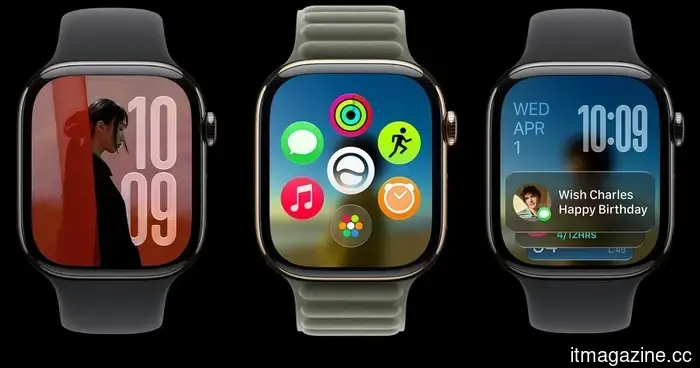 Apple clarifies the situation regarding watchOS 27 not being available for several models, partly attributing the decision to AI.
Apple's watchOS team clarified the reason behind the exclusion of five models from watchOS 27, attributing it directly to the hardware requirements of Siri AI.
Apple clarifies the situation regarding watchOS 27 not being available for several models, partly attributing the decision to AI.
Apple's watchOS team clarified the reason behind the exclusion of five models from watchOS 27, attributing it directly to the hardware requirements of Siri AI.
Researchers at Wharton introduced the term 'cognitive surrender' to characterize the phenomenon where individuals allow AI to take over their thinking.
A study from Wharton revealed that individuals accept incorrect AI responses 80% of the time, especially with applications like Moot that allow five AI personas to weigh in on personal decisions.