
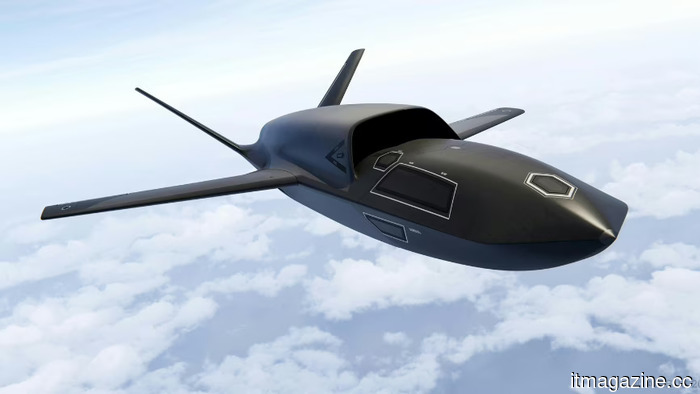
With Europe increasing its military capabilities, the 'wingman' drone is prominently featured at the Berlin airshow.
The aircraft that attracted attention at last week’s Berlin airshow was not the one featuring a pilot. The "loyal wingman," an unmanned jet designed to accompany a crewed fighter and carry additional sensors, jammers, and weapons that the fighter itself cannot, has become a focal point for European defense, with four companies presenting their versions of it.
Airbus, Boeing, Helsing, and General Atomics each showcased a rendition of this concept to Germany’s military and neighboring procurement officials. The central idea remains consistent across all models: pair a limited number of costly crewed jets with a greater number of affordable autonomous aircraft, allowing the drones to take on risks in air-to-air, air-to-ground, and electronic warfare missions, thus enhancing the effectiveness of a single pilot.
The conflict in Ukraine, where drones and electronic warfare have rapidly transformed the battlefield beyond prior expectations, underpins the rationale for this category. Airbus made a bold impression by introducing its U760 Ravenstorm, an uncrewed collaborative combat aircraft built to function alongside crewed fighters like the Eurofighter Typhoon.
The European company effectively operates two programs simultaneously: the U740 Valkyrie, a near-term option based on the American XQ-58A, aiming for German deployment by 2029, and the more ambitious Ravenstorm, envisioned as a long-term solution expected in the early 2030s. This dual approach—quick and borrowed now, self-sufficient and advanced later—reflects Europe’s predicament. The continent desires its own cutting-edge defense technology and wants operational capabilities before the decade concludes, yet these objectives do not align on the same timeline. Consequently, the market is filled with competing designs at various stages of development.
The most notable participant is one without any aviation roots. Helsing, a software firm from Munich, has capitalized on the rearmament trend, becoming one of Europe’s five most valuable private tech companies, valued at around €12 billion, by arguing that modern combat aircraft's crucial element is its software, not its structure. Helsing has already teamed up with Mistral to form a European defense-AI alliance, and its presence in Berlin placed a software company alongside traditional airframe manufacturers it aims to surpass.
The established players are not remaining idle. Boeing is enhancing its Ghost Bat drone to compete specifically against newer entrants in Germany, while General Atomics is modifying an American loyal-wingman prototype to meet European needs. Competition is a key element; Berlin and its neighbors prefer multiple suppliers rather than a single entity holding pricing power.
None of these aircraft are currently deployed in frontline service. The Valkyrie has a target year of 2029, the Ravenstorm aims for the early 2030s, and most competing programs occupy a similar timeline. What Berlin displayed was not a fleet but rather a field of competitors, reflecting a Europe that has realized, after Ukraine, that it cannot rely on foreign sources for this category of technology.
Other articles
 1Password acquires Apono to manage access for AI agents.
1Password has purchased the Israeli startup Apono, with reports estimating the deal to be worth between $250 million and $300 million, to manage access for humans, machines, and AI agents within company systems.
1Password acquires Apono to manage access for AI agents.
1Password has purchased the Israeli startup Apono, with reports estimating the deal to be worth between $250 million and $300 million, to manage access for humans, machines, and AI agents within company systems.
 France’s intelligence agency is replacing Palantir with a domestically developed competitor.
The DGSI will substitute Palantir’s data tools with ChapsVision’s ArgonOS, just six months after extending the American company’s contract.
France’s intelligence agency is replacing Palantir with a domestically developed competitor.
The DGSI will substitute Palantir’s data tools with ChapsVision’s ArgonOS, just six months after extending the American company’s contract.
 SailPoint is acquiring Entro to enhance its Agentic Fabric.
SailPoint intends to acquire Entro, based in Tel Aviv, for approximately $200 million, aiming to enhance its Agentic Fabric platform with non-human identity discovery capabilities.
SpaceX surpasses Amazon as its post-IPO surge continues.
On Tuesday, SpaceX's value surged by over 10%, bringing it close to $2.8 trillion and surpassing Amazon, just days after the biggest IPO ever.
SailPoint is acquiring Entro to enhance its Agentic Fabric.
SailPoint intends to acquire Entro, based in Tel Aviv, for approximately $200 million, aiming to enhance its Agentic Fabric platform with non-human identity discovery capabilities.
SpaceX surpasses Amazon as its post-IPO surge continues.
On Tuesday, SpaceX's value surged by over 10%, bringing it close to $2.8 trillion and surpassing Amazon, just days after the biggest IPO ever.
 SoftBank and OpenAI introduce 'Patching as a Service' in Japan.
SoftBank and OpenAI have introduced 'Patching as a Service', a tool powered by OpenAI designed to identify and address cybersecurity vulnerabilities in Japan's critical infrastructure companies.
SoftBank and OpenAI introduce 'Patching as a Service' in Japan.
SoftBank and OpenAI have introduced 'Patching as a Service', a tool powered by OpenAI designed to identify and address cybersecurity vulnerabilities in Japan's critical infrastructure companies.
 France will allocate €655 million towards artificial intelligence and establish a unified chatbot for the entire civil service.
Prime Minister Sebastien Lecornu has committed €655 million for artificial intelligence, which includes funding for a sovereign chatbot intended for approximately one million employees of the French state.
France will allocate €655 million towards artificial intelligence and establish a unified chatbot for the entire civil service.
Prime Minister Sebastien Lecornu has committed €655 million for artificial intelligence, which includes funding for a sovereign chatbot intended for approximately one million employees of the French state.
With Europe increasing its military capabilities, the 'wingman' drone is prominently featured at the Berlin airshow.
At the Berlin airshow, AI-operated ‘loyal wingman’ drones took center stage as Airbus, Boeing, Helsing, and General Atomics showcased their offerings to European armed forces.