
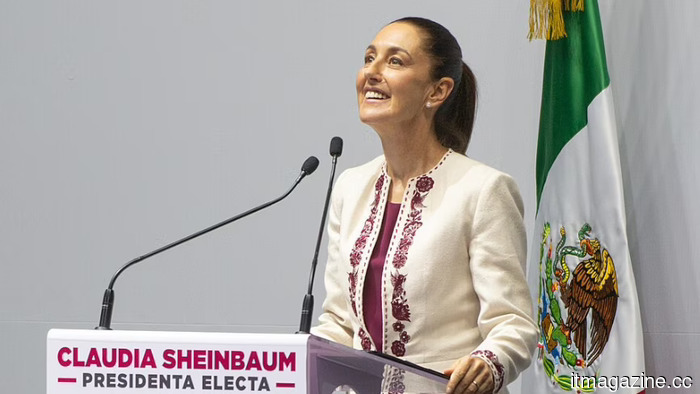
Mexico introduces Olinia Uno, a government-supported electric vehicle priced at $8,600.
**TL;DR** The government-supported electric vehicle startup Olinia in Mexico introduced its first prototype, the Olinia Uno, during an event attended by President Claudia Sheinbaum. This six-seat vehicle is intended for urban settings, has a top speed of 50 km/h, features a 14.7 kWh battery providing a range of 125 km, and is expected to retail for around 150,000 pesos ($8,600) when deliveries commence in summer 2027. A cargo version is anticipated to launch in July.
Olinia's prototype, the six-seat Olinia Uno, was showcased at a ceremony where President Claudia Sheinbaum drove it onto the stage at a Mexican Air Force hangar north of Mexico City. Priced at 150,000 pesos (approximately $8,600), this vehicle is meant for short urban trips instead of highway driving.
“For a long time, people have said Mexico was only meant to produce what others envisioned,” Sheinbaum remarked to an audience that included many engineers and designers from the project. “Olinia demonstrates that Mexico can achieve much more.”
The Olinia Uno does not directly compete with brands like Tesla or BYD. It is designed as a low-speed vehicle restricted to 50 km/h, catering to city commutes, last-mile transport, and replacements for taxis in densely populated areas. The 14.7 kWh battery allows for over 125 kilometers of range per charge and can be charged using any standard household outlet, eliminating the need for specialized charging infrastructure.
Operating costs form a key part of Olinia's appeal. Event data indicated that the Olinia Uno costs about 0.49 pesos per kilometer to operate, contrasted with 2.40 pesos per kilometer for similar gasoline vehicles, resulting in annual savings exceeding 50,000 pesos for regular urban drivers.
The project was developed over 18 months with contributions from Mexico’s National Polytechnic Institute, the National Technological Institute of Mexico, and experts from China, the USA, India, and Germany. Currently, Olinia uses 50% domestic components, aiming to reach 75% national content by 2030.
Sheinbaum, previously a climate scientist, has positioned the initiative as part of Mexico’s broader ecological shift, combining industrial policy and environmental goals. The vehicle aims to update outdated taxi fleets and offer zero-emission transport in urban areas grappling with air quality issues.
A prototype of the Olinia Cargo, a small pickup truck variant for commercial purposes, will be revealed in July, with sales of the passenger model slated for summer 2027. The government plans to set up 2,000 to 3,000 charging stations throughout Mexico City and surrounding states by the end of next year, according to Olinia's chief Roberto Capuano.
The timing is significant as Mexico becomes a key player in the global EV supply chain. Chinese manufacturers like BYD and GAC are expanding operations in Mexico, while Stellantis is considering the production of Chinese-designed Leapmotor EVs in North America, potentially targeting the Mexican market. Currently, Chinese vehicles comprise a quarter of total car sales in Mexico.
Olinia is positioned in a different market segment altogether. At $8,600, it is considerably cheaper than even the most affordable Chinese imports and aims at consumers reliant on older combustion vehicles or public transportation. Its closest comparison is the low-speed electric vehicles commonly seen in Chinese cities, used by urban commuters not requiring highway capabilities.
The scalability of Olinia remains uncertain. While it has government support, it lacks an established manufacturing base and the 2027 sales timeline could see delays. Mexico’s auto industry is primarily focused on foreign assembly rather than domestic brands. The last significant effort to produce a Mexican-designed vehicle was the Mastretta MXT sports car, which made limited production in 2011 before going silent.
However, Olinia's goals are more modest and potentially more feasible. Instead of striving for global brand recognition, it aims to introduce a practical and affordable electric vehicle on Mexican streets, developed with local engineering, at a price point unmatched by any imported EV. In a market where the cheapest Chinese EVs start at around $15,000, this pricing strategy highlights the project's strongest advantage.
Other articles
 5 iPhone applications I can't do without in 2026
From swift searches to classic gaming, these five apps have secured a lasting place on my iPhone. Some may be familiar to you, while others might be new, but each is definitely worth downloading today.
5 iPhone applications I can't do without in 2026
From swift searches to classic gaming, these five apps have secured a lasting place on my iPhone. Some may be familiar to you, while others might be new, but each is definitely worth downloading today.
 I requested ChatGPT to restore an image, and it created an image of a man with a fish head and no clothes.
If you ever contemplate what ChatGPT imagines when you request it to recreate a fictional image, the outcomes might surprise you. I attempted it myself, and I now have regrets about that choice.
I requested ChatGPT to restore an image, and it created an image of a man with a fish head and no clothes.
If you ever contemplate what ChatGPT imagines when you request it to recreate a fictional image, the outcomes might surprise you. I attempted it myself, and I now have regrets about that choice.
 Spotify is securing licenses for live concert videos and setting aside tickets for dedicated fans.
Spotify is negotiating with concert promoters to broadcast live festival recordings and has established a multi-year agreement with Live Nation to set aside tickets for its biggest fans.
Spotify is securing licenses for live concert videos and setting aside tickets for dedicated fans.
Spotify is negotiating with concert promoters to broadcast live festival recordings and has established a multi-year agreement with Live Nation to set aside tickets for its biggest fans.
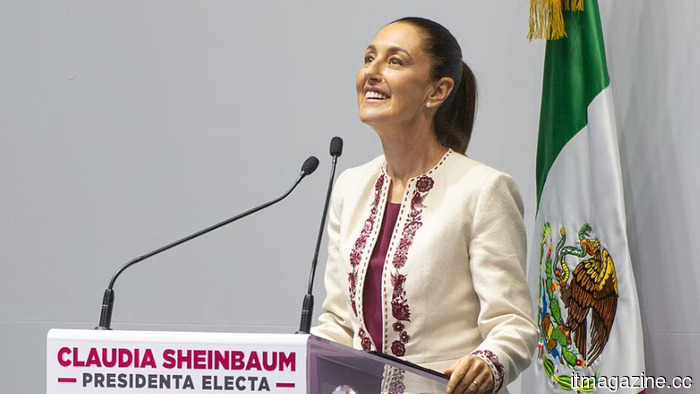 Mexico introduces Olinia Uno, an $8,600 electric vehicle supported by the government.
President Sheinbaum showcased the six-seat Olinia Uno prototype by driving it onto a stage in Mexico City. This government-supported electric vehicle is priced at 150,000 pesos, roughly equivalent to $8,600.
Mexico introduces Olinia Uno, an $8,600 electric vehicle supported by the government.
President Sheinbaum showcased the six-seat Olinia Uno prototype by driving it onto a stage in Mexico City. This government-supported electric vehicle is priced at 150,000 pesos, roughly equivalent to $8,600.
 Nvidia and SK Hynix finalize a multi-year agreement for HBM4 AI memory.
Nvidia and SK Hynix have entered into a multi-year agreement to collaboratively develop AI memory for Vera Rubin and future projects, as memory stands as the most significant bottleneck in the AI sector.
Nvidia and SK Hynix finalize a multi-year agreement for HBM4 AI memory.
Nvidia and SK Hynix have entered into a multi-year agreement to collaboratively develop AI memory for Vera Rubin and future projects, as memory stands as the most significant bottleneck in the AI sector.
 Spotify is obtaining licenses for live concert videos and setting aside tickets for passionate fans.
Spotify is negotiating with concert promoters to broadcast live festival footage and has formed a multi-year agreement with Live Nation to secure tickets for its most dedicated fans.
Spotify is obtaining licenses for live concert videos and setting aside tickets for passionate fans.
Spotify is negotiating with concert promoters to broadcast live festival footage and has formed a multi-year agreement with Live Nation to secure tickets for its most dedicated fans.
Mexico introduces Olinia Uno, a government-supported electric vehicle priced at $8,600.
President Sheinbaum showcased the six-seat Olinia Uno prototype on a stage in Mexico City. This government-supported electric vehicle is priced at 150,000 pesos, which is approximately $8,600.