
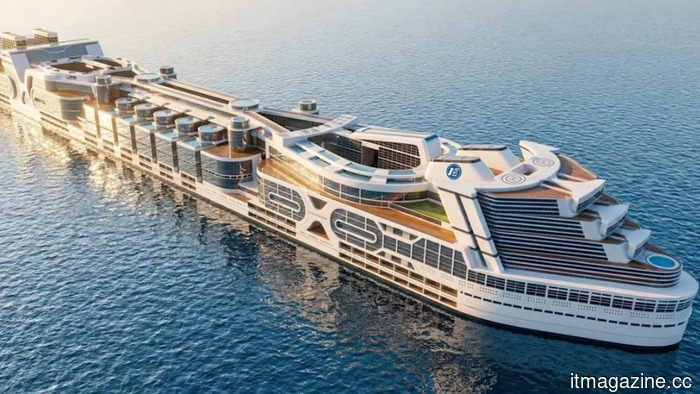
Freedom Ship: the maritime city that's been anticipated for three decades
**TL;DR** The Freedom Ship, a nuclear-powered vessel designed to accommodate 80,000 people, has been revived with new leadership and updated designs, carrying a £12 billion price tag. This concept has been on the verge of development since the 1990s, yet it lacks secured funding.
The renderings are stunning. This mile-long ship, 800 feet wide and 30 decks high, would sail the high seas with parks, schools, a 15,000-seat sports stadium, and residential areas for 50,000 long-term occupants. It’s designed to be nuclear-powered, continuously sailing around the globe without docking at ports. Essentially, it represents a floating city.
Since the 1990s, the Freedom Ship has been proposed, revised, shelved, and revived so many times that Newsweek recently remarked that the headline announcing its future construction has circulated in nearly the same form across three decades. Currently, it is back in focus, led by Freedom Cruise Line CEO Roger Gooch, who has formed a leadership team of 12 and tasked arcologist Kevin Schopfer with creating new designs.
“We are very confident in our ability to make this happen, but securing funding is crucial,” Gooch stated to the Telegraph.
**What the ship would entail**
This 2.3 million gross-ton vessel would house 50,000 residents, provide space for 10,000 tourists and day visitors, and accommodate a crew of 20,000. Proposed facilities include high-rise hotels, a convention center, a water park, two museums, a symphony hall, a casino, a dive-able aquarium, and nightclubs. Children would be educated from primary through secondary grades, with references to postsecondary opportunities as well.
Too large to dock in any current port, the Freedom Ship would operate in international waters, using ferries or helicopters to transport passengers from eight helipads. Residents would navigate between districts via a tram system linking 15 miles of walkways and three acres of parks. The plan expects the ship to circumnavigate every two to two-and-a-half years at a gentle speed of seven knots.
Construction is slated to take place in Indonesia, starting with the hull built in sections and put together offshore. Gooch has indicated that residents could begin moving onboard midway through the estimated three-to-four-year construction period, with all maintenance conducted at sea.
**The funding challenge**
The projected cost is £12 billion ($16.16 billion), yet there is no confirmed funding available. The initial concept was introduced in the 1990s by American engineer Norman Nixon, who passed away in 2012 without any physical development occurring. The designs were revisited publicly in 2013 but were shelved yet again.
Gooch maintains that there is substantial demand, claiming, “We could nearly justify constructing three ships.” Revenue would be generated through residential sales, commercial leases, and tourism. “We want entrepreneurs to lease or purchase space from us, similar to what occurs in land-based communities,” he stated. The holding company would retain ownership of the casino and a “state-of-the-art” research hospital, which Gooch claims has garnered interest from medical research institutions since the ship would function beyond the reach of national regulations.
That last aspect, a floating hospital specifically situated outside regulatory oversight, warrants consideration.
**Challenges of building floating cities**
The Freedom Ship falls into a category of megaprojects that are both too ambitious to disregard yet too lofty to financially sustain. For example, Saudi Arabia’s NEOM Line, a 170km mirrored city in the desert, exhibits the same pattern: impressive designs, exorbitant costs, and a disconnect between vision and reality that no amount of zeal has managed to bridge.
The engineering hurdles are immense. A vessel of this magnitude has never been built before. Nuclear propulsion for civilian maritime use remains largely theoretical outside military settings, and there is no regulatory framework for a nuclear-powered residential ship with tens of thousands of civilians on board. Governance, taxation, law enforcement, and liability issues in international waters pose challenges that no blueprint can resolve.
Currently operational residential ships are significantly smaller: The World, catering to millionaires with fewer than 200 residences, and the Villa Vie Odyssey, which is a more affordable option but has faced its own notable challenges to remain functional.
**The enduring aspiration**
Sridev Mookerjea, the project manager based in Singapore, brings 30 years of expertise in managing passenger and casino ships. “Perseverance and determination are essential for achieving goals in this world,” he shared with the Telegraph over green tea at London’s St Katharine Docks. “I believe that with Roger’s commitment, patience, and ambition for success, the possibilities are limitless.”
Perhaps. However, the Freedom Ship has been consistently "a year away from breaking ground" for longer than many modern billion-dollar enterprises have existed. At some point, a substantial financial commitment must be
Other articles
 Meta provides a 30-minute break on employee monitoring following criticism.
Meta has reduced its MCI keystroke tracking program following a petition signed by 1,500 employees. Workers are now able to pause the tracking for a duration of 30 minutes.
Meta provides a 30-minute break on employee monitoring following criticism.
Meta has reduced its MCI keystroke tracking program following a petition signed by 1,500 employees. Workers are now able to pause the tracking for a duration of 30 minutes.
 Monako Glass transforms smart glasses into an incredibly unique coding workstation.
Monako Glass integrates Linux and AI coding-agent support into smart glasses, but its success hinges on its ability to simplify developer tasks without claiming to substitute for a laptop.
Monako Glass transforms smart glasses into an incredibly unique coding workstation.
Monako Glass integrates Linux and AI coding-agent support into smart glasses, but its success hinges on its ability to simplify developer tasks without claiming to substitute for a laptop.
 The AI fitness coach detects muscle movements while you work out and helps prevent beginner injuries.
BioCoach is an innovative AI prototype that observes your workouts via your camera, creates a 3D model of your skeleton, and advises you on which joint angles need adjustment.
The AI fitness coach detects muscle movements while you work out and helps prevent beginner injuries.
BioCoach is an innovative AI prototype that observes your workouts via your camera, creates a 3D model of your skeleton, and advises you on which joint angles need adjustment.
 Upwind, the next-generation Wiz, now covers every aspect of the AI stack.
Upwind contends that AI security cannot be treated as a separate category. Its latest product integrates AI threat detection into all levels of cloud security, encompassing code pipelines, MCP servers, and runtime behavior.
Upwind, the next-generation Wiz, now covers every aspect of the AI stack.
Upwind contends that AI security cannot be treated as a separate category. Its latest product integrates AI threat detection into all levels of cloud security, encompassing code pipelines, MCP servers, and runtime behavior.
 CEO of Databricks: The year 2026 is
Databricks CEO Ali Ghodsi announces that the $134 billion company will forgo IPOs in 2026 as SpaceX, Anthropic, and OpenAI attract over $200 billion in public investment.
CEO of Databricks: The year 2026 is
Databricks CEO Ali Ghodsi announces that the $134 billion company will forgo IPOs in 2026 as SpaceX, Anthropic, and OpenAI attract over $200 billion in public investment.
 Upwind, the next-generation Wiz, now covers every aspect of the AI stack.
Upwind contends that AI security cannot be added as a separate element. Its latest product integrates AI threat detection throughout all levels of cloud security, encompassing code pipelines, MCP servers, and runtime behavior.
Upwind, the next-generation Wiz, now covers every aspect of the AI stack.
Upwind contends that AI security cannot be added as a separate element. Its latest product integrates AI threat detection throughout all levels of cloud security, encompassing code pipelines, MCP servers, and runtime behavior.
Freedom Ship: the maritime city that's been anticipated for three decades
The Freedom Ship, a nuclear-powered vessel measuring a mile in length and capable of holding 80,000 residents, has returned with updated renderings and a price of £12 billion, though funding is not yet secured.