
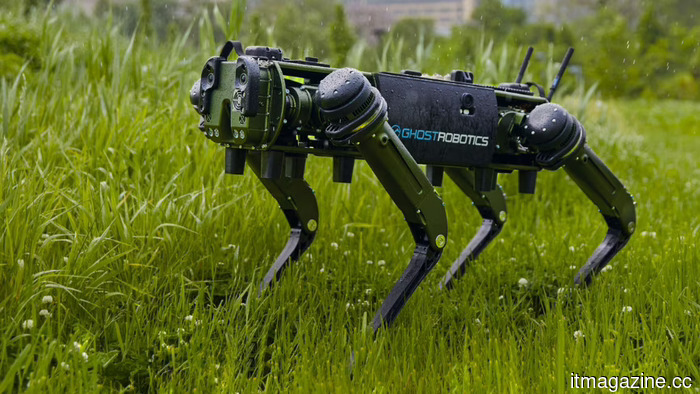
Taiwan unveils robotic patrol dogs capable of securing its islands in the South China Sea.
A military research institute showcased three variations of a four-legged robot, one of which is armed, for potential use at remote outposts where the coast guard faces staffing challenges.
On Monday, Taiwan's primary weapons development institute put three robotic dogs through their trials, presenting them as a possible solution to the difficult issue of monitoring small, isolated islands in the South China Sea without increasing the number of personnel stationed there.
The National Chung-Shan Institute of Science and Technology, which is owned by the military, displayed three different versions of a four-legged robot manufactured by Ghost Robotics, a US company specializing in quadrupedal machines, according to Reuters.
The institute has equipped the robots with its own technology for three functions: reconnaissance, surveillance, and combat capability. The combat version is particularly noteworthy as it is equipped with a gun mounted on its back, which positions these machines in a gray area between being a surveillance tool and a weapon.
Ghost Robotics has not restricted the weaponization of its quadrupeds, distinguishing it from some competitors, and this flexibility has allowed its robots to be integrated into military programs that would not align with Boston Dynamics' policies. Taiwan’s marines have expressed a significant need for robotic systems that can conduct patrols and inspections along beaches and coastlines in the Spratlys and Pratas, the two contested island groups.
The geographic context is crucial. Taiwan governs Itu Aba, also known as Taiping, the largest natural island in the Spratlys, and also controls the Pratas, located at the northern end of the South China Sea, which are protected by the coast guard in peacetime rather than the military. Both island groups are small, remote, and costly to maintain with a human presence.
A robot capable of patrolling a perimeter in harsh conditions without the need for rest, rotation, or a supply chain beyond recharging its power source is, in theory, ideally suited for this type of assignment.
The situation occurs against a backdrop of increasing maritime tensions. Taiwan has raised concerns about a growing number of Chinese coast guard patrols and even drones operating near the Pratas, as part of Beijing's broader campaign of pressure against Taiwan, which it claims as its territory.
Unmanned systems have become a significant element in this ongoing contest for both sides; Chinese forces have conducted trials of armed robotic dogs and small drones in amphibious exercises near Taiwan over the past year.
Currently, this presentation remains a demonstration rather than an actual deployment. According to Reuters, the military has expressed a need for the robots but has not yet issued a formal order, leaving the timeline, quantities, and the possibility of the armed variant actually being deployed open-ended.
Robotic quadrupeds are gradually being integrated into military use globally, from the French Army's testing of Boston Dynamics’ Spot to a surge in funding for battlefield robots across Europe. Taiwan's interpretation of this concept is now developed, complete with an armed robotic model and specific islands in mind. However, it has yet to receive an order.
Other articles
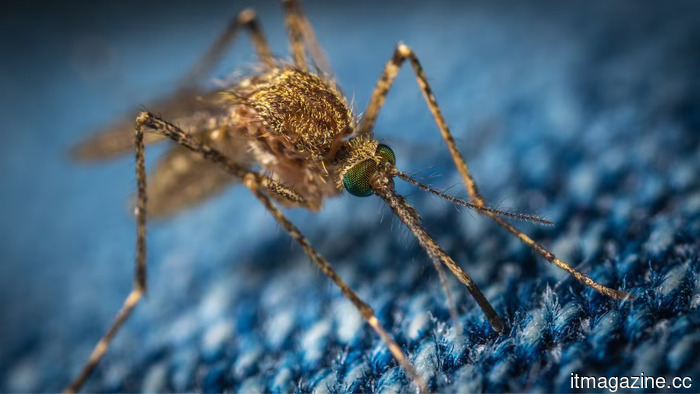 Google aims to deploy 32 million lab-grown mosquitoes to combat dengue and Zika viruses.
Alphabet's Verily seeks EPA authorization to deploy 64 million mosquitoes that carry Wolbachia in Florida and California, utilizing AI-driven sorting and breeding on an industrial scale.
Marvell sees an increase after Jensen Huang labels it the next trillion-dollar company.
Marvell's stock jumped approximately 25% in premarket trading after Nvidia's Jensen Huang forecasted at Computex that it would become the next $1 trillion company.
Google aims to deploy 32 million lab-grown mosquitoes to combat dengue and Zika viruses.
Alphabet's Verily seeks EPA authorization to deploy 64 million mosquitoes that carry Wolbachia in Florida and California, utilizing AI-driven sorting and breeding on an industrial scale.
Marvell sees an increase after Jensen Huang labels it the next trillion-dollar company.
Marvell's stock jumped approximately 25% in premarket trading after Nvidia's Jensen Huang forecasted at Computex that it would become the next $1 trillion company.
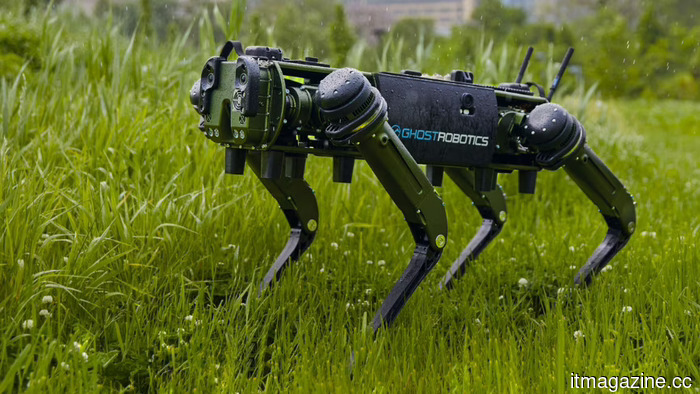 Taiwan unveils robotic patrol dogs that may protect its islands in the South China Sea.
Taiwan's military research institute showcased three Ghost Robotics robotic dogs, one of which is armed, that may eventually be utilized to patrol the Pratas and Itu Aba.
Taiwan unveils robotic patrol dogs that may protect its islands in the South China Sea.
Taiwan's military research institute showcased three Ghost Robotics robotic dogs, one of which is armed, that may eventually be utilized to patrol the Pratas and Itu Aba.
 Marvell rises after Jensen Huang labels it as the next trillion-dollar company.
Marvell's stock jumped approximately 25% in premarket trading following Nvidia's Jensen Huang's prediction at Computex that it would become the next $1 trillion company.
Marvell rises after Jensen Huang labels it as the next trillion-dollar company.
Marvell's stock jumped approximately 25% in premarket trading following Nvidia's Jensen Huang's prediction at Computex that it would become the next $1 trillion company.
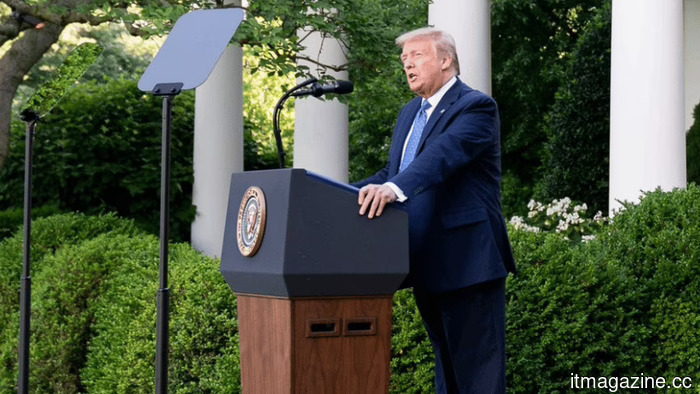 Internal disputes within the White House are hindering the progress of AI regulation in the U.S. following the Mythos incident.
A "knife fight" among Commerce, intelligence agencies, and pro-industry groups has stalled US AI policy, leading to Trump cancelling an executive order and leaving no established framework.
Internal disputes within the White House are hindering the progress of AI regulation in the U.S. following the Mythos incident.
A "knife fight" among Commerce, intelligence agencies, and pro-industry groups has stalled US AI policy, leading to Trump cancelling an executive order and leaving no established framework.
 Meta expands its 13+ teen content settings to a global level on Instagram, Facebook, and Messenger.
Meta is broadening its 13+ content settings inspired by movie ratings for Teen Accounts globally and is experimenting with a method to prevent teens from viewing the same content repeatedly.
Meta expands its 13+ teen content settings to a global level on Instagram, Facebook, and Messenger.
Meta is broadening its 13+ content settings inspired by movie ratings for Teen Accounts globally and is experimenting with a method to prevent teens from viewing the same content repeatedly.
Taiwan unveils robotic patrol dogs capable of securing its islands in the South China Sea.
Taiwan's military research institute showcased three robot dogs from Ghost Robotics, one of which is armed, that may eventually be used to patrol the Pratas and Itu Aba.