
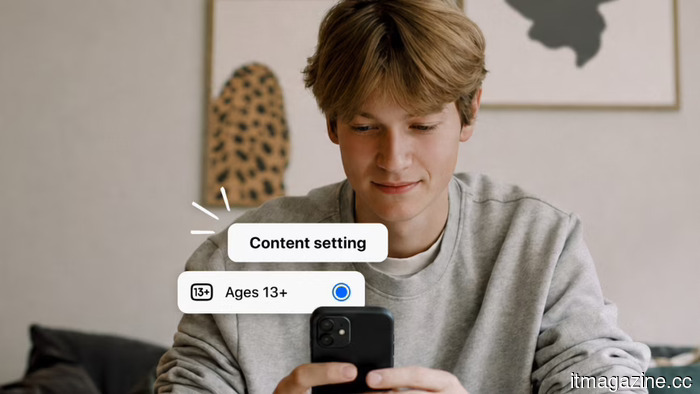
Meta expands its 13+ teen content settings to a global level on Instagram, Facebook, and Messenger.
Meta is expanding its “13+” content settings for Teen Accounts globally. The company announced that this setting, which it compares to a movie rating, will now be the default for teenagers on Instagram, Facebook, and Messenger worldwide, building on a system first rolled out last October in the US, UK, Australia, and Canada. According to Meta, nine out of ten teens have remained with the default setting since its introduction instead of opting to change it.
The purpose is to influence the default content that teens see. On Facebook, the new 13+ setting aims to conceal material that Meta considers unsuitable for teens in Feed and Reels, while also restricting their interactions with Profiles, Pages, Groups, and Events that mainly share such content.
In Messenger, this setting prevents teens from accessing links to inappropriate content or engaging with accounts that predominantly share it on Facebook. A more stringent option known as Limited Content, which is already available on Instagram, is set to be introduced on Facebook and Messenger later this year.
Meta has relied on parents to help define what is considered “appropriate.” The company reports that hundreds of thousands of parents have rated over 15 million content pieces, and in its latest survey conducted at the end of April, which involved parents from the US, UK, Australia, and Canada reviewing suggested Facebook posts, fewer than 2% were deemed inappropriate for teens by the majority of parents.
The framework draws from the Motion Picture Association’s public guidelines, although Meta emphasizes that the MPA does not rate or endorse its content.
Along with the rollout, Meta is testing a feature designed to prevent teens from being shown the same type of post repeatedly on Instagram. While content related to nutrition, weightlifting, or managing anxiety can be beneficial, the company believes it should not be presented too often, so it is experimenting with limits on how many such posts appear consecutively in Explore, Feed, and Reels.
This reflects a quiet recognition that a recommendation engine’s issues extend beyond just what it presents once but also include the relentless repetition of certain content.
To evaluate its effectiveness, Meta engaged Alice, a safety firm formerly known as ActiveFence, to conduct adversarial testing on the settings. According to Alice, Instagram Teen Accounts with the default mode encountered 68% less mature content compared to a competitor's unnamed teen experience, which increased to 96% less in the stricter Limited Content mode.
The assessment identified two areas needing improvement, including that “car surfing,” a newer viral trend, was not yet restricted in the same way as “subway surfing.” Meta stated it updated its policies and verified these adjustments before their announcement.
This expansion comes after years of scrutiny regarding how Meta's apps impact young users, from halting an “Instagram Kids” initiative to gradually introducing teen-safety features. The figures and the positive audit results are from Meta itself, and the company presents the announcement as a sign of progress. Whether parents, regulators, and teens themselves concur is a question that cannot be answered by any press release.
Other articles
 Meta's AI bot assisted hackers in stealing Instagram accounts, and it was alarmingly simple to deceive.
Instagram has fixed a major security vulnerability that allowed hackers to utilize Meta's AI support chatbot to gain access to accounts without needing the victim’s password or email.
Meta's AI bot assisted hackers in stealing Instagram accounts, and it was alarmingly simple to deceive.
Instagram has fixed a major security vulnerability that allowed hackers to utilize Meta's AI support chatbot to gain access to accounts without needing the victim’s password or email.
 Internal disputes within the White House are hindering the progress of AI regulation in the U.S. following the Mythos incident.
A "knife fight" among Commerce, intelligence agencies, and pro-industry groups has stalled US AI policy, leading to Trump cancelling an executive order and leaving no established framework.
Internal disputes within the White House are hindering the progress of AI regulation in the U.S. following the Mythos incident.
A "knife fight" among Commerce, intelligence agencies, and pro-industry groups has stalled US AI policy, leading to Trump cancelling an executive order and leaving no established framework.
 Taiwan unveils robotic patrol dogs capable of securing its islands in the South China Sea.
Taiwan's military research institute showcased three robot dogs from Ghost Robotics, one of which is armed, that may eventually be used to patrol the Pratas and Itu Aba.
Taiwan unveils robotic patrol dogs capable of securing its islands in the South China Sea.
Taiwan's military research institute showcased three robot dogs from Ghost Robotics, one of which is armed, that may eventually be used to patrol the Pratas and Itu Aba.
 As Microsoft approaches Build, it faces a challenge with AI integrated throughout its offerings and a dilemma regarding paying customers.
Microsoft kicks off its Build developer conference in San Francisco, aiming to integrate AI further into Windows and Copilot, although adoption remains uncertain.
Marvell sees an increase after Jensen Huang labels it the next trillion-dollar company.
Marvell's stock jumped approximately 25% in premarket trading after Nvidia's Jensen Huang forecasted at Computex that it would become the next $1 trillion company.
As Microsoft approaches Build, it faces a challenge with AI integrated throughout its offerings and a dilemma regarding paying customers.
Microsoft kicks off its Build developer conference in San Francisco, aiming to integrate AI further into Windows and Copilot, although adoption remains uncertain.
Marvell sees an increase after Jensen Huang labels it the next trillion-dollar company.
Marvell's stock jumped approximately 25% in premarket trading after Nvidia's Jensen Huang forecasted at Computex that it would become the next $1 trillion company.
 Amazon's Ring faces a lawsuit regarding its Familiar Faces facial-recognition technology.
A man from Virginia is taking legal action against Amazon regarding Ring's Familiar Faces feature, claiming it scans and retains the images of people's faces who are not authorized. He is requesting a minimum of $5 million in damages.
Amazon's Ring faces a lawsuit regarding its Familiar Faces facial-recognition technology.
A man from Virginia is taking legal action against Amazon regarding Ring's Familiar Faces feature, claiming it scans and retains the images of people's faces who are not authorized. He is requesting a minimum of $5 million in damages.
Meta expands its 13+ teen content settings to a global level on Instagram, Facebook, and Messenger.
Meta is broadening its 13+ content settings inspired by movie ratings for Teen Accounts globally and is experimenting with a method to prevent teens from viewing the same content repeatedly.