
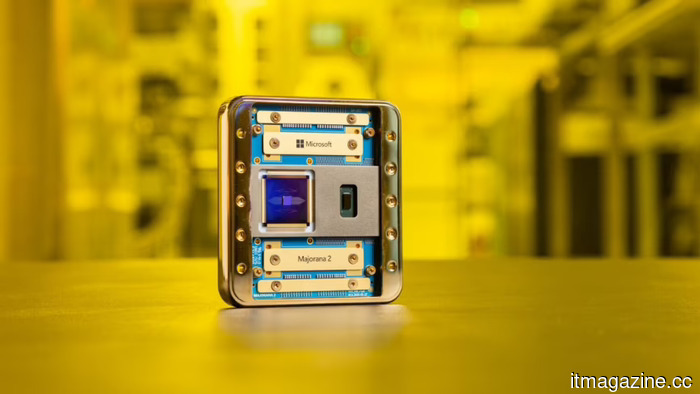
Microsoft's Majorana 2 quantum chip boasts a reliability improvement of 1,000 times and aims for a 2029 launch.
TL;DR: Microsoft introduced Majorana 2, a quantum chip with qubits that are 1,000 times more reliable than its predecessor, achieving a mean lifetime of 20 seconds compared to competitors' microseonds. The development was expedited by Agentic AI through Microsoft Discovery, and the company aims to achieve a scalable quantum computer by 2029, halving its original timeline.
Microsoft has announced Majorana 2, a new topological quantum chip with qubits that boast a reliability improvement of 1,000 times over those in the original Majorana chip released last year. This significant advancement has allowed Microsoft to revise its goal for a scalable quantum computer from 2033 to 2029, effectively cutting the timeline in half. The company attributes this rapid progress to the use of agentic AI, which has been integrated into its Microsoft Discovery research platform, facilitating advancements in materials science, fabrication optimization, and measurement automation.
The results are impressive. Majorana 2’s qubits sustain their quantum state with a mean lifetime of 20 seconds, with some qubits lasting up to one minute. In contrast, most other quantum approaches report qubit lifetimes measured in microseconds. Microsoft likens the advancement to a phone battery that lasts three years on a single charge instead of depleting in a day. Coupled with one-microsecond operations and qubit dimensions of just 1/100th of a millimeter, the chip positions Microsoft on a trajectory toward commercially viable quantum computing by the decade's end.
How agentic AI enhanced chip performance
A crucial change in materials involved switching from aluminum to lead as the superconductor. Lead naturally protects qubits from cosmic disturbances that can cause instability, but its use presented challenges that took years to address. Quantum computing startups across Europe and the US are exploring various solutions to the qubit stability issue, yet Microsoft’s topological method, which establishes an entirely new state of matter, differs architecturally from the superconducting circuits favored by IBM, Google, and other competitors.
Microsoft Discovery's AI agents were incorporated throughout the quantum team’s workflow in several beneficial ways. They automated a measurement process that previously took weeks when done manually, drastically reducing the time required. The agents analyzed nearly two decades of experimental data from various sources, uncovering correlations that individual researchers would have missed. They optimized fabrication techniques by running simulations to identify the most promising material compositions prior to physical tests. Additionally, they identified an uncalibrated temperature sensor that was causing noise in the fabrication process, a flaw that had escaped human detection.
“Agentic AI has become integral to nearly all our activities,” said Chetan Nayak, a technical fellow at Microsoft. The fusion of AI with quantum hardware development could significantly accelerate the entire field, as improved AI facilitates the creation of better quantum computers, which could enhance AI's performance in the future.
Microsoft Discovery goes public
In conjunction with the Majorana 2 announcement, Microsoft made its Discovery platform publicly available. This platform allows organizations to deploy teams of autonomous AI agents, directed by human expertise, to expedite scientific research and development. It features a Discovery Engine for research and reasoning workflows, along with enterprise-grade security and governance, and is integrated with Azure. While companies like Google, Anthropic, and OpenAI are pursuing AI for scientific purposes, Microsoft is the first to offer a commercially available platform specifically designed for cutting-edge research and development with built-in agent orchestration.
Microsoft also rolled out a free Discovery app in early preview, enabling individuals to download and run it locally using a GitHub Copilot account. Clients such as chemical company Syensqo are already leveraging the platform to create next-generation fluids for semiconductor production.
The competitive landscape
The quantum computing sector is witnessing a surge in funding and initial public offerings. Quantinuum’s recent IPO was massively oversubscribed, valuing the Honeywell-backed firm at $14.3 billion. In May, the US government allocated $2 billion to quantum companies, with IBM receiving a $1 billion investment for its Anderon quantum chip foundry. Focused Energy secured $240 million for laser fusion initiatives. The market appears to be anticipating that quantum computing will follow the trajectory of AI from experimental curiosity to commercial viability within this decade.
Microsoft’s topological method has been notably controversial within the field. The company’s 2018 assertion of having observed Majorana zero modes was retracted after independent evaluation. Majorana 1, launched in 2025, successfully restored credibility with peer-reviewed findings. The dramatic improvements seen in Majorana 2 and the revised 2029 target will undergo similar scrutiny, and the peer-reviewed paper that accompanies the announcement will serve as a conclusive test of whether the results can be validated.
Given the energy and computational requirements of AI, the potential of quantum computing has never been more relevant commercially. If Microsoft succeeds in delivering a scalable topological quantum computer by 2029, its applications in drug discovery, materials
Other articles
 Microsoft announces Project Solara: an operating system designed for agent-first devices.
Microsoft's Project Solara is an innovative platform designed for devices that utilize AI agents rather than traditional apps. Currently, two concept designs—a badge and a desk device—are being tested in partnership with Best Buy, CVS, Levi's, and Target.
Microsoft announces Project Solara: an operating system designed for agent-first devices.
Microsoft's Project Solara is an innovative platform designed for devices that utilize AI agents rather than traditional apps. Currently, two concept designs—a badge and a desk device—are being tested in partnership with Best Buy, CVS, Levi's, and Target.
 EXCLUSIVE: Obsession Star Megan Lawless Discusses Sarah’s Unexpected Destiny, Audience Reactions, and Future Plans
In a unique interview, Obsession star Megan Lawless talks about Sarah's unexpected demise, the film's remarkable success, her camaraderie with Inde Navarrette, and her future plans.
EXCLUSIVE: Obsession Star Megan Lawless Discusses Sarah’s Unexpected Destiny, Audience Reactions, and Future Plans
In a unique interview, Obsession star Megan Lawless talks about Sarah's unexpected demise, the film's remarkable success, her camaraderie with Inde Navarrette, and her future plans.
 Poland implements
The Polish Prime Minister, Tusk, has declared a sovereignty assessment for state technology purchases and will issue yearly reports on IT independence, cautioning that reliance on foreign AI poses risks to both security and the economy.
Poland implements
The Polish Prime Minister, Tusk, has declared a sovereignty assessment for state technology purchases and will issue yearly reports on IT independence, cautioning that reliance on foreign AI poses risks to both security and the economy.
 Microsoft's Majorana 2 quantum chip boasts reliability that is 1,000 times greater, with a goal set for 2029.
Microsoft's Majorana 2 qubits can last 20 seconds, compared to microseconds for competitors, and are developed using agentic AI. The company is now aiming to create a scalable quantum computer by 2029.
Microsoft's Majorana 2 quantum chip boasts reliability that is 1,000 times greater, with a goal set for 2029.
Microsoft's Majorana 2 qubits can last 20 seconds, compared to microseconds for competitors, and are developed using agentic AI. The company is now aiming to create a scalable quantum computer by 2029.
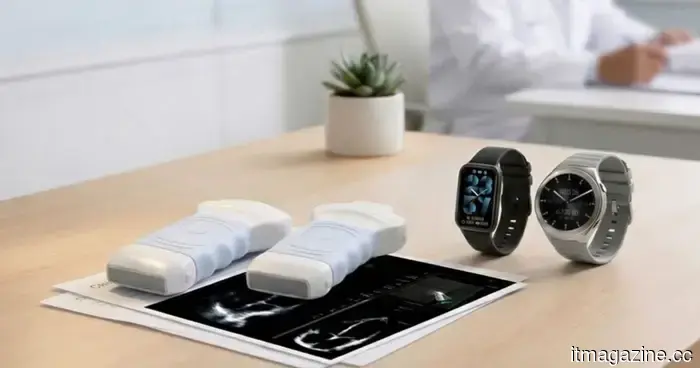 Asus Vivowatch 6 Plus debuts featuring blood pressure monitoring and ECG capabilities, accompanied by a wellness coach.
ASUS has introduced the VivoWatch 6, which includes ECG monitoring, blood pressure monitoring, AI wellness coaching, and a range of advanced health-oriented features.
Asus Vivowatch 6 Plus debuts featuring blood pressure monitoring and ECG capabilities, accompanied by a wellness coach.
ASUS has introduced the VivoWatch 6, which includes ECG monitoring, blood pressure monitoring, AI wellness coaching, and a range of advanced health-oriented features.
 Hackers forcefully bypassed Dashlane's two-factor authentication and accessed encrypted vaults.
Attackers managed to circumvent Dashlane's two-factor authentication on fewer than 20 accounts by brute-forcing numeric codes and downloading encrypted password vaults. Data is safeguarded by zero-knowledge encryption, provided that the master passwords are robust.
Hackers forcefully bypassed Dashlane's two-factor authentication and accessed encrypted vaults.
Attackers managed to circumvent Dashlane's two-factor authentication on fewer than 20 accounts by brute-forcing numeric codes and downloading encrypted password vaults. Data is safeguarded by zero-knowledge encryption, provided that the master passwords are robust.
Microsoft's Majorana 2 quantum chip boasts a reliability improvement of 1,000 times and aims for a 2029 launch.
Microsoft's Majorana 2 qubits have a duration of 20 seconds, compared to microseconds for competitors, and are developed using agentic AI. The company aims to achieve a scalable quantum computer by 2029.