
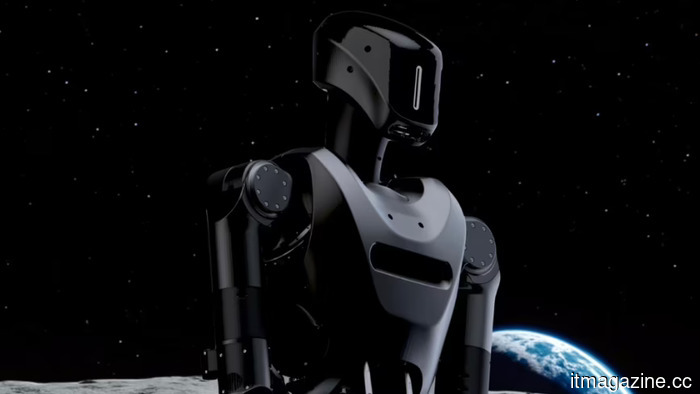
A startup advised by Eric Trump is conducting tests on humanoid robots in Ukraine, aiming to deploy them on US front lines within 18 months.
**TL;DR** Foundation Future Industries has dispatched humanoid robots to Ukraine and has secured $24 million in contracts with the Pentagon. Eric Trump serves as the chief strategy adviser, which has prompted Warren to label the situation as “corruption.”
Foundation Future Industries, a startup based in San Francisco that was established in 2024, sent two Phantom MK-1 humanoid robots to Ukraine earlier this year. This is considered the first documented use of humanoid robots in a combat zone. The tests, which were supported by the US government and conducted alongside Ukrainian officials, were aimed at logistics in hazardous locations.
CEO Sankaet Pathak informed CNBC that the MK-1 tests demonstrated the robots' capability in performing supply pickups that currently put soldiers at risk. Each robot can carry about 44 pounds, but they lack waterproofing and adequate battery life for prolonged use.
The company plans to send enhanced Phantom 2 units to Ukraine later this year, which Pathak claims will possess “superhuman abilities” and have double the payload capacity. They aim to deploy these robots on the front lines with the US military within 12 to 18 months.
The political aspect cannot be overlooked. Eric Trump, the second son of the current president, has recently taken on the role of chief strategy adviser at Foundation. The company has received $24 million in government contracts from the Army, Navy, and Air Force for feasibility studies concerning inspection, logistics, and weapons handling.
Democratic Senator Elizabeth Warren has accused these contracts of representing “corruption in plain sight.” A spokesperson for Foundation clarified to CNBC that Eric Trump had invested in the company before transitioning to an advisory role. Both parties aim to revitalize manufacturing in the US.
Pathak is also known for his leadership at Synapse, a fintech platform that filed for bankruptcy in 2024. Foundation has come under scrutiny for alleging strong ties to General Motors, which GM has since denied. The company's credibility is in question.
The military's rationale for using humanoid robots revolves around urban combat situations. "Modern urban combat spaces, with stairwells, ladders, basements, and tight corridors, were designed for human movement," noted Kateryna Bondar, a senior fellow at CSIS. Humanoid systems may have advantages over tracked or quadruped robots in these environments.
However, there are arguments against this approach citing cost and complexity. “Designing robots to resemble humans is a complicated and costly engineering task,” explained Melanie Sisson from the Brookings Foreign Policy program. “What the situation in Ukraine has highlighted is the need for rapid adaptation and cost-effective manufacturing.”
Ukraine's conflict has emerged as a primary testing venue for AI and robotics in warfare. Ground robots are supplying the front lines, while autonomous drones execute precision strikes. This conflict generates operational data unattainable through peacetime testing.
The European defense-tech industry is advancing more quickly on autonomous strike systems. For example, Berlin’s Stark is raising €300 million at a €2.5 billion valuation for kamikaze drones, while Destinus produces 2,000 cruise missiles annually through a partnership with Rheinmetall. These companies create purpose-built armaments, whereas Foundation is attempting to have a humanoid perform similar functions.
Pathak stated that weaponized uses of the Phantom robots will involve human confirmation in the decision-making process. In urgent scenarios, however, the robots will need the ability to make completely autonomous decisions. The ethical ramifications of autonomous lethal decision-making remain a topic of international debate.
Foundation has significant ambitions, aiming to ramp up production to thousands of units this year. The goal is to provide the US military with “the best robots we can build” that surpass anything available from China. China maintains its own prominent humanoid firms and has state-backed military robotics programs, though the specifics of their trials are not fully known.
The larger humanoid market is dividing into distinct applications. 1X is selling home robots for $20,000, while Colin Angle develops companion robots that feature bear cub ears. In contrast, Foundation is creating robots designed to transport supplies through areas with artillery fire. Although the underlying technology is consistent, the purposes vary greatly.
Toby Walsh, the chief scientist at the University of New South Wales AI Institute, anticipates that tracked, flying, and underwater robots will replace human forces before humanoid robots do. "It may be a science fiction concept to expect humanoid, terminator-style robots," he remarked. The era of AI robots in warfare is approaching, and it remains to be seen if they need to resemble humans to be effective—a question Foundation is addressing through its $24 million in government contracts.
Other articles
 I spent a day using the Xiaomi 17T Pro, and the Leica cameras made each shot enticing.
After a day of photographing with the Xiaomi 17T Pro, I found myself more captivated by the mood, texture, and character of its Leica-tuned camera than by its specifications.
I spent a day using the Xiaomi 17T Pro, and the Leica cameras made each shot enticing.
After a day of photographing with the Xiaomi 17T Pro, I found myself more captivated by the mood, texture, and character of its Leica-tuned camera than by its specifications.
 Meta is developing an AI pendant and is also preparing to launch a business subscription service called Wearables for Work.
An internal memo indicates that Meta plans to begin testing the pendant next year, following its acquisition of Limitless. Reality Labs experienced a loss of $4 billion last quarter.
Meta is developing an AI pendant and is also preparing to launch a business subscription service called Wearables for Work.
An internal memo indicates that Meta plans to begin testing the pendant next year, following its acquisition of Limitless. Reality Labs experienced a loss of $4 billion last quarter.
 Social media firms compensated a school district with an amount exceeding its yearly budget in order to prevent a trial.
Financial specifics regarding the Breathitt County settlement indicate the cost of preventing the initial school addiction trial. An additional 1,300 districts are in anticipation.
Social media firms compensated a school district with an amount exceeding its yearly budget in order to prevent a trial.
Financial specifics regarding the Breathitt County settlement indicate the cost of preventing the initial school addiction trial. An additional 1,300 districts are in anticipation.
 Gemini Spark is now being deployed, and it aims for you to have more confidence in an AI than in applications.
Google's newest Gemini feature aims to go beyond simply providing answers. It has the potential to transform the way you engage with applications completely.
Gemini Spark is now being deployed, and it aims for you to have more confidence in an AI than in applications.
Google's newest Gemini feature aims to go beyond simply providing answers. It has the potential to transform the way you engage with applications completely.
 Meta is developing an AI pendant and also intends to launch a business subscription service named Wearables for Work.
An internal memo indicates that Meta will begin testing the pendant next year, following its Limitless acquisition. Last quarter, Reality Labs reported a loss of $4 billion.
Meta is developing an AI pendant and also intends to launch a business subscription service named Wearables for Work.
An internal memo indicates that Meta will begin testing the pendant next year, following its Limitless acquisition. Last quarter, Reality Labs reported a loss of $4 billion.
 Shift will clean your home at no cost, but will keep a record of the tasks to help train robots.
Your untidy home might hold more value for AI companies than you realize. Shift is offering to clean it at no cost and use the recordings to train robots.
Shift will clean your home at no cost, but will keep a record of the tasks to help train robots.
Your untidy home might hold more value for AI companies than you realize. Shift is offering to clean it at no cost and use the recordings to train robots.
A startup advised by Eric Trump is conducting tests on humanoid robots in Ukraine, aiming to deploy them on US front lines within 18 months.
The Foundation dispatched two Phantom MK-1 robots to Ukraine for testing in logistics. It holds $24 million in contracts from the Pentagon. Senator Warren referred to the deal as "corruption."