
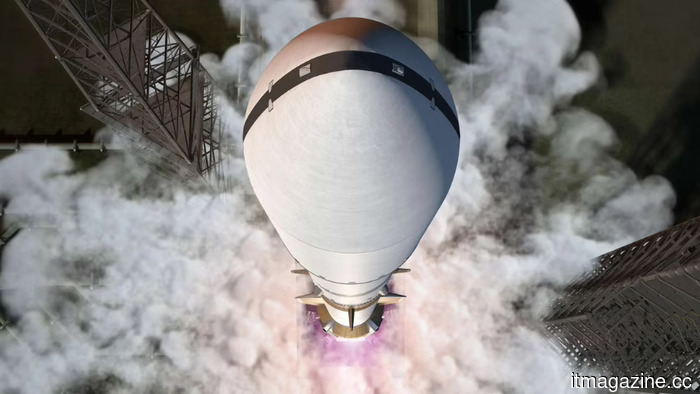
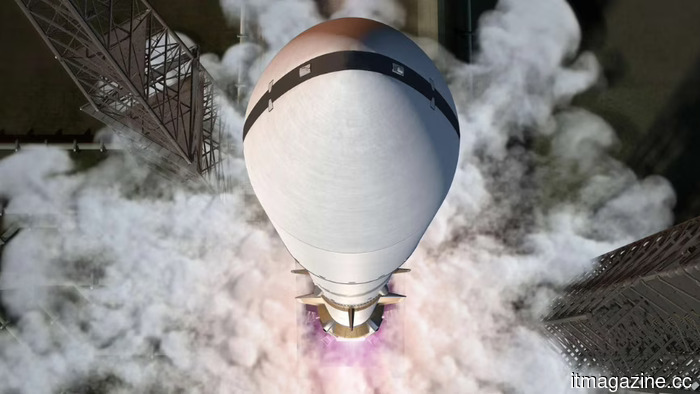
Blue Origin's New Glenn rocket detonates on a launch pad in Florida.
**Summary**
Blue Origin’s New Glenn rocket exploded during a static fire test at Cape Canaveral on May 28, destroying the vehicle, erector-gantry, and a lightning tower at the launch pad. This incident jeopardizes Amazon’s satellite deployment timeline, occurring just a day after NASA awarded Blue Origin a $188 million contract for a Moon Base.
The New Glenn rocket exploded during a static fire test at Cape Canaveral Space Force Station on Thursday night, producing a massive fireball and damaging key infrastructure. The explosion happened around 9 PM EDT as engineers were preparing for a test of the rocket’s seven BE-4 methane-fueled engines, with the vehicle fully fueled with methane and liquid oxygen at the time of detonation.
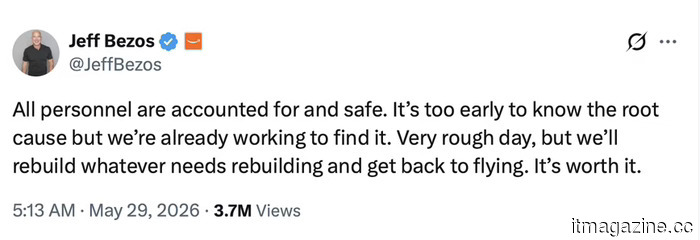
All personnel on site were safe. Jeff Bezos tweeted after the event, stating that it was too soon to determine the cause but affirming that the company would rebuild as necessary. Blue Origin referred to the explosion as an "anomaly."
**The Launch Pad is Gone**
The damage went beyond the rocket itself; the erector-gantry used for moving and positioning New Glenn was totally destroyed, and one of the two lightning towers collapsed. This blast represents one of the most significant rocket failures in U.S. history and marks the first on-pad explosion at the Cape since a SpaceX Falcon 9 incident on September 1, 2016.
Launch Complex 36 is the sole pad capable of launching New Glenn. After the Falcon 9 incident in 2016, that rocket was grounded for over three months, and the launch pad remained unusable for more than a year. Blue Origin has not yet disclosed a timeline for returning to flight or for reconstructing the pad.
**A Troubling Flight Record**
The explosion occurred just before the NG-4 mission, set for next week, which aimed to deploy 48 Amazon Leo broadband satellites into orbit. This would have been the first of 24 launches under contract between Amazon and Blue Origin for its satellite internet project.
New Glenn has completed three launches: the first in January 2025 successfully reached orbit, marking a milestone for commercial rockets, but the booster failed to land. The second flight in November 2025 achieved a successful booster landing, while the third flight in April 2026 also landed properly but experienced an upper-stage failure due to a cryogenic leak in one of its BE-3U engines, resulting in the loss of an AST SpaceMobile satellite. Following the April incident, the FAA grounded New Glenn, and it was only recently cleared to fly again.
**Amazon’s Satellite Timeline is at Risk**
Amazon Leo, the satellite internet service previously called Project Kuiper, started an enterprise beta in April and is aiming for a commercial launch by mid-2026. However, it has only managed to place 210 to 241 satellites in orbit, far short of the FCC's requirement of 1,618 by July 30, 2026. The company has requested a two-year extension and arranged for 22 additional launches to meet its goals.
The loss of the NG-4 mission, coupled with the potential months needed to repair the pad, complicates an already tight schedule. While Amazon has launch contracts with other providers like United Launch Alliance and Arianespace, New Glenn was expected to handle the bulk of the workload. SpaceX’s Starlink has already deployed over 7,600 satellites and serves more than 10 million subscribers, creating significant competitive pressure for Amazon.
**The Timing is Critical**
The explosion occurred just one day after NASA Administrator Jared Isaacman lauded Blue Origin's role in the Artemis program and announced a $188 million contract for the delivery of two rovers to the Moon using the Blue Moon Mark 1 Endurance cargo lander. The first delivery mission, Moon Base I, is set for no earlier than autumn 2026. Following the explosion, Isaacman mentioned on Twitter that NASA is "aware" of the situation and will provide updates on any effects on the Artemis and Moon Base programs.
Blue Origin finds itself at a crucial commercial juncture. Valued around $100 billion, the company has recently been reported to be considering outside investment for the first time as SpaceX prepares for an IPO valued between $1.75 trillion and $2 trillion. Blue Origin had anticipated 8 to 12 launches in 2026, while SpaceX has planned around 140 to 145.
**Future Steps**
To resume its launch operations, Blue Origin must investigate the cause of the explosion, repair the launch pad, and return to flight status. The company has not disclosed how many additional New Glenn rockets are being produced or how quickly it can replace the lost vehicle. SpaceX recovered from its 2016 explosion and became the dominant launch provider worldwide; however, it had more financial backing and a proven rocket. Blue Origin currently lacks both.
For Bezos, the explosion tests his long-held belief
Other articles
 Asana has purchased Stack AI for $75 million to develop an AI agent platform.
Asana has acquired Stack AI, which is backed by Y Combinator, for an estimated $75 million, thereby incorporating no-code AI agents into its platform. Revenue for Q1 reached $205 million, while the stock is trading 53% lower than it was in January.
Asana has purchased Stack AI for $75 million to develop an AI agent platform.
Asana has acquired Stack AI, which is backed by Y Combinator, for an estimated $75 million, thereby incorporating no-code AI agents into its platform. Revenue for Q1 reached $205 million, while the stock is trading 53% lower than it was in January.
 Are the EU's tech regulations sufficient? Founders, policymakers, and operators gather in Amsterdam to talk about the realities of scaling in Europe.
On June 30, DutchBasecamp and CCIA Europe will present "EU Nough Tech Rules? The Realities of Scaling in Europe," an exclusive gathering of founders and CEOs from rapidly growing European tech firms.
Are the EU's tech regulations sufficient? Founders, policymakers, and operators gather in Amsterdam to talk about the realities of scaling in Europe.
On June 30, DutchBasecamp and CCIA Europe will present "EU Nough Tech Rules? The Realities of Scaling in Europe," an exclusive gathering of founders and CEOs from rapidly growing European tech firms.
 Asana has purchased Stack AI for $75 million to develop an AI agent platform.
Asana has acquired Stack AI, which is supported by Y Combinator, for an estimated $75 million, integrating no-code AI agents into its platform. In the first quarter, revenue reached $205 million, while its stock is trading 53% lower than in January.
Asana has purchased Stack AI for $75 million to develop an AI agent platform.
Asana has acquired Stack AI, which is supported by Y Combinator, for an estimated $75 million, integrating no-code AI agents into its platform. In the first quarter, revenue reached $205 million, while its stock is trading 53% lower than in January.
 Acer unveils the Predator Atlas 8 gaming handheld featuring metal fans. Let's keep our fingers crossed that it won't be prohibitively expensive.
Acer's Predator Atlas 8 combines desktop-grade Intel performance with an innovative cooling system in a portable design. It appears to be highly competent, but it may come with a hefty price tag as well.
Acer unveils the Predator Atlas 8 gaming handheld featuring metal fans. Let's keep our fingers crossed that it won't be prohibitively expensive.
Acer's Predator Atlas 8 combines desktop-grade Intel performance with an innovative cooling system in a portable design. It appears to be highly competent, but it may come with a hefty price tag as well.
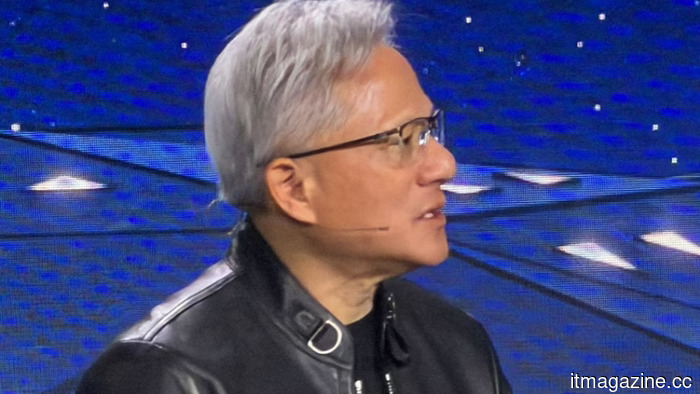 Nvidia invests $6.5 billion in photonics to address the copper bottleneck in AI.
Since March, Nvidia has invested over $6.5 billion in photonics, focusing on companies like Coherent, Lumentum, Marvell, Corning, and Ayar Labs to transition from copper to light in AI data centers.
Nvidia invests $6.5 billion in photonics to address the copper bottleneck in AI.
Since March, Nvidia has invested over $6.5 billion in photonics, focusing on companies like Coherent, Lumentum, Marvell, Corning, and Ayar Labs to transition from copper to light in AI data centers.
 Blue Origin's New Glenn rocket detonates on launch pad in Florida.
Blue Origin's New Glenn detonated during a static fire test at Cape Canaveral, resulting in the destruction of its sole launch pad. This incident jeopardizes Amazon's satellite timeline and the NASA Moon Base contract.
Blue Origin's New Glenn rocket detonates on launch pad in Florida.
Blue Origin's New Glenn detonated during a static fire test at Cape Canaveral, resulting in the destruction of its sole launch pad. This incident jeopardizes Amazon's satellite timeline and the NASA Moon Base contract.
Blue Origin's New Glenn rocket detonates on a launch pad in Florida.
Blue Origin's New Glenn experienced an explosion during a static fire test at Cape Canaveral, leading to the destruction of its sole launch pad. This incident puts Amazon's satellite timeline and NASA's Moon Base contract in jeopardy.