
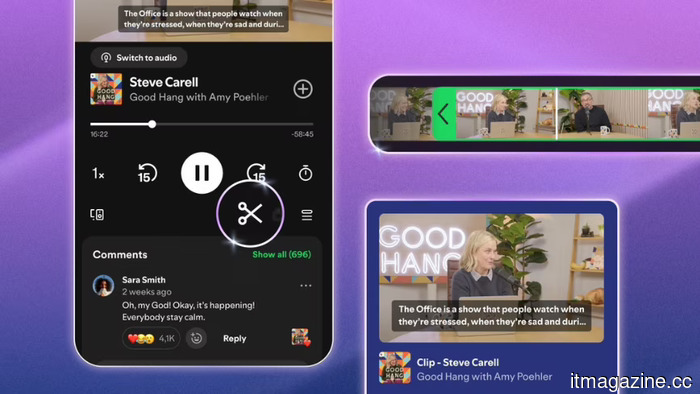
Spotify now enables users to clip and share segments from any podcast.
TL;DR: Spotify has introduced Podcast Clips, a feature that allows listeners to cut, save, and share snippets from podcast episodes with a new scissors icon in the Now Playing view. This tool is available worldwide to both free and Premium users on mobile devices.
Spotify's new feature, Podcast Clips, enables listeners to choose, trim, and share particular moments from podcast episodes. By clicking on a scissors icon in the Now Playing view, users can access a clipping tool to select an audio segment, preview it, and share it through social media, messaging apps, or a direct link. This feature is gradually being rolled out to both free and Premium mobile users, with additional support for more shows coming soon. Saved clips will be kept in a user's Spotify Library and can also be incorporated into podcast playlists.
When users click the share button, they now have four options: a link to the entire episode, a specific chapter, a timestamp, or a clip, with clips being the newest option. The previous options already existed, but the consolidated sharing interface makes their differentiation clearer.
Spotify notes that this feature builds on the success of Chapters, an automatic segmentation tool launched earlier this year that organizes long episodes into titled sections, facilitating navigation through lengthy interviews. Since its launch, Chapters have been saved and added to playlists more than 2 million times per month.
This launch comes amid a transformation in how tech news is disseminated, as top executives are increasingly choosing to engage with podcasters rather than traditional media, leading to longer and softer discussions. Many listeners may not have time to listen to entire lengthy episodes, but clips help highlight significant moments for sharing.
This development also aligns with Spotify's business goals. Each shared clip on platforms like Instagram, X, or WhatsApp serves as a marketing opportunity for Spotify. If someone sees a brief 45-second clip of a podcast interview and finds it intriguing, they may return to Spotify to listen to more. This effectively turns listeners into promoters, which is a cost-efficient alternative to paid marketing.
Discoverability has been a longstanding challenge for the podcasting industry. Unlike music, which can be sampled through algorithm-generated playlists and short previews, podcasts require a commitment that many potential listeners are hesitant to make for unfamiliar shows. Short clips help mitigate this issue. Apple recognized this need and added video podcast capabilities earlier this year, while YouTube has been the go-to for podcast discovery for years, primarily due to its short clips and recommendation system directing viewers to full episodes.
Spotify is significantly investing in podcast-related enhancements throughout 2026. During its Investor Day on May 21, the company unveiled a series of AI-driven features, such as real-time Q&A, Personal Podcasts generated from natural language queries, and Studio by Spotify Labs, a dedicated desktop app that compiles personalized audio summaries based on a user’s email, calendar, and browsing activity.
Spotify also announced Memberships, a new monetization feature that will allow podcast creators to sell paid subscriptions directly on the platform. Creator Sponsorships are currently active for video content in the Spotify Partner Program, giving podcasters more control over managing, replacing, and analyzing brand partnerships.
The overall statistics support this initiative. Spotify reported 761 million monthly active users in Q1 2026, a growth of 12% year-over-year, as well as 293 million Premium subscribers. The company generated €4.53 billion in revenue for the quarter, with operating income reaching €715 million. According to Roman Wasenmüller, Spotify’s VP and global head of podcasts, podcasts are now in their second year of profitability on the platform.
The introduction of clips coincides with rising tensions around AI-generated content on the platform. Spotify has recently rolled out a Verified badge for artists that specifically excludes AI-generated accounts, while its partnership with Universal Music Group allows for AI-generated covers and remixes under a revenue-sharing model, indicating that Spotify is looking to channel AI creativity rather than limit it.
Clips represent a convergence of two trends that Spotify is pursuing: enhancing the social aspect of podcasts and improving their discoverability. The company has been aggressively diversifying into related content formats, ranging from audiobooks to physical book sales to AI-generated personal audio. CEO Daniel Ek has positioned 2026 as a year focused on greater ambitions, positioning Spotify as a media platform, rather than just a music streaming service.
The effectiveness of clips in enhancing podcast discovery will largely depend on listener engagement. Spotify has previously launched various social features, including its now-defunct messaging system and collaborative playlists, which gained some popularity but never became integral to the user experience. This time, however, the process is straightforward: a scissors icon, a trim tool, and a share button provide a seamless experience.
The true competition does not stem from other podcast applications but rather from short-form video platforms like TikTok, YouTube Shorts, and Instagram Reels, which have become the primary means through which users share audio snippets. Creators already use third-party
Other articles
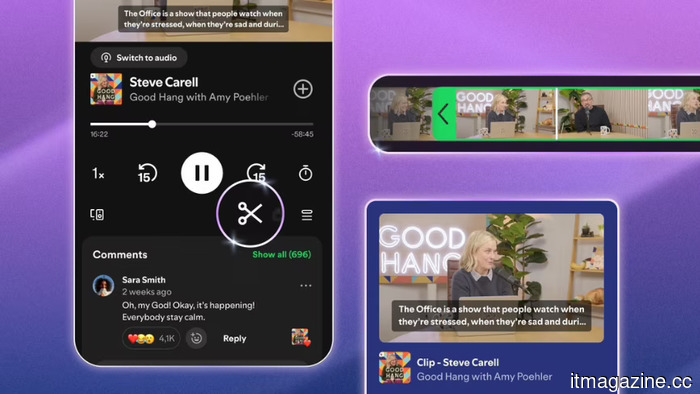 Spotify now allows users to capture and share segments from any podcast.
Spotify introduces Podcast Clips, which allows listeners to cut and share audio snippets from episodes using a new scissors icon. This feature is accessible worldwide on mobile for both free and Premium users.
Spotify now allows users to capture and share segments from any podcast.
Spotify introduces Podcast Clips, which allows listeners to cut and share audio snippets from episodes using a new scissors icon. This feature is accessible worldwide on mobile for both free and Premium users.
 Scammers are profiting from GTA 6 even before Rockstar sells a single unit.
Although GTA 6 is still several months from release, scammers are already taking advantage of the excitement to promote fake beta keys, malware-infested downloads, Android adware, and phishing sites aimed at Rockstar accounts.
Scammers are profiting from GTA 6 even before Rockstar sells a single unit.
Although GTA 6 is still several months from release, scammers are already taking advantage of the excitement to promote fake beta keys, malware-infested downloads, Android adware, and phishing sites aimed at Rockstar accounts.
 Robinhood enables AI agents to engage in stock trading and utilize credit cards.
Robinhood introduces autonomous stock trading through MCP and a virtual credit card for AI agents that offers 3% cashback, making it the first significant retail brokerage to allow bots to take control.
Robinhood enables AI agents to engage in stock trading and utilize credit cards.
Robinhood introduces autonomous stock trading through MCP and a virtual credit card for AI agents that offers 3% cashback, making it the first significant retail brokerage to allow bots to take control.
 EXCLUSIVE: The director and cast of Backrooms discuss the process of transforming a viral web series into one of A24’s most disturbing horror films.
Kane Parsons, Chiwetel Ejiofor, and Renate Reinsve discuss how A24’s Backrooms transforms the popular viral liminal horror series into a chilling psychological film that explores themes of isolation, liminal spaces, and emotional trauma.
EXCLUSIVE: The director and cast of Backrooms discuss the process of transforming a viral web series into one of A24’s most disturbing horror films.
Kane Parsons, Chiwetel Ejiofor, and Renate Reinsve discuss how A24’s Backrooms transforms the popular viral liminal horror series into a chilling psychological film that explores themes of isolation, liminal spaces, and emotional trauma.
 Germany and Spain oppose Brussels' proposals to impose a bloc-wide ban on Huawei equipment.
Germany and Spain are opposing the European Commission's proposed mandatory regulations concerning Huawei and ZTE, pointing to the potential for retaliation from Beijing and the expenses associated with developing European AI infrastructure.
Germany and Spain oppose Brussels' proposals to impose a bloc-wide ban on Huawei equipment.
Germany and Spain are opposing the European Commission's proposed mandatory regulations concerning Huawei and ZTE, pointing to the potential for retaliation from Beijing and the expenses associated with developing European AI infrastructure.
 YouTube will now automatically label videos that are generated by AI.
YouTube is transitioning from a system of voluntary creator disclosures to an automatic detection method using AI for videos. This will include clear labels and permanent markers for content created with its tools or validated by C2PA metadata.
YouTube will now automatically label videos that are generated by AI.
YouTube is transitioning from a system of voluntary creator disclosures to an automatic detection method using AI for videos. This will include clear labels and permanent markers for content created with its tools or validated by C2PA metadata.
Spotify now enables users to clip and share segments from any podcast.
Spotify introduces Podcast Clips, allowing listeners to cut and share audio snippets from episodes using a new scissors icon, accessible globally on mobile for both free and Premium users.