
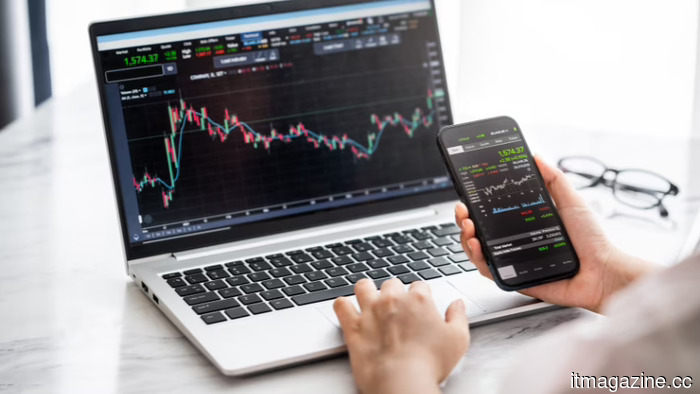
Robinhood enables AI agents to engage in stock trading and utilize credit cards.
TL;DR: Robinhood has launched a beta AI agent trading platform, allowing users to connect AI agents via MCP to perform stock trades from a specific wallet. It is also introducing a virtual credit card for AI agents offering 3% cashback, making it the first major retail brokerage to allow both trading and spending by autonomous software.
Robinhood has unveiled a platform that enables users to link AI agents to their brokerage accounts for autonomous stock trading. Additionally, the company is introducing a virtual credit card specifically for AI agents, marking it as the first significant consumer brokerage to permit both autonomous trading and spending.
The agentic trading system operates through a designated account structure. Users must create a dedicated trading account for their AI agent, load a specific amount of funds, and connect the agent to Robinhood’s Model Context Protocol service. The AI agent can evaluate portfolios, analyze concentration risks and sector exposure, review analyst notes, and execute trades but can only utilize the funds from its linked wallet.
These safeguards are intentional. Agents do not have access to a user’s complete brokerage balance. Users receive notifications for every trade executed by the agent and can track activities within the Robinhood app. For specific trades, agents must provide a preview and wait for user consent before proceeding. Robinhood has also incorporated fraud detection measures, with a dedicated team to review suspicious trades and handle disputes.
This feature is launching in beta and currently limited to stock trading. Robinhood has plans to introduce options, cryptocurrencies, event contracts, futures, and prediction markets in future updates.
The virtual credit card is a separate but related offering. Gold Card holders can link their account to a new virtual card number, distinct from their primary card, which an AI agent may use for transactions. Agents using this card earn 3% cashback, equivalent to the standard Gold Card rate. Users can impose monthly spending limits and decide whether the agent needs approval for each transaction or only for purchases exceeding a specific amount. The virtual card can be deleted at any time.
Robinhood’s Platinum Card, a premium offering costing $695 per year that debuted through invitation in March 2026, will also feature a similar function for agents when it becomes generally available later this year.
Abhishek Fatehpuria, Robinhood’s vice president of product, shared with TechCrunch that the company developed this feature in response to user requests. Customers expressed a desire to integrate their own tools, large language models, and agents into the platform. Fatehpuria, who began as an intern at Robinhood in 2016 and now leads the brokerage product, positioned the launch as catering to early adopters.
The launch places Robinhood amid a broader effort to establish the financial framework for AI agents. Stripe has unveiled an Agentic Commerce Suite with Shared Payment Tokens, allowing AI agents to initiate purchases using a buyer’s saved payment method without exposing card details. Amazon Web Services introduced Bedrock AgentCore Payments in collaboration with Coinbase and Stripe, enabling AI agents to make stablecoin purchases. Google announced Universal Cart at I/O 2026, featuring an updated Agent Payments Protocol for completing transactions across Search, Gemini, and YouTube.
Visa and Mastercard are also advancing. Mastercard launched Agent Pay in 2025, presenting agentic tokens that enable AI agents to initiate payments within specified limits. Visa has partnered with Ramp on a trusted agent protocol for corporate spending management. Additionally, Meow Technologies introduced what it claims to be the first agentic banking platform earlier this year, addressing the gap between AI capabilities and financial infrastructure.
What distinguishes Robinhood's approach is its provision for AI agents to trade securities, not solely conduct purchases. This introduces a different level of risk. Stock trading requires market timing, sensitivity to prices, and regulatory compliance that do not pertain to straightforward purchases. FINRA Rule 3110 mandates human oversight over trading activities, while the SEC's Market Access Rule requires pre-trade risk assessments. It remains uncertain whether an AI agent performing autonomous trades for retail investors meets these regulatory criteria.
Robinhood has previously dealt with regulatory challenges. In 2020, the company paid $65 million to settle SEC accusations over misleading customers regarding how it generates revenue, and in 2021, FINRA fined it $70 million for systemic supervisory lapses. Introducing autonomous AI trading to a platform already under regulatory scrutiny is a calculated risk, assuming that their controls, dedicated wallets, notifications, trade previews, and fraud detection measures are sufficient to appease regulators.
The company’s growth trajectory supports this gamble. Robinhood reported $4.5 billion in revenue in 2025 and $1.07 billion in the first quarter of 2026, reflecting a 15% year-over-year increase. It has 4.3 million Gold subscribers, a 36% rise compared to the previous year. The company's market capitalization, which peaked at $101 billion in December 2025, has since fallen to about $62 billion. Robinhood is evolving from being a volatile meme-stock platform
Other articles
 The broader perspective on property valuation: e2Value explains the significance of historical context in a new age of AI.
Todd Rissel, CEO of e2Value, discusses how decades of changes in economics, construction methods, and consumer expectations render historical context crucial for precise AI-based property valuation.
The broader perspective on property valuation: e2Value explains the significance of historical context in a new age of AI.
Todd Rissel, CEO of e2Value, discusses how decades of changes in economics, construction methods, and consumer expectations render historical context crucial for precise AI-based property valuation.
 Robinhood allows AI agents to trade stocks and utilize credit cards.
Robinhood introduces autonomous stock trading through MCP and a virtual credit card for AI agents, offering 3% cashback, making it the first significant retail brokerage to give control to bots.
Robinhood allows AI agents to trade stocks and utilize credit cards.
Robinhood introduces autonomous stock trading through MCP and a virtual credit card for AI agents, offering 3% cashback, making it the first significant retail brokerage to give control to bots.
 Germany and Spain oppose Brussels' proposals to impose a bloc-wide ban on Huawei equipment.
Germany and Spain are opposing the European Commission's proposed mandatory regulations concerning Huawei and ZTE, pointing to the potential for retaliation from Beijing and the expenses associated with developing European AI infrastructure.
Germany and Spain oppose Brussels' proposals to impose a bloc-wide ban on Huawei equipment.
Germany and Spain are opposing the European Commission's proposed mandatory regulations concerning Huawei and ZTE, pointing to the potential for retaliation from Beijing and the expenses associated with developing European AI infrastructure.
 A Samsung Galaxy S25 FE exploded during the night, marking it as not the first instance of a Galaxy S25 experiencing such an incident.
A Samsung Galaxy S25 FE ignited while being charged in bed, injuring its owner and sparking new concerns regarding the safety of Samsung's batteries.
A Samsung Galaxy S25 FE exploded during the night, marking it as not the first instance of a Galaxy S25 experiencing such an incident.
A Samsung Galaxy S25 FE ignited while being charged in bed, injuring its owner and sparking new concerns regarding the safety of Samsung's batteries.
 YouTube will now automatically label videos that are generated by AI.
YouTube is transitioning from a system of voluntary creator disclosures to an automatic detection method using AI for videos. This will include clear labels and permanent markers for content created with its tools or validated by C2PA metadata.
YouTube will now automatically label videos that are generated by AI.
YouTube is transitioning from a system of voluntary creator disclosures to an automatic detection method using AI for videos. This will include clear labels and permanent markers for content created with its tools or validated by C2PA metadata.
 YouTube will now automatically mark videos that are generated by AI.
YouTube is transitioning from optional creator disclosures to automated AI detection of videos, featuring noticeable labels and permanent indicators for content created using its tools or validated by C2PA metadata.
YouTube will now automatically mark videos that are generated by AI.
YouTube is transitioning from optional creator disclosures to automated AI detection of videos, featuring noticeable labels and permanent indicators for content created using its tools or validated by C2PA metadata.
Robinhood enables AI agents to engage in stock trading and utilize credit cards.
Robinhood introduces autonomous stock trading through MCP and a virtual credit card for AI agents that offers 3% cashback, making it the first significant retail brokerage to allow bots to take control.