
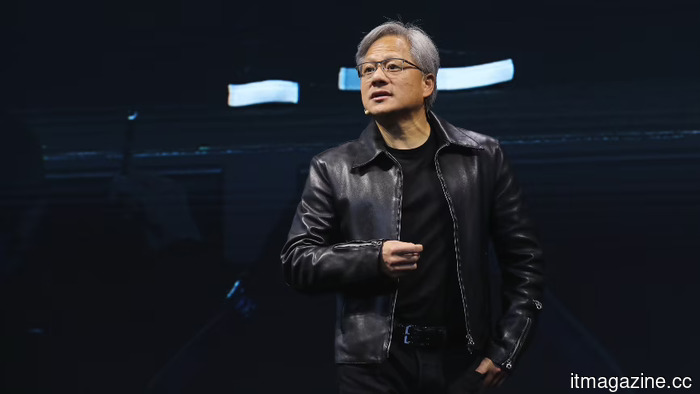
NVIDIA's Jensen Huang refers to Taiwan as the 'epicenter' of the AI revolution, with expenditures reaching $150 billion annually.
NVIDIA's CEO Jensen Huang told an audience in Taipei during Computex 2026 on Wednesday that Taiwan is the "epicentre" of the AI revolution, announcing that the company's yearly expenditure on the island will approach approximately $150 billion. This figure, the highest specific amount Huang has publicly shared regarding spending in Taiwan, indicates that Nvidia’s commitment to the island surpasses the GDP of most EU nations.
Huang elaborated on this figure during his keynote, explaining its distribution through the supply chain. He highlighted Vera Rubin, Nvidia’s next-generation AI platform, calling it "probably the largest product launch in the history of Taiwan." Each Vera Rubin system comprises nearly 2 million components and is produced in collaboration with 150 ecosystem partners in Taiwan, mostly Taiwanese firms. TSMC is responsible for fabricating the essential logic, while companies such as Foxconn, Quanta, and Wistron manage assembly.
SK Hynix, based in Seoul but with a significant presence in Taiwan, provides the HBM4 memory required to achieve the platform's 22 TB/s system bandwidth. Huang's characterisation of the situation holds political as well as engineering significance. The Trump administration's second-term tariff policies have placed noticeable pressure on Nvidia and other US chip manufacturers to relocate more of their production back to the United States.
The disclosure about spending in Taiwan serves, in part, as Huang's message to Washington regarding the substantial cost of such a move, while also affirming to Taipei that Nvidia's commitment to Taiwan has solidified rather than weakened. This announcement follows Huang's recent comments about DeepSeek, which runs on Huawei chips, stating it would be a "horrible outcome" for America, which industry insiders interpreted as Nvidia clearly aligning with the US side in the technological cold war.
Notably, Huang did not mention any specific new fabs, packaging facilities, or sovereign supply commitments. The $150 billion figure represents an overall amount flowing through the existing Taiwanese ecosystem rather than a detailed capital investment plan. The ramp-up of Rubin is already straining that ecosystem, with reports that TSMC is working overtime to meet Nvidia’s orders for Rubin. The $150 billion annual commitment is likely to exacerbate that strain instead of alleviating it.
For Taiwan, the political implications are quite beneficial. The Lai Ching-te administration has spent the last year arguing in Washington that the island’s crucial role in the US AI expansion is a strategic asset rather than a burden. Huang's framing of Taiwan as the "epicentre" reinforces this argument.
On the other hand, for Beijing, which has been tightening its own AI policies throughout 2026, Huang's keynote serves as further evidence that the global AI structure is becoming more geographically concentrated rather than widely distributed. Computex 2026, themed "AI Together," continues this week, with Huang's keynote as the central event; AMD's Lisa Su is set to deliver a counterpart presentation later this week. Both are anticipated to outline their respective roadmaps through 2027, coinciding with the planned large-scale shipping of Nvidia’s Rubin Ultra and AMD’s MI400-series.
Other articles
 PlayStation Plus subscribers can expect a month focused on co-op games in June following the increase in prices.
PlayStation Plus will offer a co-op-focused lineup for June following the price increase, featuring Grounded, Darktide, and Nickelodeon All-Star Brawl 2 as the highlights.
PlayStation Plus subscribers can expect a month focused on co-op games in June following the increase in prices.
PlayStation Plus will offer a co-op-focused lineup for June following the price increase, featuring Grounded, Darktide, and Nickelodeon All-Star Brawl 2 as the highlights.
 Europe's efforts to reduce the control of Big Tech face challenges from its own internal divisions.
The EU’s Tech Sovereignty Package, set to be released on Wednesday, has been moderated by internal discussions between advocates of European preferences and supporters of interoperability.
Europe's efforts to reduce the control of Big Tech face challenges from its own internal divisions.
The EU’s Tech Sovereignty Package, set to be released on Wednesday, has been moderated by internal discussions between advocates of European preferences and supporters of interoperability.
 Aurzen merges Roku TV with SGS-certified brightness for large-screen applications.
The D1R lineup from Aurzen features a built-in Roku TV, native 1080P resolution, and confirmed brightness ratings, offering a more practical approach to contemporary home projection.
Aurzen merges Roku TV with SGS-certified brightness for large-screen applications.
The D1R lineup from Aurzen features a built-in Roku TV, native 1080P resolution, and confirmed brightness ratings, offering a more practical approach to contemporary home projection.
 Introducing the speakers: Who will be on stage at the gathering organized by TNW, Oneflow, and Flexas in Amsterdam?
Four guests, one question: what will distinguish a SaaS company in a world where everyone has AI? Introducing the panel for the gathering on June 3, 2026, in Amsterdam.
SK Hynix enters the trillion-dollar club, boosted by orders for Nvidia's HBM4.
On Wednesday, SK Hynix's market capitalization exceeded $1 trillion during trading in Seoul, positioning the South Korean memory company as the third chip manufacturer to reach this milestone, following Nvidia and TSMC.
SK Hynix enters the trillion-dollar club, fueled by orders for Nvidia's HBM4.
On Wednesday, SK Hynix's market capitalization exceeded $1 trillion in trading in Seoul, making the Korean memory company the third chip manufacturer, following Nvidia and TSMC, to reach this milestone.
Introducing the speakers: Who will be on stage at the gathering organized by TNW, Oneflow, and Flexas in Amsterdam?
Four guests, one question: what will distinguish a SaaS company in a world where everyone has AI? Introducing the panel for the gathering on June 3, 2026, in Amsterdam.
SK Hynix enters the trillion-dollar club, boosted by orders for Nvidia's HBM4.
On Wednesday, SK Hynix's market capitalization exceeded $1 trillion during trading in Seoul, positioning the South Korean memory company as the third chip manufacturer to reach this milestone, following Nvidia and TSMC.
SK Hynix enters the trillion-dollar club, fueled by orders for Nvidia's HBM4.
On Wednesday, SK Hynix's market capitalization exceeded $1 trillion in trading in Seoul, making the Korean memory company the third chip manufacturer, following Nvidia and TSMC, to reach this milestone.
NVIDIA's Jensen Huang refers to Taiwan as the 'epicenter' of the AI revolution, with expenditures reaching $150 billion annually.
During Computex 2026, Jensen Huang announced that Nvidia's annual expenditure in Taiwan would amount to $150 billion, positioning Taiwan as the "epicenter" of the AI revolution.