
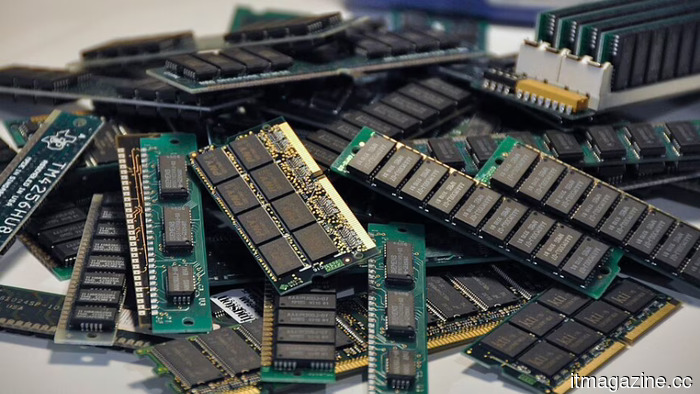
Corsair is now incorporating Chinese DRAM in its DDR5 memory kits. This could potentially lead to a decrease in memory prices.
TL;DR: Corsair DDR5 modules featuring Chinese CXMT chips have been identified, as demand from AI impacts DRAM availability for PCs. Prices may decline in the second half of 2027.
Corsair, a well-known brand in PC components, is now offering DDR5 memory modules that incorporate DRAM produced by ChangXin Memory Technologies, China’s largest memory chip manufacturer. Screenshots shared on X by hardware enthusiast @wxnod reveal a Corsair Vengeance DDR5-6000 module, part number CMK5X16G3E60C36A2, with CPU-Z and HWiNFO64 indicating ChangXin Technologies as the DRAM source instead of Corsair’s usual supplier, Micron. The module operates at 6000 MT/s with CL36 timings at 1.35V and is compatible with Intel XMP and AMD EXPO overclocking profiles. Its specifications are standard and comparable to similar kits based on Samsung or SK Hynix DRAM.
This change is significant as it indicates that the AI-driven memory shortage has led Western brands to seek alternative supply chains from Chinese manufacturers. Samsung, SK Hynix, and Micron have shifted most of their production capacity to high-bandwidth memory for AI applications, resulting in a chronic undersupply in the consumer PC market. Consequently, DDR5 prices surged throughout 2026. In late April, Samsung and SK Hynix cautioned that shortages driven by AI are likely to continue through 2027 and beyond, with large tech companies securing supplies well in advance. This situation has been challenging for PC builders.
CXMT is well-positioned to take advantage of this gap, holding about 7.7% of the global DRAM market and counting major firms like Alibaba, Tencent, and ByteDance among its clients. It produces DDR5 chips in 16 Gb and 24 Gb configurations, with speeds reaching 8,000 MT/s. Its revenue for Q1 2026 soared to 50.8 billion yuan ($7.4 billion), a 719% year-over-year increase, and it reported a net profit of 33 billion yuan ($4.4 billion), compared to a loss of 2.83 billion yuan in the same quarter last year. The company is reportedly preparing for a listing on the Shanghai Stock Exchange later this year.
Kye-hyun Kyung, a former leader at Samsung’s chip and display division, mentioned at a Korean engineering forum that Chinese companies are rapidly increasing their memory production capacity, with relief expected in the second half of 2027. CXMT and YMTC, a leading NAND flash manufacturer in China, anticipate almost doubling their wafer production capacity under an initiative termed “Epic Expansion.” Other Chinese firms, such as Jiahe Jinwei, are also increasing DDR5 RDIMM production for data centers and server use.
A crucial question posed by Tom’s Hardware is whether sourcing cheaper materials leads to lower retail prices. While Corsair might be acquiring CXMT DRAM at a reduced cost, they could still sell the final products at the elevated rates supported by the ongoing shortage. Unless Chinese supply scales up enough to exert significant downward pressure on the market, consumer advantages may primarily lie in availability rather than pricing.
There are structural reasons to expect a price decrease, though not immediately. Currently, CXMT produces approximately 240,000 wafers per month, roughly half of SK Hynix’s output and about a third of Samsung’s, as per market research firm Omdia. This capacity is insufficient to saturate the market. However, the growth trajectory appears promising, and CXMT possesses a structural advantage over the leading three firms: it does not have to fulfill AI contracts. In contrast to Samsung and SK Hynix, which are committed to HBM4 and LPDDR5X production for major tech companies and hyperscalers, CXMT’s capacity can focus on consumer PC memory, which is currently less attractive.
Additionally, Samsung’s labor disputes add further uncertainty to supply. The company's largest union is threatening an 18-day strike starting May 21, which South Korea's prime minister has warned could incur costs of up to $668 million per day. If the strike proceeds, Samsung's already limited consumer DRAM output would worsen, further driving the shift towards Chinese options.
The geopolitical context is also significant. The U.S. has restricted the export of advanced chipmaking equipment to China, particularly EUV lithography tools from ASML, preventing CXMT from manufacturing the latest memory nodes. However, consumer DDR5 does not require this technology and can be produced on older process nodes that CXMT possesses without significant constraints from export regulations. The irony lies in the fact that U.S. sanctions intended to hinder China's semiconductor industry could inadvertently bolster Chinese dominance in the very market segment that the sanctions do not affect.
The DDR5 price crisis is already evident in consumer products. The ROG NUC 16, Asus's premium gaming mini PC
Other articles
 Berlin's Peec AI saw its revenue increase more than twofold to $10 million ARR within six months. Its solution assists brands in appearing in ChatGPT.
The GEO startup secured its Series A funding at a $4M ARR six months back. It is now monitoring $10M, with billboards placed outside competitor offices throughout Berlin.
Berlin's Peec AI saw its revenue increase more than twofold to $10 million ARR within six months. Its solution assists brands in appearing in ChatGPT.
The GEO startup secured its Series A funding at a $4M ARR six months back. It is now monitoring $10M, with billboards placed outside competitor offices throughout Berlin.
 Berlin's Peec AI increased its revenue by more than twofold to reach $10 million in annual recurring revenue (ARR) over the course of six months. The company's product assists brands in appearing in ChatGPT.
The GEO startup secured its Series A funding with a $4M ARR six months prior. It now reports a $10M ARR, having placed billboards near competing offices throughout Berlin.
Berlin's Peec AI increased its revenue by more than twofold to reach $10 million in annual recurring revenue (ARR) over the course of six months. The company's product assists brands in appearing in ChatGPT.
The GEO startup secured its Series A funding with a $4M ARR six months prior. It now reports a $10M ARR, having placed billboards near competing offices throughout Berlin.
 Tesla has finally introduced FSD in China, while its competitors have been offering self-driving vehicles in the country for several years.
Tesla's Full Self-Driving (Supervised) is now available in China, following Musk's visit with Trump to Beijing last week. Meanwhile, Chinese competitors are already providing Level 3 autonomy.
Tesla has finally introduced FSD in China, while its competitors have been offering self-driving vehicles in the country for several years.
Tesla's Full Self-Driving (Supervised) is now available in China, following Musk's visit with Trump to Beijing last week. Meanwhile, Chinese competitors are already providing Level 3 autonomy.
 Anthropic's Claude Mythos identified 10,000 critical vulnerabilities within a single month. The patches are unable to keep pace.
The partners of Project Glasswing utilized Claude Mythos to identify 1,094 verified high-severity vulnerabilities in over 1,000 open-source projects. Only 97 of these have been resolved.
Anthropic's Claude Mythos identified 10,000 critical vulnerabilities within a single month. The patches are unable to keep pace.
The partners of Project Glasswing utilized Claude Mythos to identify 1,094 verified high-severity vulnerabilities in over 1,000 open-source projects. Only 97 of these have been resolved.
 This new feature in Raycast 2.0 is driving me crazy.
Raycast 2.0 is an excellent update, but a modification to the clipboard history has disrupted my workflow entirely. Here's the change that occurred and how to resolve it.
This new feature in Raycast 2.0 is driving me crazy.
Raycast 2.0 is an excellent update, but a modification to the clipboard history has disrupted my workflow entirely. Here's the change that occurred and how to resolve it.
 Wireless earbuds might soon recognize you by your heartbeat.
Scientists have created a novel earbud authentication system capable of identifying users by detecting minute heartbeat vibrations within the ear canal. While the concept seems futuristic, it might be more feasible than one might think.
Wireless earbuds might soon recognize you by your heartbeat.
Scientists have created a novel earbud authentication system capable of identifying users by detecting minute heartbeat vibrations within the ear canal. While the concept seems futuristic, it might be more feasible than one might think.
Corsair is now incorporating Chinese DRAM in its DDR5 memory kits. This could potentially lead to a decrease in memory prices.
CXMT chips have been noticed in Corsair Vengeance DDR5 modules, as Samsung, SK Hynix, and Micron focus more on AI memory rather than on consumer PCs.