
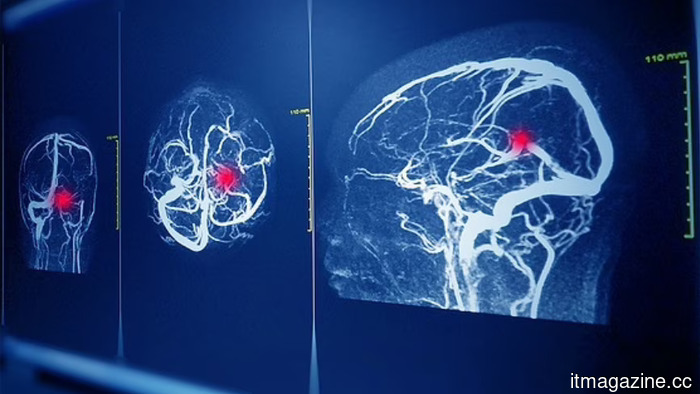
Within the subtle transformation of clinical decision-making.
Neurovascular care is one of the more complex and unpredictable fields in modern medicine. Millions live with conditions like intracranial aneurysms without showing symptoms, but when an event happens, the outcomes can be devastating, often resulting in high mortality rates and a significant chance of long-term neurological impairment.
For neurospecialists, a key challenge lies in distinguishing between cases that can be monitored safely and those that necessitate intervention to prevent life-threatening events. This clinical uncertainty is the issue CARA Systems Inc. seeks to tackle. The Brooklyn-based NYU spinout, headed by Co-Founder and CEO Prithvinath Garigapuram, has created a non-invasive clinical decision-support platform that merges AI-driven medical imaging with patient-specific analytics into a cohesive workflow for neurovascular evaluation. The company’s overarching aim is to enhance the assessment of complex neurovascular scenarios by bringing together fragmented clinical and imaging data into a more coherent, interpretable, and patient-focused decision-making system.
The Complexity of Clinical Decisions
Neurovascular decision-making and risk assessment heavily rely on analyzing imaging and individual patient physiology. Current risk stratification methods predominantly depend on clinical frameworks based on factors like size, location, and patient demographics. However, these frameworks offer limited insight into the unique anatomical and hemodynamic features that may affect disease progression for an individual patient.
This reliance creates interpretive variability; two clinicians reviewing the same case may reach significantly different conclusions regarding severity, rupture risk, urgency, or the necessity for intervention. A 2024 study published in Scientific Reports revealed notable inconsistencies in aneurysm sizing measurements, with deviations surpassing the thresholds typically linked to rupture-risk categorization.
When uncertainty exists, clinical workflows frequently lead to invasive diagnostic approaches such as digital subtraction angiography, which imposes additional costs and operational burdens on both patients and healthcare systems. Often, this escalation reflects the complexity of the disease as well as the challenge of integrating fragmented clinical data into a clear and consistent assessment pathway.
Garigapuram notes that this difficulty extends beyond neurovascular medicine. In various fields like oncology, cardiology, and acute care, clinicians regularly face the task of collating imaging, lab results, physiological data, and patient histories under intense time constraints and within highly fragmented information landscapes. Much of the necessary data for informed decision-making already exists within the care process, but it is rarely provided in a form that is integrated, contextualized, and readily actionable at the point of care.
For Garigapuram, this structural fragmentation represents an opportunity for healthcare technology. “It’s well known how challenging healthcare systems can be in terms of implementation and adoption,” he explains. “Yet, that is also what I see as a significant opportunity: recognizing where substantial gaps exist in clinical workflows and creating systems to help clinicians navigate them more effectively.”
Creating a New Environment for Synthesis
Garigapuram describes a shift in clinical synthesis. Traditionally in medicine, the integration of imaging, patient history, physiology, and risk factors has depended on clinicians interpreting fragmented information in real time, often while managing busy clinical workflows and urgent decision-making.
A new generation of healthcare technology is beginning to shift some of this synthesis to an earlier stage by organizing and contextualizing patient-specific signals before they reach the point of care. Instead of having crucial information scattered across imaging studies, reports, and clinical records, these systems aim to bring relevant clinical insights to the forefront in a way that physicians can interpret and act upon more efficiently.
The goal is not to replace clinical judgment but to enhance the quality and specificity of the information clinicians analyze. Rather than depending primarily on generic triage frameworks, physicians can assess cases through the lens of patient-specific anatomical, biomechanical, and clinical characterizations derived directly from each individual patient.
A prime example of this approach in neurovascular care is AneuView™, a clinical decision-support platform developed by CARA Systems Inc., an NYU spinout based in Brooklyn. The platform merges AI-driven medical imaging analysis with patient-specific analytics within a single workflow, utilizing routine non-invasive imaging already conducted during standard clinical care.
The outcome is a structured patient-specific risk profile designed to support physicians' decision-making during neurovascular triage and treatment planning.
Garigapuram articulates, "There is already a wealth of information within the clinical workflow. The opportunity lies in consolidating that data into a system that can better assist clinicians during the decision-making process."
Transformations at the Decision Point
The real-world implications of this patient-specific approach begin at the initial triage stages. By offering individualized risk assessments at the time of initial imaging, clinicians can evaluate neurovascular cases with greater contextual understanding before committing patients to more invasive diagnostic or treatment routes.
In certain instances, patients who might otherwise be directed toward invasive diagnostic procedures due to uncertainty may instead be more confidently evaluated through non-invasive assessments and surveillance. Similarly, patient-specific anatomical and hemodynamic evaluations may reveal elevated-risk factors not entirely captured by conventional population-based scoring systems, allowing for higher-risk
Other articles
 Elon Musk will receive a significant payday if he establishes a colony of one million people on Mars.
Elon Musk's SpaceX compensation scheme could result in a significant stock grant if the company achieves a substantial valuation and establishes a colony of one million people on Mars.
Elon Musk will receive a significant payday if he establishes a colony of one million people on Mars.
Elon Musk's SpaceX compensation scheme could result in a significant stock grant if the company achieves a substantial valuation and establishes a colony of one million people on Mars.
 Chinese researchers assert that a solid-state electric vehicle battery can be charged in just a few minutes.
Chinese researchers assert that a newly developed solid-state battery can withstand ultra-fast charging while offering significantly higher energy density, which could transform the future of electric vehicles. Scientists at the Chinese Academy of Sciences report the creation of a solid-state lithium-metal battery that can provide exceptionally high energy density while enduring ultra-fast charging conditions – an impressive combination […]
Chinese researchers assert that a solid-state electric vehicle battery can be charged in just a few minutes.
Chinese researchers assert that a newly developed solid-state battery can withstand ultra-fast charging while offering significantly higher energy density, which could transform the future of electric vehicles. Scientists at the Chinese Academy of Sciences report the creation of a solid-state lithium-metal battery that can provide exceptionally high energy density while enduring ultra-fast charging conditions – an impressive combination […]
 Elon Musk will receive a record-breaking salary if he establishes a colony of one million people on Mars.
Elon Musk’s compensation plan for SpaceX could lead to a substantial stock grant if the company achieves a significant valuation and establishes a colony on Mars with one million inhabitants.
Elon Musk will receive a record-breaking salary if he establishes a colony of one million people on Mars.
Elon Musk’s compensation plan for SpaceX could lead to a substantial stock grant if the company achieves a significant valuation and establishes a colony on Mars with one million inhabitants.
 Microsoft is addressing a Windows 11 search problem that has likely caused you frustration numerous times.
Windows 11 Search might soon cease directing you to Bing when you are merely trying to locate files on your computer. Microsoft is currently testing a solution that will prioritize local results more effectively.
Microsoft is addressing a Windows 11 search problem that has likely caused you frustration numerous times.
Windows 11 Search might soon cease directing you to Bing when you are merely trying to locate files on your computer. Microsoft is currently testing a solution that will prioritize local results more effectively.
 A UN draft protocol aims to broaden countries' authority to impose taxes on technology giants.
A UN draft protocol from May 5 would allow countries to impose taxes on digital giants based on the location of their users. The document is set for negotiation in New York this August.
A UN draft protocol aims to broaden countries' authority to impose taxes on technology giants.
A UN draft protocol from May 5 would allow countries to impose taxes on digital giants based on the location of their users. The document is set for negotiation in New York this August.
Within the subtle transformation of clinical decision-making.
CARA Systems, a spinoff from NYU, employs AI-based imaging and personalized analytics to assist neurospecialists in making more uniform and tailored choices regarding the risk of intracranial aneurysms.