
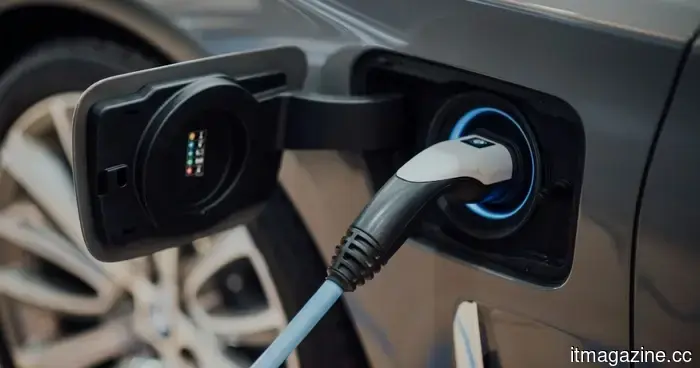
Chinese researchers assert that a solid-state electric vehicle battery can be charged in just a few minutes.
Chinese researchers are announcing a new solid-state battery that can endure ultra-fast charging while providing significantly higher energy density, which could transform the future of electric vehicles. Scientists at the Chinese Academy of Sciences assert that they have created a solid-state lithium-metal battery that offers exceptional energy density and can withstand ultra-fast charging—an aspiration that the global EV industry has pursued for years.
As reported in a research paper published in the Journal of the American Chemical Society, this prototype battery achieved an energy density of 451.5 Wh/kg while maintaining stable performance over 700 charge cycles at a 20C charging rate. This suggests a potential charging and discharging time of approximately three minutes.
If successfully brought to market, this technology could signify a substantial advancement compared to current EV batteries. Most mass-market electric vehicles from American and European manufacturers still operate within conservative fast-charging limits. Brands like Tesla, Ford, Volkswagen, and Mercedes-Benz typically have peak charging speeds between 150kW and 350kW under optimal conditions, with many vehicles needing 20 to 40 minutes for significant charging sessions.
At the same time, Chinese manufacturers and battery companies are quickly advancing ultra-fast charging technologies. Firms such as BYD, CATL, Ganfeng Lithium, and various startups are actively pursuing solid-state battery designs that can achieve much higher charging speeds and energy densities.
China's push in battery technology is transforming the industry.
This latest innovation comes at a time when Western automakers are increasingly forming partnerships with Chinese firms to stay competitive in EV technology. Earlier this month, Stellantis enhanced its collaboration with Dongfeng Motor Corporation through an agreement worth €1.17 billion covering vehicle production, exports, and engineering collaboration. The company has also bolstered its relationship with Leapmotor to co-develop electric vehicles for European markets.
Other global manufacturers are making similar strategic moves. Volkswagen has teamed up with Chinese EV startups like Xpeng, while several Japanese and European brands are exploring joint manufacturing and battery development initiatives with Chinese suppliers.
With Chinese companies consistently achieving advancements in battery chemistry and manufacturing capacity, these partnerships could enable Western firms to indirectly benefit from China's swift technological developments.
However, high energy density does pose safety concerns.
Despite the optimism surrounding ultra-dense battery chemistries, they raise significant safety issues. Greater energy density can lead to heightened thermal risks if a battery experiences thermal runaway. The industry has already encountered several notable EV fire cases involving lithium battery systems, with specific scrutiny of earlier-generation BYD batteries and widespread worries about EV heat management worldwide.
The Chinese researchers assert that their pouch cell passed nail-penetration safety tests, commonly used to measure internal short-circuit resistance. Nonetheless, laboratory results do not assure real-world reliability for automotive applications.
This challenge remains one of the main drawbacks of solid-state batteries. While breakthroughs are frequently announced, bringing them to market can take years due to complex manufacturing processes, validation of durability, safety certification, and regulatory testing.
Many battery manufacturers are aiming for commercialization between 2026 and 2028. In the interim, traditional lithium iron phosphate (LFP) batteries are likely to continue dominating the market due to their lower costs, established supply chains, and proven reliability.
Still, the pace of innovation indicates that the EV battery race is shifting into a much more competitive phase, with China appearing to be at the forefront.
Other articles
 Chinese researchers assert that a solid-state EV battery can be charged in only a few minutes.
Chinese researchers assert that a new solid-state battery can endure ultra-fast charging and provide significantly higher energy density, which could transform the future of electric vehicles. Scientists from the Chinese Academy of Sciences state they have created a solid-state lithium-metal battery that can achieve exceptionally high energy density while withstanding ultra-fast charging conditions – a combination […]
Chinese researchers assert that a solid-state EV battery can be charged in only a few minutes.
Chinese researchers assert that a new solid-state battery can endure ultra-fast charging and provide significantly higher energy density, which could transform the future of electric vehicles. Scientists from the Chinese Academy of Sciences state they have created a solid-state lithium-metal battery that can achieve exceptionally high energy density while withstanding ultra-fast charging conditions – a combination […]
 HHS initiates an AI project aimed at identifying fraud and waste in federal health programs.
HHS has introduced an AI initiative to conduct real-time screenings of Medicare, Medicaid, CHIP, and Marketplace claims for fraud, moving away from the previous "pay and chase" approach.
Farewell home screen: How NEED is transforming Telegram into a digital marketplace.
NEED creates a chat-based marketplace within Telegram that allows users to purchase eSIMs, gift cards, and VPNs without needing to download an application. This is part of a larger trend moving from traditional app stores to mini-app ecosystems.
HHS initiates an AI project aimed at identifying fraud and waste in federal health programs.
HHS has introduced an AI initiative to conduct real-time screenings of Medicare, Medicaid, CHIP, and Marketplace claims for fraud, moving away from the previous "pay and chase" approach.
Farewell home screen: How NEED is transforming Telegram into a digital marketplace.
NEED creates a chat-based marketplace within Telegram that allows users to purchase eSIMs, gift cards, and VPNs without needing to download an application. This is part of a larger trend moving from traditional app stores to mini-app ecosystems.
 Brett Adcock's AI hardware company, Hark, has secured $700 million in funding, achieving a valuation of $6 billion.
Hark, established by serial entrepreneur Brett Adcock, has secured $700 million at a valuation of $6 billion. Investors include Nvidia, AMD, and Intel.
Brett Adcock's AI hardware company, Hark, has secured $700 million in funding, achieving a valuation of $6 billion.
Hark, established by serial entrepreneur Brett Adcock, has secured $700 million at a valuation of $6 billion. Investors include Nvidia, AMD, and Intel.
 Magic Cue, one of the most intelligent Android features on Pixel phones, is set to be integrated into additional apps.
Google has confirmed the integration of Snapchat, introduced a new user interface, and provided strong indications of support for Wallet and Tasks. This is the update that the feature genuinely required.
Magic Cue, one of the most intelligent Android features on Pixel phones, is set to be integrated into additional apps.
Google has confirmed the integration of Snapchat, introduced a new user interface, and provided strong indications of support for Wallet and Tasks. This is the update that the feature genuinely required.
 Elon Musk will receive a significant payday if he establishes a colony of one million people on Mars.
Elon Musk's SpaceX compensation scheme could result in a significant stock grant if the company achieves a substantial valuation and establishes a colony of one million people on Mars.
Elon Musk will receive a significant payday if he establishes a colony of one million people on Mars.
Elon Musk's SpaceX compensation scheme could result in a significant stock grant if the company achieves a substantial valuation and establishes a colony of one million people on Mars.
Chinese researchers assert that a solid-state electric vehicle battery can be charged in just a few minutes.
Chinese researchers assert that a newly developed solid-state battery can withstand ultra-fast charging while offering significantly higher energy density, which could transform the future of electric vehicles. Scientists at the Chinese Academy of Sciences report the creation of a solid-state lithium-metal battery that can provide exceptionally high energy density while enduring ultra-fast charging conditions – an impressive combination […]