
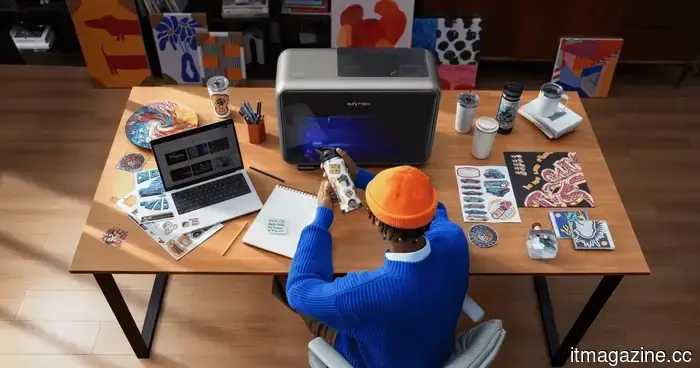
The Design Trade-Offs Influencing Contemporary UV Printing Systems
As more UV printers become available in the consumer market, discussions are evolving beyond just print quality and creative potential. Users are increasingly raising a more practical question: why are so many contemporary UV printers designed with closed ink systems?
This discussion extends beyond a particular product or brand. Across the printer industry, manufacturers are progressively leaning towards proprietary cartridges and strictly controlled ink systems, even as refillable and third-party options are still prevalent in other printing sectors. Some users view closed systems as a way to achieve simplicity, consistency, and reduced maintenance. Conversely, others express concerns over long-term operating expenses and control over consumables, especially when bulk refill ink is often much cheaper than branded cartridges.
This dynamic illustrates a broader transition occurring in UV printing. As the technology migrates from industrial settings into smaller studios, maker spaces, and home environments, manufacturers find themselves needing to balance reliability, user-friendliness, maintenance requirements, and long-term system stability in fundamentally different ways. To comprehend the reasons for these trade-offs, one must look beyond the cartridge itself and examine the chemistry, engineering, and operational conditions shaping the design of modern UV printing systems.
UV ink modifies the operational rules surrounding it
UV ink is formulated to cure under ultraviolet light, transforming from liquid to solid due to a reaction started by photoinitiators. These compounds absorb UV energy and initiate the polymerization of monomers, creating a durable printed layer while pigments remain suspended to provide color. This process is both rapid and precise, yet it introduces a level of sensitivity that alters the design of the entire printing system, encompassing the ink cartridge, ink pathway, and printhead.
Photoinitiators not only respond to controlled UV exposure during printing but can also be affected by low levels of ambient light over time. This can lead to gradual micro-curing at the nozzle, while exposure to air can modify viscosity and contribute to particle formation within the ink path. Over time, these particles can disrupt stable flow, heighten the risk of clogging, and impact the consistency of ink dispensing.
These issues are not just isolated incidents or user errors. They are inherent qualities of the material itself. Consequently, UV ink cannot be regarded as a passive input. It must be shielded from the very environmental factors it reacts to, and this necessity ultimately influences the engineering of modern UV printing systems.
Industrial environments do not eliminate risk; they manage it through control
In industrial settings, the stability of UV ink is maintained by strictly monitored conditions. Lighting is controlled to minimize unintended exposure, handling protocols are rigorously defined, and maintenance is carried out consistently by trained personnel. Open or refillable systems can operate effectively in such environments as the surroundings absorb much of the variability.
Even in professional and high-end desktop UV printers, tightly controlled ink ecosystems are standard rather than the exception. Industrial platforms from brands like Epson and Roland depend on proprietary UV ink systems calibrated in conjunction with the hardware, underscoring the prevalence of controlled ink ecosystems within the UV printing sector.
Smaller studios and home setups, however, function under very different conditions. Light exposure is inconsistent, handling practices differ, and maintenance is less regular. This discrepancy is where many users misjudge the system. The expectation of uniform output persists, yet the conditions necessary to sustain that output are no longer assured.
Open systems maintain flexibility but place more responsibility on the user
This does not render open or refillable systems inherently flawed. In industrial contexts and among skilled operators, they can offer significant benefits, particularly where reduced ink costs, material adaptability, or customized workflows are prioritized over user convenience. Users already comfortable managing maintenance routines and environmental factors may be willing to embrace the added complexity for greater control over the process.
The trade-off is that stability relies more on operator discipline than on the system itself. When UV printing occurs outside of strictly managed settings, elements like air exposure, handling consistency, and maintenance practices become harder to standardize, heightening the likelihood of instability over time. For certain professional users, this remains a tolerable compromise. However, for newer users or smaller workspaces, it can quickly translate into a steep learning curve.
Closed systems encapsulate that control with the machine
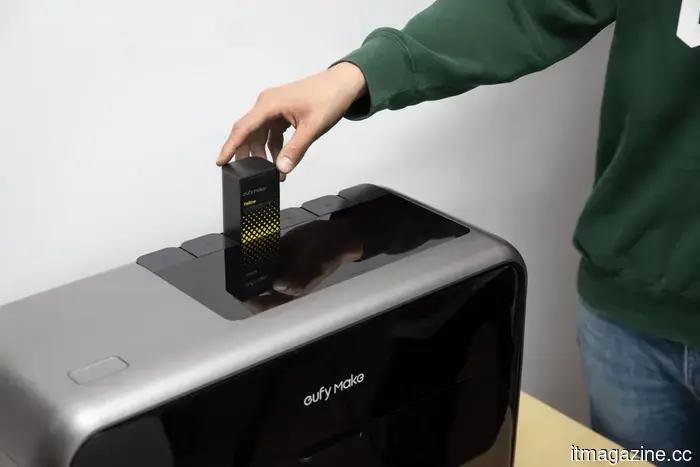
Closed ink systems are crafted to internalize many of the necessary conditions for stability by shielding ink from light, air, and external contaminants throughout its lifecycle. In UV printing, even minimal exposure can gradually impact viscosity, curing behavior, and flow consistency over time.
Such control becomes increasingly critical outside industrial environments, where handling conditions and maintenance practices are significantly less predictable. Additionally, there is a safety aspect to consider. Photoinitiators are chemically active substances, and direct exposure may lead to irritation or more severe reactions, making containment vital for both system stability and product design.
In UV printing, ink and hardware are seen as an integrated whole rather than separate entities
UV printing systems are designed as cohesive environments instead of interchangeable setups. Ink is developed in conjunction with the hardware, with its viscosity, flow characteristics, and curing properties fine-tuned to

Other articles
 Google introduces Universal Cart and announces updates to AP2 at I/O 2026.
Google introduced Universal Cart, an AI shopping platform that integrates Search, Gemini, YouTube, and Gmail, along with enhancements to its Agent Payments Protocol for autonomous transactions.
At I/O 2026, Google introduces voice prompting features for Docs, Keep, and Gmail.
At I/O 2026, Google introduced voice-enabled AI capabilities for Docs, Keep, and Gmail, allowing users to generate documents and search their emails through voice commands rather than typing.
Google introduces Universal Cart and announces updates to AP2 at I/O 2026.
Google introduced Universal Cart, an AI shopping platform that integrates Search, Gemini, YouTube, and Gmail, along with enhancements to its Agent Payments Protocol for autonomous transactions.
At I/O 2026, Google introduces voice prompting features for Docs, Keep, and Gmail.
At I/O 2026, Google introduced voice-enabled AI capabilities for Docs, Keep, and Gmail, allowing users to generate documents and search their emails through voice commands rather than typing.
 Microsoft has announced that new Surface laptops featuring Snapdragon X2 chips will be released later this year.
Microsoft introduced Intel Surface models today and announced that Snapdragon X2 variants will be released later in 2026, featuring faster AI inferencing, improved battery life, and a potential OLED display option.
Microsoft has announced that new Surface laptops featuring Snapdragon X2 chips will be released later this year.
Microsoft introduced Intel Surface models today and announced that Snapdragon X2 variants will be released later in 2026, featuring faster AI inferencing, improved battery life, and a potential OLED display option.
 Google announces Universal Cart and releases AP2 updates at I/O 2026.
Google introduced Universal Cart, an AI-driven shopping platform that integrates Search, Gemini, YouTube, and Gmail, while also announcing enhancements to its Agent Payments Protocol for automated purchases.
Google introduces voice prompting for Docs, Keep, and Gmail at I/O 2026.
At I/O 2026, Google introduced voice-activated AI functionalities for Docs, Keep, and Gmail, enabling users to generate documents and search through their inboxes by speaking rather than typing.
Google announces Universal Cart and releases AP2 updates at I/O 2026.
Google introduced Universal Cart, an AI-driven shopping platform that integrates Search, Gemini, YouTube, and Gmail, while also announcing enhancements to its Agent Payments Protocol for automated purchases.
Google introduces voice prompting for Docs, Keep, and Gmail at I/O 2026.
At I/O 2026, Google introduced voice-activated AI functionalities for Docs, Keep, and Gmail, enabling users to generate documents and search through their inboxes by speaking rather than typing.
The Design Trade-Offs Influencing Contemporary UV Printing Systems
UV printing depends on precisely managed chemical reactions, where even minor changes in ink performance can influence the results, upkeep, and long-term dependability. As the technology expands into smaller studios and home environments, the discussion surrounding open versus closed ink systems increasingly focuses on finding a balance between flexibility, stability, and user-friendliness.