
Google introduces voice prompting for Docs, Keep, and Gmail at I/O 2026.
**Summary**: At I/O 2026, Google revealed voice prompting features for Docs, Keep, and Gmail, allowing users to create documents, organize notes, and search emails by speaking instead of typing. These functionalities, powered by Gemini AI, will be available this summer for premium subscribers and Workspace business customers.
Google is positioning voice as the future of productivity software rather than traditional keyboard input. During the I/O 2026 developer conference, the company introduced voice prompting capabilities for Docs, Keep, and Gmail, utilizing its Gemini AI technology.
The standout feature, Docs Live, enables users to create and edit documents solely through verbal commands. A demonstration showcased a user instructing the tool to extract résumé details from Drive, integrate event information from an email thread, and add humorous stories, all in one spontaneous verbal response. The concept emphasizes that speaking allows for more detailed and intricate prompts than many would type, and the technology is advanced enough to understand shifts in the speaker's direction mid-sentence.
CEO Sundar Pichai described this transformation as inevitable, asserting that users will increasingly create and edit documents using their voice. While this assertion is bold, the technical foundation does appear to be in place. Google recently launched a dictation tool named Rambler, part of its Gboard keyboard, which eliminates filler words and accommodates multilingual code-switching in real time. Rambler was released earlier this month for Samsung Galaxy and Google Pixel devices.
A similar voice upgrade is coming to Keep, enabling users to express unstructured thoughts that range from gift ideas to grocery lists to home renovation plans, with the AI organizing the transcription into distinct, well-structured notes. While this idea isn't new—apps like Voicenotes and AudioPen have long provided voice-to-text functionalities—Google's advantage lies in its extensive integration within the Workspace ecosystem, allowing voice notes to seamlessly connect with Docs, Sheets, and other applications.
For Gmail, a feature called Gmail Live will introduce a conversational voice interface. Instead of typing search queries, users can ask Gmail to retrieve specific information, such as flight confirmation codes, Airbnb check-in details, or school schedules, receiving spoken responses based on their messages. This essentially serves as an AI assistant for email, capable of managing multi-step requests by understanding context.
The overarching trend is evident: users are increasingly posing complex, multi-faceted questions to AI tools, and voice offers a more natural mode of interaction compared to typing. Google is not alone in this observation; its recent Cloud Next conference highlighted a surge of AI features across Workspace, while competitors like OpenAI and Apple are also eager to integrate voice-first AI into their productivity tools.
These new voice features will be available this summer for Google AI Premium subscribers and Google Workspace business users. Whether using voice for document creation will become a widespread practice remains uncertain, but Google is evidently confident that the dominance of keyboards in productivity is ready for a shift.
Other articles
 Google substitutes the search box with AI agents at I/O 2026.
At I/O 2026, Google introduced its most significant redesign of Search in 25 years, featuring information agents, a generative user interface, and mini-apps driven by Gemini 3.5 Flash.
Google substitutes the search box with AI agents at I/O 2026.
At I/O 2026, Google introduced its most significant redesign of Search in 25 years, featuring information agents, a generative user interface, and mini-apps driven by Gemini 3.5 Flash.
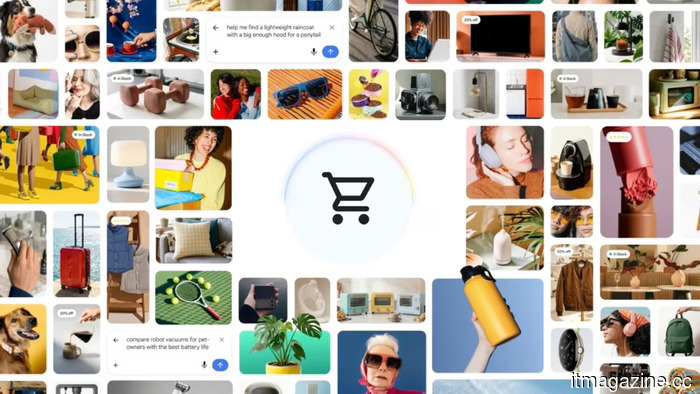 Google introduces Universal Cart and enhances AP2 at I/O 2026.
Google introduced Universal Cart, an AI shopping center that integrates Search, Gemini, YouTube, and Gmail, while also updating its Agent Payments Protocol for automated purchases.
Google introduces Universal Cart and enhances AP2 at I/O 2026.
Google introduced Universal Cart, an AI shopping center that integrates Search, Gemini, YouTube, and Gmail, while also updating its Agent Payments Protocol for automated purchases.
 The Design Trade-Offs Influencing Contemporary UV Printing Systems
UV printing depends on precisely regulated chemical reactions, as even minor changes in ink behavior can impact production, upkeep, and long-term dependability. As this technology is adopted by smaller studios and home environments, the discussion surrounding open versus closed ink systems increasingly focuses on finding a balance between flexibility, stability, and user-friendliness.
The Design Trade-Offs Influencing Contemporary UV Printing Systems
UV printing depends on precisely regulated chemical reactions, as even minor changes in ink behavior can impact production, upkeep, and long-term dependability. As this technology is adopted by smaller studios and home environments, the discussion surrounding open versus closed ink systems increasingly focuses on finding a balance between flexibility, stability, and user-friendliness.
 Google introduces Android CLI 1.0 for AI programming agents.
Google's stable Android CLI 1.0 provides AI agents such as Claude Code, Codex, and Antigravity with direct command line access to Android Studio's toolchain.
Google introduces Android CLI 1.0 for AI programming agents.
Google's stable Android CLI 1.0 provides AI agents such as Claude Code, Codex, and Antigravity with direct command line access to Android Studio's toolchain.
 You can now explore AI-generated versions of actual locations with Google’s Project Genie.
Google's experimental Project Genie is no longer solely creating worlds from imagination. With the inclusion of Street View, the distinction between actual locations and AI-generated environments is beginning to blend in intriguing ways.
At I/O 2026, Google introduces voice prompting features for Docs, Keep, and Gmail.
At I/O 2026, Google introduced voice-enabled AI capabilities for Docs, Keep, and Gmail, allowing users to generate documents and search their emails through voice commands rather than typing.
You can now explore AI-generated versions of actual locations with Google’s Project Genie.
Google's experimental Project Genie is no longer solely creating worlds from imagination. With the inclusion of Street View, the distinction between actual locations and AI-generated environments is beginning to blend in intriguing ways.
At I/O 2026, Google introduces voice prompting features for Docs, Keep, and Gmail.
At I/O 2026, Google introduced voice-enabled AI capabilities for Docs, Keep, and Gmail, allowing users to generate documents and search their emails through voice commands rather than typing.
Google introduces voice prompting for Docs, Keep, and Gmail at I/O 2026.
At I/O 2026, Google introduced voice-activated AI functionalities for Docs, Keep, and Gmail, enabling users to generate documents and search through their inboxes by speaking rather than typing.