

Google DeepMind links Street View to the Project Genie world model | TNW
Google DeepMind has linked its Project Genie world model with 20 years’ worth of Google Street View images, enabling users to explore AI-generated simulations of real places. This integration, announced during the Google I/O developer conference on Monday, represents one of the most significant examples of what generative world models can achieve when utilized alongside an extensive real-world dataset.
Project Genie, the company’s versatile system for creating interactive settings, now has access to over 280 billion images collected from 110 countries across all seven continents. Consequently, it allows users to immerse themselves in simulated environments, such as a snow-covered New York City block or a sunny London street, and navigate them in real time.
From research demo to consumer offering
Genie 3, the model's latest version, was first introduced as a research preview in August 2025, as part of Google's wider initiative to integrate AI throughout its platforms. In January 2026, DeepMind granted access to Google AI Ultra subscribers in the United States. The Street View integration is currently being rolled out to select Ultra users in the US, with a global expansion planned for the coming weeks.
Jack Parker-Holder, a research scientist on DeepMind’s open-endedness team, emphasized that the feature caters to two different groups. Robotics developers can utilize it to train agents in simulated settings that closely resemble actual locations, while regular users can explore it for enjoyment.
Waymo is already utilizing it
The robotics aspect is already in practice. Genie 3 powers one of Waymo’s simulators, where the self-driving car company trains on rare situations that would be too dangerous or impractical to recreate in real life, such as tornadoes or unexpected encounters with elephants on roads. Grounding these simulations in real Street View geography adds an extra layer of realism.
This simulation-to-reality pipeline is increasingly vital in physical AI. Companies like Nvidia and Cadence are vying to bridge the gap between what robots learn in simulations and their performance in real-world applications. DeepMind’s method of layering generative models over real-world imagery provides a unique approach.
Not yet photorealistic, but impressive
Diego Rivas, a product manager at DeepMind, warned that the Street View integration is still experimental. The generated environments resemble a video game more than a photograph, and the model currently lacks an awareness of physics. In one demonstration, a character passed directly through a line of cacti without any effect.
Parker-Holder acknowledged the discrepancies, estimating that interactive world generation still lags behind video generation by about six to twelve months in terms of precision. For reference, Google’s Veo model has already incorporated basic physics, and its Nano Banana tool can create flawless text in infographics. Genie has not yet reached that level.
The advantage of spatial continuity
According to Jonathan Herbert, director of Google Maps, one aspect that functions effectively is spatial continuity. When you turn 360 degrees within a Genie-generated environment, the AI retains awareness of what’s behind you, maintaining a coherent representation of the space instead of recreating it from the ground up with every viewpoint change.
Herbert described this spatial awareness as a significant breakthrough. After two decades of capturing the world through Street View, the Maps team has long sought ways to build richer models on that data. Genie seems to be a promising solution or at least the start of one.
What's next
The launch aligns with a larger trend at Google, where the company is gradually integrating AI features into existing products with large user bases. The extensive dataset of Street View creates a competitive advantage that other AI labs cannot easily replicate, and linking it to a generative world model transforms a static mapping tool into a more dynamic experience.
It remains to be seen whether Genie’s simulated streets will ever match the quality of dedicated game engines or professional video productions. For the time being, this feature serves as an intriguing proof of concept, suggesting a future where the distinction between navigating a map and exploring a living, AI-generated world becomes increasingly blurred.
Other articles
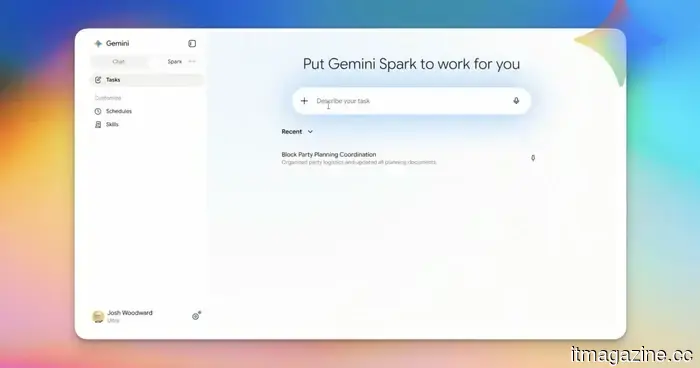 Google's latest Gemini Spark AI agent can take care of your tasks while you manage your life.
Google's Gemini Spark is an innovative AI assistant that manages multi-step tasks in the background, operates within Google's applications, and continues functioning even when you shut your laptop.
Google's latest Gemini Spark AI agent can take care of your tasks while you manage your life.
Google's Gemini Spark is an innovative AI assistant that manages multi-step tasks in the background, operates within Google's applications, and continues functioning even when you shut your laptop.
 Google Search will now indicate whether an image is generated by AI and provide detailed information about it.
Google is extending its SynthID technology to Search, Chrome, and Android to assist users in more easily recognizing images that have been generated or altered by AI.
Google Search will now indicate whether an image is generated by AI and provide detailed information about it.
Google is extending its SynthID technology to Search, Chrome, and Android to assist users in more easily recognizing images that have been generated or altered by AI.
 Google's Gemini Omni is a versatile content creation tool designed to take the place of your entire studio.
Gemini Omni not only generates AI videos but also retains your edits, comprehends physics, and allows you to direct everything through simple dialogue. Here’s what it truly offers and who can access it now.
Google's Gemini Omni is a versatile content creation tool designed to take the place of your entire studio.
Gemini Omni not only generates AI videos but also retains your edits, comprehends physics, and allows you to direct everything through simple dialogue. Here’s what it truly offers and who can access it now.
 Google’s Gemini Omni is a versatile content generator aiming to take over the functions of your entire studio.
Gemini Omni not only produces AI videos but also retains your edits, comprehends physics, and allows you to control everything through simple conversation. Here's what it truly offers and who can access it today.
Google’s Gemini Omni is a versatile content generator aiming to take over the functions of your entire studio.
Gemini Omni not only produces AI videos but also retains your edits, comprehends physics, and allows you to control everything through simple conversation. Here's what it truly offers and who can access it today.
 Microsoft's latest Surface PCs are becoming more intelligent, more expensive, and surprisingly adept at maintaining confidentiality.
Microsoft has recently unveiled its newest generation of Surface series laptops specifically targeting the business sector. The updated Surface Pro and Surface Laptop for Business models feature Intel’s latest Core Ultra Series 3 processors, on-device AI capabilities, enhanced security, and various other enhancements designed to cater to business needs. What features do these devices provide, and how substantial […]
Microsoft's latest Surface PCs are becoming more intelligent, more expensive, and surprisingly adept at maintaining confidentiality.
Microsoft has recently unveiled its newest generation of Surface series laptops specifically targeting the business sector. The updated Surface Pro and Surface Laptop for Business models feature Intel’s latest Core Ultra Series 3 processors, on-device AI capabilities, enhanced security, and various other enhancements designed to cater to business needs. What features do these devices provide, and how substantial […]
 Microsoft has announced that new Surface laptops featuring Snapdragon X2 chips will be released later this year.
Microsoft introduced Intel Surface models today and announced that Snapdragon X2 variants will be available later in 2026, featuring accelerated AI inferencing, improved battery life, and a potential OLED display option.
Microsoft has announced that new Surface laptops featuring Snapdragon X2 chips will be released later this year.
Microsoft introduced Intel Surface models today and announced that Snapdragon X2 variants will be available later in 2026, featuring accelerated AI inferencing, improved battery life, and a potential OLED display option.
Google DeepMind links Street View to the Project Genie world model | TNW
Google DeepMind has connected two decades of Street View images to its Genie world model, enabling AI Ultra subscribers to navigate AI-created simulations of actual streets.