

Google DeepMind links Street View to Project Genie world model | TNW
Google DeepMind has linked its Project Genie world model to 20 years of Street View images, enabling users to explore AI-created simulations of actual locations. This integration, revealed at the Google I/O developer conference, showcases how generative world models can effectively utilize a vast real-world dataset.
Project Genie, a flexible system designed for crafting interactive environments, can now access over 280 billion images from 110 countries and all seven continents. This allows users to experience a simulated version of a snow-covered block in New York City or a sunlit street in London, navigating in real time.
Initially introduced as a research preview in August 2025, Genie 3 is part of Google's extensive effort to incorporate AI throughout its platform. Access for Google AI Ultra subscribers in the US began in January 2026, and the Street View integration is currently being rolled out to select Ultra users, with global expansion expected in the coming weeks.
Jack Parker-Holder, a research scientist on DeepMind's open-endedness team, mentioned that the feature aims to cater to two main groups: robotics developers, who can utilize it for training in simulated environments that reflect real locations, and casual users, who can explore just for enjoyment.
Waymo is already utilizing these capabilities, using Genie 3 in one of its simulators to prepare for rare situations that would be risky or impractical to simulate in reality, such as tornadoes or unexpected encounters with elephants. Grounding these scenarios in actual Street View locations adds a layer of authenticity.
This simulation-to-reality connection has become a key challenge in the field of physical AI, as companies like Nvidia and Cadence strive to bridge the gap between what robots learn in simulations and their performance in the real world. DeepMind's method of combining generative models with real-world images presents a unique approach.
However, Diego Rivas, a product manager at DeepMind, noted that the Street View integration is still in an experimental stage. The generated environments resemble video game graphics more than photographs, and the model currently lacks physics-awareness. In one instance, a character ran through a row of cacti without any reaction.
Parker-Holder highlighted that interactive world generation is currently about six to twelve months behind video generation in terms of precision. In contrast, Google's Veo model already comprehends basic physics, while its Nano Banana tool can produce flawless text in infographics—something Genie has yet to achieve.
Jonathan Herbert, director of Google Maps, emphasized that one successful aspect is spatial continuity. When users turn 360 degrees within a Genie-created environment, the AI retains memory of what was behind them, maintaining a consistent model of the space rather than regenerating it with each viewpoint adjustment.
Herbert views this spatial awareness as a significant advancement. With two decades of data collection from Street View, the Maps team has long considered how to develop more detailed models based on this information. Genie appears to be a preliminary solution.
This launch aligns with Google's broader strategy, which focuses on integrating AI capabilities into well-established products. Street View's extensive dataset provides a competitive advantage that other AI labs cannot easily replicate, transforming a simple mapping tool into a more dynamic experience when linked with a generative world model.
It remains to be seen whether Genie’s simulated streets will ever match the quality of specialized game engines or professional video production. For now, it serves as a compelling proof of concept, suggesting a future where navigating a map and exploring a vibrant, AI-generated world become increasingly indistinguishable.
Other articles
 Apple introduces new accessibility features powered by AI for the iPhone, Mac, and Vision Pro.
Apple has introduced new AI-driven accessibility features, which include enhanced VoiceOver tools, automatic subtitles, better reading assistance, and eye-controlled wheelchair support for Vision Pro.
Apple introduces new accessibility features powered by AI for the iPhone, Mac, and Vision Pro.
Apple has introduced new AI-driven accessibility features, which include enhanced VoiceOver tools, automatic subtitles, better reading assistance, and eye-controlled wheelchair support for Vision Pro.
 Microsoft has announced that new Surface laptops featuring Snapdragon X2 chips will be released later this year.
Microsoft introduced Intel Surface models today and announced that Snapdragon X2 variants will be released later in 2026, featuring faster AI inferencing, improved battery life, and a potential OLED display option.
Microsoft has announced that new Surface laptops featuring Snapdragon X2 chips will be released later this year.
Microsoft introduced Intel Surface models today and announced that Snapdragon X2 variants will be released later in 2026, featuring faster AI inferencing, improved battery life, and a potential OLED display option.
 Fortnite has returned to the App Store globally as the conflict between Epic and Apple reaches its concluding stage.
Fortnite is making a comeback to Apple's App Store globally as Epic Games persists in its legal and regulatory battle against Apple's app store limitations.
Fortnite has returned to the App Store globally as the conflict between Epic and Apple reaches its concluding stage.
Fortnite is making a comeback to Apple's App Store globally as Epic Games persists in its legal and regulatory battle against Apple's app store limitations.
 Android Halo might serve as the crucial connection between Android and AI agents.
Google's new Android Halo feature suggests a future where AI seamlessly supports you without requiring constant interaction. The most intriguing aspect is how minimally it interferes with your activities.
Android Halo might serve as the crucial connection between Android and AI agents.
Google's new Android Halo feature suggests a future where AI seamlessly supports you without requiring constant interaction. The most intriguing aspect is how minimally it interferes with your activities.
 EXCLUSIVE: Spider-Noir showrunner Oren Uziel discusses the development of Nicolas Cage’s new dark Spider-Man series.
Few superhero franchises maintain their status in pop culture as strongly as Spider-Man. As anticipation grows for upcoming films such as Spider-Man: Brand New Day and Spider-Man: Beyond the Spider-Verse, Sony is now expanding the web-slinger's universe onto streaming platforms with a new live-action series titled Spider-Noir, which is being developed by Oren Uziel and set in the 1930s noir style.
EXCLUSIVE: Spider-Noir showrunner Oren Uziel discusses the development of Nicolas Cage’s new dark Spider-Man series.
Few superhero franchises maintain their status in pop culture as strongly as Spider-Man. As anticipation grows for upcoming films such as Spider-Man: Brand New Day and Spider-Man: Beyond the Spider-Verse, Sony is now expanding the web-slinger's universe onto streaming platforms with a new live-action series titled Spider-Noir, which is being developed by Oren Uziel and set in the 1930s noir style.
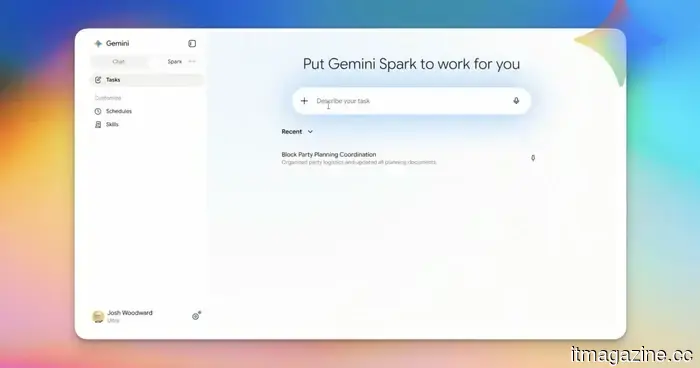 Google's latest Gemini Spark AI agent can take care of your tasks while you manage your life.
Google's Gemini Spark is an innovative AI assistant that manages multi-step tasks in the background, operates within Google's applications, and continues functioning even when you shut your laptop.
Google's latest Gemini Spark AI agent can take care of your tasks while you manage your life.
Google's Gemini Spark is an innovative AI assistant that manages multi-step tasks in the background, operates within Google's applications, and continues functioning even when you shut your laptop.
Google DeepMind links Street View to Project Genie world model | TNW
Google DeepMind has connected 20 years of Street View images to its Genie world model, enabling AI Ultra subscribers to navigate AI-generated simulations of actual streets.