

Step aside gigabytes, AI tokens are now the latest currency on your phone bill.
It’s truly remarkable how swiftly artificial intelligence has evolved from a futuristic concept to something that individuals depend on daily. Tools such as ChatGPT, Claude, and Gemini are gradually integrating into our routine digital experiences—assisting with email composition, document summaries, schedule planning, code debugging, and even aiding in problem-solving. A recent report indicates that telecom companies in China are capitalizing on this transition in a manner that is both intriguing and somewhat unsettling: they are offering AI token plans similarly to mobile data packages.
Indeed, AI usage quotas are beginning to take shape. Instead of focusing on depleting 5GB of data by month’s end, individuals might soon be concerned about whether they have enough tokens for a few interactions with ChatGPT, AI-generated visuals, or coding tasks.
Telecom companies have already recognized this trend.
China Telecom, one of the largest carriers in the country, has reportedly launched specific AI token packages. Consumer plans start at 9.9 yuan (approximately $1.45) for 10 million tokens and can go up to 80 million tokens in more expensive tiers. Plans targeted towards businesses for coding tasks and AI agents reach as high as 250 million tokens per month. The figures may sound vastly inflated until one grasps what tokens entail.
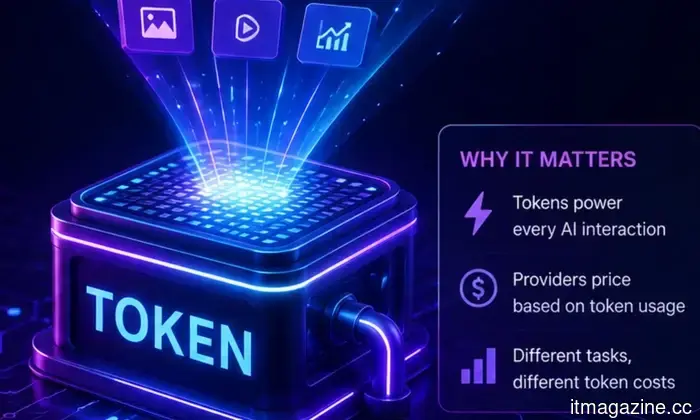
Tokens are the small units of language and data that AI systems process. Each sentence input into an AI chatbot is broken down into tokens, and the AI consumes tokens for every response it generates. This includes images and code, which also utilize tokens.
Generally speaking, one token equates to about four characters or roughly three-quarters of a word in English. Although a million tokens may seem substantial, AI systems can exhaust them rapidly when producing lengthy documents, analyzing files, or working with images. According to the report, processing a high-resolution image may use between 200 and 1,000 tokens alone. What captivates me the most is not the actual pricing, but rather what this indicates about the tech industry’s views on the future of AI.
Telecom companies are regarding AI similarly to how they once viewed internet access: a utility for which people will consistently pay monthly. This represents a significant psychological shift. AI is no longer perceived as an extravagant application on top of the internet; instead, it is being woven into the fabric of the internet experience itself.
That future seems imminent.
China Telecom is reportedly combining these token plans with its own TeleChat AI system, while also accommodating third-party models like DeepSeek and GLM-5. Concurrently, other leading Chinese carriers are adopting a similar strategy. China Unicom has rolled out regional token plans, and China Mobile is testing comparable offerings across various provinces earlier this year.
This timing is not coincidental. Demand for AI in China is, quite frankly, skyrocketing. The report references government statistics revealing that daily AI token calls surged to over 140 trillion in March—a thousand-fold increase since early 2024. That figure almost seems unbelievable until we recall how deeply AI has entrenched itself into daily life over the past year.
The peculiar aspect is that most individuals likely won’t even recognize this transition at first. AI token plans are expected to emerge under the guise of “AI assistant bundles,” “premium productivity packages,” or “smart services.” However, behind all this marketing jargon, the industry is constructing an entirely new economy centered around AI consumption.
We spent decades paying for access to online information, and now it seems we are entering a phase where we are paying for the very capacity to think.

Other articles
 Peter Steinberger's 100 AI agents accumulated $1.3 million in OpenAI tokens within 30 days by developing OpenClaw.
The bill totaled 603 billion tokens from 7.6 million requests across 100 Codex instances utilizing GPT-5.5. Turning off Fast Mode would reduce the expense to $300,000, underscoring the actual financial aspects of developing autonomous AI.
Peter Steinberger's 100 AI agents accumulated $1.3 million in OpenAI tokens within 30 days by developing OpenClaw.
The bill totaled 603 billion tokens from 7.6 million requests across 100 Codex instances utilizing GPT-5.5. Turning off Fast Mode would reduce the expense to $300,000, underscoring the actual financial aspects of developing autonomous AI.
 HistoSonics has obtained TFDA approval in Taiwan for the Edison Histotripsy System, which speeds up its expansion in Asia.
The non-invasive focused ultrasound technology eliminates liver tumors without the need for surgery or radiation. Supported by Bezos Expeditions and valued at $2.25 billion, HistoSonics has also filed with the FDA concerning kidney tumors on May 11.
HistoSonics has obtained TFDA approval in Taiwan for the Edison Histotripsy System, which speeds up its expansion in Asia.
The non-invasive focused ultrasound technology eliminates liver tumors without the need for surgery or radiation. Supported by Bezos Expeditions and valued at $2.25 billion, HistoSonics has also filed with the FDA concerning kidney tumors on May 11.
 Researchers have recently set a new record for wireless speed that may influence the future of 6G technology.
Researchers achieved 112Gbps through a 560GHz wireless connection, demonstrating how terahertz technology powered by microcombs could accelerate data transmission for future 6G networks.
Researchers have recently set a new record for wireless speed that may influence the future of 6G technology.
Researchers achieved 112Gbps through a 560GHz wireless connection, demonstrating how terahertz technology powered by microcombs could accelerate data transmission for future 6G networks.
 Amazon introduces Alexa Podcasts, an AI capability that produces complete episodes using licensed news material.
Alexa+ is now able to produce podcast episodes on a wide range of topics, featuring narration by two AI-generated co-hosts. This capability leverages licensing agreements with organizations such as AP, Reuters, the Washington Post, and over 200 local newspapers.
Amazon introduces Alexa Podcasts, an AI capability that produces complete episodes using licensed news material.
Alexa+ is now able to produce podcast episodes on a wide range of topics, featuring narration by two AI-generated co-hosts. This capability leverages licensing agreements with organizations such as AP, Reuters, the Washington Post, and over 200 local newspapers.
 Nostalgic for the old PC era? This website allows you to interact with Wikipedia as if you were using Windows XP.
A new web initiative transforms Wikipedia into a desktop interface reminiscent of Windows XP, allowing users to navigate through categories, articles, and Wikimedia Commons as if they were browsing folders rather than searching through pages.
Nostalgic for the old PC era? This website allows you to interact with Wikipedia as if you were using Windows XP.
A new web initiative transforms Wikipedia into a desktop interface reminiscent of Windows XP, allowing users to navigate through categories, articles, and Wikimedia Commons as if they were browsing folders rather than searching through pages.
 Coursera initiates a $500 million share buyback program just days after finalizing its merger with Udemy.
The buyback, which is financed using current cash reserves, occurs as COUR's stock is close to its 52-week low of $5.00. The merged Coursera-Udemy platform reports having 290 million learners and aims to achieve $115 million in annual cost synergies.
Coursera initiates a $500 million share buyback program just days after finalizing its merger with Udemy.
The buyback, which is financed using current cash reserves, occurs as COUR's stock is close to its 52-week low of $5.00. The merged Coursera-Udemy platform reports having 290 million learners and aims to achieve $115 million in annual cost synergies.
Step aside gigabytes, AI tokens are now the latest currency on your phone bill.
China's telecommunications firms are beginning to approach AI usage similarly to mobile data, indicating a future for technology that may be more unconventional than many anticipated.