

Peter Steinberger's 100 AI agents accumulated $1.3 million in OpenAI tokens within 30 days by developing OpenClaw.
**TL;DR**: Peter Steinberger, the creator of OpenClaw, incurred costs of $1.3 million in OpenAI API tokens within 30 days while operating 100 Codex instances for his open-source project. This expenditure was funded by OpenAI, where Steinberger is now employed. It amounts to 603 billion tokens and 7.6 million requests, providing a significant data point on the expenses of large-scale autonomous AI coding.
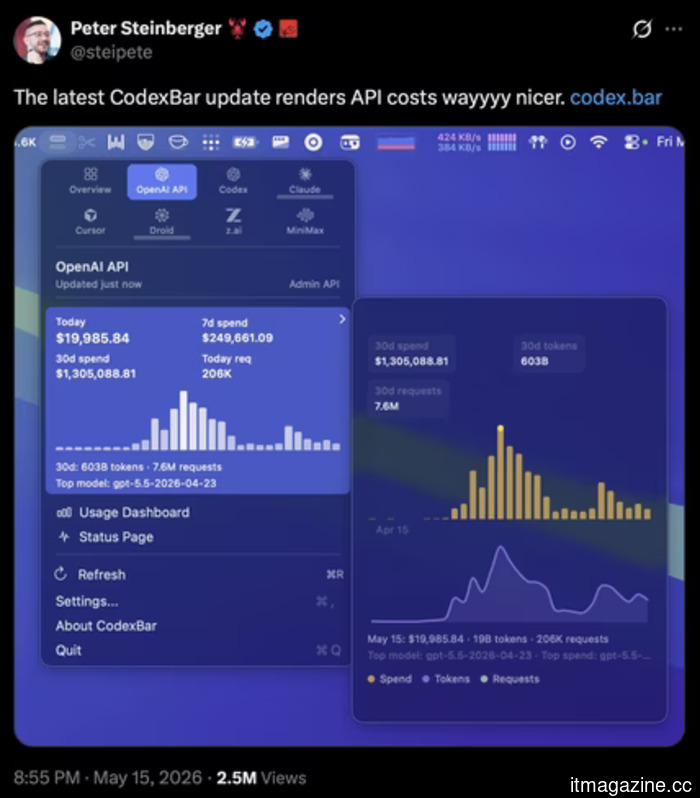
Peter Steinberger, an engineer at OpenAI and the mind behind OpenClaw, accumulated $1.3 million in API expenses in a single month by running nearly 100 Codex instances concurrently for his open-source initiative. This billing, which involved 603 billion tokens across 7.6 million requests over 30 days, serves as a clear illustration of the financial implications of AI-driven software development without budget limitations, highlighting how quickly costs can rise when autonomous agents are deployed extensively.
Steinberger shared a screenshot of the invoice on X, indicating a charge of $1,305,088.81 for the OpenAI API, primarily utilizing the GPT-5.5 model. OpenAI covers these expenses because Steinberger has been with the company since February 2026, and the spending is viewed as a research investment to explore software development without token cost restrictions.
### **Functionality of the Agents**
The 100 Codex instances are not merely producing code. Steinberger's team of three has established an autonomous development pipeline where AI agents handle various tasks typically requiring a larger engineering workforce. These agents review pull requests, check commits for security flaws, consolidate GitHub issues, draft fixes, and initiate new pull requests according to the project's broader roadmap. Additionally, some agents track performance benchmarks and notify the team via Discord about regressions. Reports suggest that some agents even participate in meetings and create pull requests for new features raised during discussions.
The team also employs Clawpatch.ai, Vercel’s Deepsec, and Codex Security for further bug and security examination. Consequently, the development operation is managed by three humans who oversee a fleet of AI agents performing the work typically associated with a mid-sized engineering team.
### **Financial Considerations**
Steinberger has been open regarding the financial implications. He explained that the $1.3 million figure is based on Codex’s “Fast Mode” pricing, which consumes credits at a considerably higher rate than standard execution. Disabling Fast Mode would lower the raw API cost to around $300,000 monthly, a reduction of 70%. Under standard pricing, the operation would still total $3.6 million annually, but the difference between the prominent figure and the actual economics highlights how pricing tiers and execution modes can significantly inflate reported costs.
When questioned about return on investment, Steinberger stated that everything his team creates is open source and compatible with top proprietary models, as well as open-weight alternatives. “I'd say pretty high,” he remarked.
The information is valuable particularly because vendor marketing surrounding AI coding tools seldom reveals raw spending and token quantities at this scale. Most enterprise teams looking to implement autonomous development tools are relying on estimates. Steinberger's bill serves as a tangible, public data point: maintaining 100 continuously operating agents for 30 days on a large open-source codebase costs between $300,000 and $1.3 million monthly, depending on execution speed, before any optimization.
### **About Peter Steinberger**
Steinberger is well-versed in developing developer tools at scale. The Austrian engineer founded PSPDFKit in 2011, creating a PDF rendering and annotation framework that became the industry standard for mobile document management. By 2021, PSPDFKit had been integrated into apps on over one billion devices globally, and the company garnered $116 million in funding from Insight Partners, marking its first external investment after a decade of profitable, self-funded growth.
After departing from PSPDFKit, Steinberger began exploring AI agents as a personal endeavor. OpenClaw, a self-hosted autonomous AI assistant that operates solely on users’ own hardware, rapidly became the fastest-growing open-source project in GitHub history, amassing over 302,000 stars by April 2026—surpassing React, Vue.js, and TensorFlow in far less time. The framework connects to commonly used tools such as email, calendars, browsers, and messaging platforms like Slack and Discord, allowing AI agents to execute shell commands, file management, and local automation of web tasks.
Upon joining OpenAI, Steinberger announced that OpenClaw would transition to an independent foundation to maintain its open-source nature. “I want to change the world, not build a large company,” he expressed. “Pairing with OpenAI is the quickest way to bring this to everyone.”
### **Implications for AI Coding Economics**
The $1.3 million invoice arrives during a pivotal time when the economics of AI-driven development are a key concern in the software industry. OpenAI recently opened
Other articles
 Meta eliminates 8,000 positions while reporting a record $56 billion in quarterly revenue, as Zuckerberg invests $145 billion in AI infrastructure.
Employee morale has plummeted following Meta's announcement of record profits while cutting 10 percent of its workforce. Additional layoffs are anticipated in August and fall 2026 as the company shifts payroll into AI capital expenditures.
Meta eliminates 8,000 positions while reporting a record $56 billion in quarterly revenue, as Zuckerberg invests $145 billion in AI infrastructure.
Employee morale has plummeted following Meta's announcement of record profits while cutting 10 percent of its workforce. Additional layoffs are anticipated in August and fall 2026 as the company shifts payroll into AI capital expenditures.
 Experts are concerned that as artificial intelligence becomes more intelligent, we may become less intelligent.
As AI transforms intelligence into a readily available service, specialists caution that immediate responses may diminish the curiosity, critical thinking, and verification practices that are essential to valuable human reasoning.
Experts are concerned that as artificial intelligence becomes more intelligent, we may become less intelligent.
As AI transforms intelligence into a readily available service, specialists caution that immediate responses may diminish the curiosity, critical thinking, and verification practices that are essential to valuable human reasoning.
 Researchers have set a new record for wireless speed that may influence the future of 6G technology.
Researchers achieved a speed of 112Gbps through a 560GHz wireless connection, demonstrating how terahertz technology driven by microcombs could enhance data transfer rates in future 6G networks behind the scenes.
Researchers have set a new record for wireless speed that may influence the future of 6G technology.
Researchers achieved a speed of 112Gbps through a 560GHz wireless connection, demonstrating how terahertz technology driven by microcombs could enhance data transfer rates in future 6G networks behind the scenes.
 Step aside gigabytes, AI tokens have become the latest unit on your phone bill.
China's telecommunications firms are beginning to approach AI utilization similarly to mobile data, and this transition suggests a future for technology that is more unconventional than many anticipated.
Step aside gigabytes, AI tokens have become the latest unit on your phone bill.
China's telecommunications firms are beginning to approach AI utilization similarly to mobile data, and this transition suggests a future for technology that is more unconventional than many anticipated.
 Meta eliminates 8,000 positions while reporting a historic $56 billion in quarterly revenue, as Zuckerberg invests $145 billion in AI infrastructure.
Employee morale has plummeted as Meta announces record profits while cutting 10 percent of its staff. Further layoffs are anticipated in August and fall 2026 as the company shifts payroll into investments in AI technology.
Meta eliminates 8,000 positions while reporting a historic $56 billion in quarterly revenue, as Zuckerberg invests $145 billion in AI infrastructure.
Employee morale has plummeted as Meta announces record profits while cutting 10 percent of its staff. Further layoffs are anticipated in August and fall 2026 as the company shifts payroll into investments in AI technology.
 The breach at NYC Health and Hospitals has revealed the medical records, fingerprints, and geolocation information of 1.8 million individuals.
The hackers were able to access the network for over two months before being discovered, taking biometric data that individuals cannot replace. The security incident started through an unnamed third-party vendor.
The breach at NYC Health and Hospitals has revealed the medical records, fingerprints, and geolocation information of 1.8 million individuals.
The hackers were able to access the network for over two months before being discovered, taking biometric data that individuals cannot replace. The security incident started through an unnamed third-party vendor.
Peter Steinberger's 100 AI agents accumulated $1.3 million in OpenAI tokens within 30 days by developing OpenClaw.
The bill totaled 603 billion tokens from 7.6 million requests across 100 Codex instances utilizing GPT-5.5. Turning off Fast Mode would reduce the expense to $300,000, underscoring the actual financial aspects of developing autonomous AI.