
Researchers have recently set a new record for wireless speed that may influence the future of 6G technology.
Researchers achieved 112Gbps on a 560GHz wireless connection, indicating potential for faster backhaul before 6G devices hit the market.
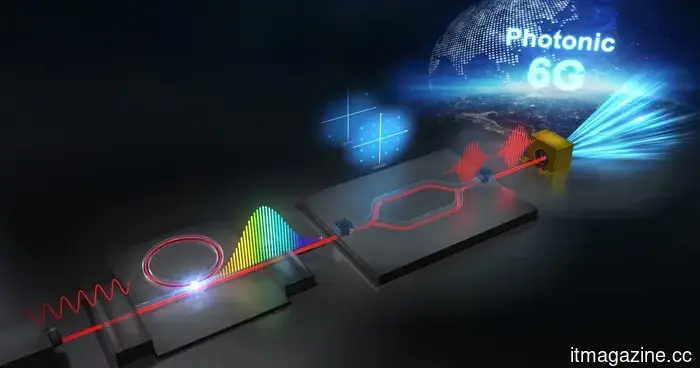
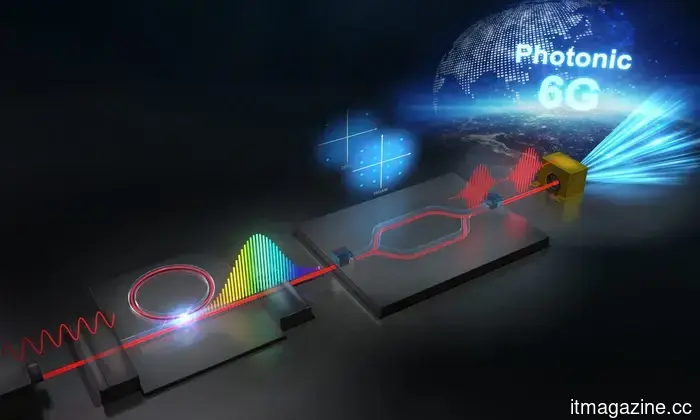
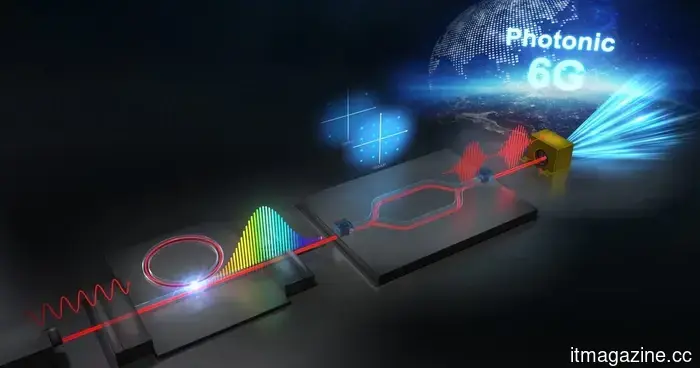
A team from Tokushima University has reached wireless speeds that surpass the capabilities of current mobile networks. They managed to demonstrate a wireless connection of 112Gbps in the 560GHz band by utilizing soliton microcombs to produce a more stable terahertz signal intended for future 6G systems.
For now, the focus is not on faster smartphones but rather on the underlying infrastructure that manages data between network locations. The capacity for backhaul can influence whether the expected speeds of 6G can be realized or if they become limited by congested network connections. Thus, this represents a significant advancement in 6G speed that is worth monitoring, even if it won't be visible to consumers in the immediate future.
Why is this achievement significant?
The 112Gbps speed is bolstered by the 560GHz frequency. The team transmitted a single-channel wireless signal far beyond the point where traditional electronic equipment encounters reduced output power and increased signal noise.
This frequency range resides in the terahertz spectrum, which researchers are investigating to create wider data pathways for 6G. Previous communication systems operating at these frequencies typically achieved speeds ranging from a few to several dozen gigabits per second. This recent test has exceeded the 100Gbps threshold in the 420GHz range, elevating the work to a more advanced stage.
How was the signal kept clear?
At these high frequencies, achieving speed relies heavily on control as much as on bandwidth. Factors like phase noise and limited output power can complicate maintaining stable wireless transmission, particularly when transmitting higher volumes of data through a single channel.
Tokushima University’s setup employs a compact fiber-coupled microresonator, minimizing the need for exact optical alignment. Additionally, it features temperature control to enhance the consistency of optical resonance behavior. While these aspects may seem minor, they are crucial engineering advancements that differentiate showy lab results from practical, sustained operations.
When will real networks get closer?
It’s important not to interpret this finding as an imminent smartphone upgrade. The researchers still face challenges in further reducing phase noise, supporting higher-order modulation, enhancing terahertz output power, and improving transmission distances through superior antenna design.
The initial application of this technology is likely to be in mobile backhaul or photonic-wireless network links. Although this is less visible than the launch of new 6G smartphones, it plays a vital role in the network's operation. Before 6G can provide high speeds to consumer devices, the supporting infrastructure must be able to transmit data more efficiently.





Other articles
 Researchers have just set a new wireless speed record that may influence the future of 6G technology.
Researchers achieved 112Gbps using a 560GHz wireless connection, demonstrating how microcomb-driven terahertz technology could enhance data transfer speeds in future 6G networks.
Researchers have just set a new wireless speed record that may influence the future of 6G technology.
Researchers achieved 112Gbps using a 560GHz wireless connection, demonstrating how microcomb-driven terahertz technology could enhance data transfer speeds in future 6G networks.
 Amazon introduces Alexa Podcasts, an AI capability that produces complete episodes using licensed news material.
Alexa+ is now able to produce podcast episodes on a wide range of topics, featuring narration by two AI-generated co-hosts. This capability leverages licensing agreements with organizations such as AP, Reuters, the Washington Post, and over 200 local newspapers.
Amazon introduces Alexa Podcasts, an AI capability that produces complete episodes using licensed news material.
Alexa+ is now able to produce podcast episodes on a wide range of topics, featuring narration by two AI-generated co-hosts. This capability leverages licensing agreements with organizations such as AP, Reuters, the Washington Post, and over 200 local newspapers.
 Researchers have set a new record for wireless speed that may influence the future of 6G technology.
Researchers achieved a speed of 112Gbps through a 560GHz wireless connection, demonstrating how terahertz technology driven by microcombs could enhance data transfer rates in future 6G networks behind the scenes.
Researchers have set a new record for wireless speed that may influence the future of 6G technology.
Researchers achieved a speed of 112Gbps through a 560GHz wireless connection, demonstrating how terahertz technology driven by microcombs could enhance data transfer rates in future 6G networks behind the scenes.
 Peter Steinberger's 100 AI agents accumulated $1.3 million in OpenAI tokens within 30 days by developing OpenClaw.
The total amounted to 603 billion tokens through 7.6 million requests from 100 Codex instances utilizing GPT-5.5. If Fast Mode were turned off, the expense would decrease to $300,000, but this number highlights the actual financial implications of developing autonomous AI.
Peter Steinberger's 100 AI agents accumulated $1.3 million in OpenAI tokens within 30 days by developing OpenClaw.
The total amounted to 603 billion tokens through 7.6 million requests from 100 Codex instances utilizing GPT-5.5. If Fast Mode were turned off, the expense would decrease to $300,000, but this number highlights the actual financial implications of developing autonomous AI.
 Do you long for the classic PC days? This website allows you to navigate Wikipedia as if you’re using Windows XP.
A new web project transforms Wikipedia into a Windows XP-style desktop, allowing categories, articles, and Wikimedia Commons to resemble folders that can be browsed instead of just pages to search through.
Do you long for the classic PC days? This website allows you to navigate Wikipedia as if you’re using Windows XP.
A new web project transforms Wikipedia into a Windows XP-style desktop, allowing categories, articles, and Wikimedia Commons to resemble folders that can be browsed instead of just pages to search through.
 Meta eliminates 8,000 positions while reporting a historic $56 billion in quarterly revenue, as Zuckerberg invests $145 billion in AI infrastructure.
Employee morale has plummeted as Meta announces record profits while cutting 10 percent of its staff. Further layoffs are anticipated in August and fall 2026 as the company shifts payroll into investments in AI technology.
Meta eliminates 8,000 positions while reporting a historic $56 billion in quarterly revenue, as Zuckerberg invests $145 billion in AI infrastructure.
Employee morale has plummeted as Meta announces record profits while cutting 10 percent of its staff. Further layoffs are anticipated in August and fall 2026 as the company shifts payroll into investments in AI technology.
Researchers have recently set a new record for wireless speed that may influence the future of 6G technology.
Researchers achieved 112Gbps through a 560GHz wireless connection, demonstrating how terahertz technology powered by microcombs could accelerate data transmission for future 6G networks.