

Coursera initiates a $500 million share buyback program just days after finalizing its merger with Udemy.
TL;DR: Coursera has initiated a $500 million share repurchase program, marking its first buyback, just one week after completing its $2.5 billion all-stock merger with Udemy. The newly formed company claims to have 290 million learners and projects over $1.5 billion in revenue for 2025.
Coursera has unveiled a $500 million share repurchase program, its initial buyback since going public in 2021, and this announcement comes exactly one week after completing its merger with Udemy. The board approved this initiative on May 18, 2026, which will be funded through existing cash reserves and operational cash flow, with no set expiration date.
The timing is quite strategic. By initiating a buyback shortly after acquiring a competitor in a $2.5 billion all-stock transaction, Coursera aims to convey to shareholders that it perceives its stock to be undervalued and possesses the liquidity to return capital while managing a significant acquisition. Shares of COUR have been trading around $5.90, significantly lower than its 52-week high of $13.56 and near the lower end of its range since its market debut.
The context of the Udemy merger is relevant here. Coursera completed its merger with Udemy on May 11, 2026, establishing what it labels as the world's most comprehensive skills platform. Shareholders of Udemy received 0.800 shares of Coursera common stock for each Udemy share, resulting in former Coursera shareholders owning approximately 59% of the new company while former Udemy shareholders accounted for about 41%. The merger was valued at roughly $2.5 billion.
The combined company now boasts over 290 million registered learners, 95,000 instructors and content creators, as well as partnerships with numerous universities and industry leaders across more than 315,000 courses. For the time being, both platforms will operate independently, allowing learners, instructors, and corporate customers to maintain their existing accounts, subscriptions, and agreements on Coursera.org and Udemy.com. Future integration details have yet to be announced.
The financial outlook for the merged entity is impressive. Coursera reported a combined revenue of over $1.5 billion for 2025 and has forecasted revenue between $805 million and $815 million for the full year of 2026. It is aiming for $115 million in annual cost synergies within 24 months post-merger, a figure that analysts will closely scrutinize to see if the two platforms can improve efficiencies without damaging one another’s revenue streams.
The decision to initiate a share buyback soon after a significant merger is a strategic move. The $500 million authorization is substantial given Coursera’s market capitalization and serves multiple purposes: it helps support the stock price during a time when dilution from issuing new shares to Udemy stockholders could lower it, it reflects management’s confidence in the cash generation of the combined entity, and it creates demand for shares that have lost over half their value from the 52-week high.
The program is designed with maximum flexibility. The board has allowed for purchases through open market transactions, privately negotiated agreements, or other methods, and retains the right to adjust, suspend, or terminate the program as needed. There is no commitment to repurchase a specific number of shares, a legal safeguard that also gives management latitude to adjust purchase levels based on market conditions and integration expenses.
Netflix authorized a $25 billion buyback in April following its own share price decline, and the trend of large tech companies using repurchase programs to stabilize valuations during uncertain periods has become increasingly common. While Coursera’s program is considerably smaller in absolute terms, it represents a similar level of dedication relative to the company's size.
The merger and buyback reflect Coursera's bet on the rising demand for AI-related skills training as a driver of growth for the combined platform. The company frames the Udemy acquisition as a means to cater to the entire skills market, leveraging Coursera's strength in university-accredited courses and professional certifications alongside Udemy’s marketplace of practitioner-led, on-demand training. The rationale is that both employers and individual learners will increasingly need both types of content as companies adapt their workforces to AI capabilities, and as the gap between traditional education and practical AI skills continues to widen.
The pace of this restructuring is increasing. On May 20, Meta announced plans to cut 8,000 jobs as part of an AI-driven reorganization, while the three major automakers in Detroit collectively eliminated 20,000 white-collar positions, a move analysts describe as a structural shift instead of a temporary downturn. Each wave of layoffs results in displaced workers needing new skills and employers needing to train remaining employees on AI tools, creating opportunities for platforms like Coursera and Udemy.
Whether the combined company can effectively meet this demand while concurrently integrating two distinct platforms, realizing $115 million in cost synergies, and returning $500 million to shareholders will be a question the
Other articles
 Your upcoming pipeline issue might begin in AI Search.
AI search is transforming the way B2B SaaS purchasers create their shortlists. Here's the reason visibility begins even before they set foot on your website.
Your upcoming pipeline issue might begin in AI Search.
AI search is transforming the way B2B SaaS purchasers create their shortlists. Here's the reason visibility begins even before they set foot on your website.
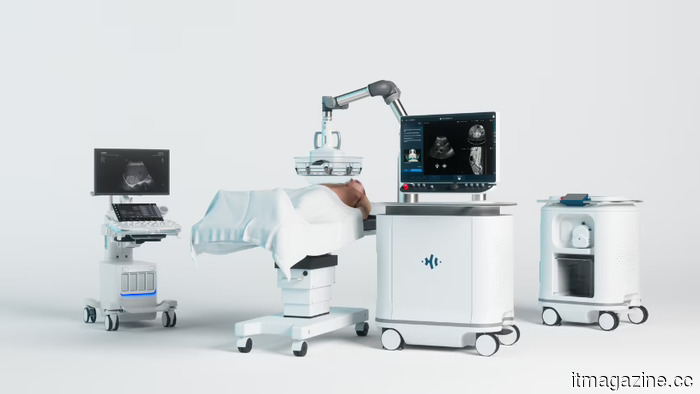 HistoSonics has obtained TFDA approval in Taiwan for the Edison Histotripsy System, which speeds up its expansion in Asia.
The non-invasive focused ultrasound technology eliminates liver tumors without the need for surgery or radiation. Supported by Bezos Expeditions and valued at $2.25 billion, HistoSonics has also filed with the FDA concerning kidney tumors on May 11.
HistoSonics has obtained TFDA approval in Taiwan for the Edison Histotripsy System, which speeds up its expansion in Asia.
The non-invasive focused ultrasound technology eliminates liver tumors without the need for surgery or radiation. Supported by Bezos Expeditions and valued at $2.25 billion, HistoSonics has also filed with the FDA concerning kidney tumors on May 11.
 Pope Leo XIV is set to release the AI encyclical titled Magnifica Humanitas on May 25, featuring Christopher Olah, co-founder of Anthropic.
The encyclical, signed to mark the 135th anniversary of Rerum Novarum, is anticipated to denounce the use of AI in warfare and discuss its effects on workers' rights. Olah heads the interpretability research at Anthropic.
Pope Leo XIV is set to release the AI encyclical titled Magnifica Humanitas on May 25, featuring Christopher Olah, co-founder of Anthropic.
The encyclical, signed to mark the 135th anniversary of Rerum Novarum, is anticipated to denounce the use of AI in warfare and discuss its effects on workers' rights. Olah heads the interpretability research at Anthropic.
 Grafana Labs rejects ransom demand after hackers obtain code that is already open source.
Grafana Labs has revealed that hackers obtained its source code by exploiting a compromised GitHub token and have requested a ransom.
Sigma Computing secures $80 million in Series E funding, achieving a valuation of $3 billion, with support from Databricks, ServiceNow, and Workday Ventures.
The analytics firm based in San Francisco reached an annual recurring revenue of $200 million in April, reflecting a year-over-year increase of 100%. Its no-code AI offering, Sigma Agents, has become the most rapidly adopted feature in the company's history.
Omnia and Casa dos Ventos finalize a $2 billion power agreement to support TikTok's data center in Brazil.
Omnia and Casa dos Ventos have finalized a renewable-energy supply agreement worth approximately $2 billion, which will support TikTok's $9.8 billion data center in Pecém, Ceará, marking ByteDance's inaugural dedicated facility in Latin America.
Grafana Labs rejects ransom demand after hackers obtain code that is already open source.
Grafana Labs has revealed that hackers obtained its source code by exploiting a compromised GitHub token and have requested a ransom.
Sigma Computing secures $80 million in Series E funding, achieving a valuation of $3 billion, with support from Databricks, ServiceNow, and Workday Ventures.
The analytics firm based in San Francisco reached an annual recurring revenue of $200 million in April, reflecting a year-over-year increase of 100%. Its no-code AI offering, Sigma Agents, has become the most rapidly adopted feature in the company's history.
Omnia and Casa dos Ventos finalize a $2 billion power agreement to support TikTok's data center in Brazil.
Omnia and Casa dos Ventos have finalized a renewable-energy supply agreement worth approximately $2 billion, which will support TikTok's $9.8 billion data center in Pecém, Ceará, marking ByteDance's inaugural dedicated facility in Latin America.
Coursera initiates a $500 million share buyback program just days after finalizing its merger with Udemy.
The buyback, which is financed using current cash reserves, occurs as COUR's stock is close to its 52-week low of $5.00. The merged Coursera-Udemy platform reports having 290 million learners and aims to achieve $115 million in annual cost synergies.