

Peter Steinberger's 100 AI agents amassed $1.3 million in OpenAI tokens over the course of 30 days while creating OpenClaw.
TL;DR: Peter Steinberger, creator of OpenClaw, spent $1.3 million on OpenAI API tokens in 30 days while running 100 Codex instances for his open-source project. This expenditure, now covered by OpenAI where Steinberger works, amounts to 603 billion tokens across 7.6 million requests and serves as a significant public data point regarding the costs of using autonomous AI for coding at scale.
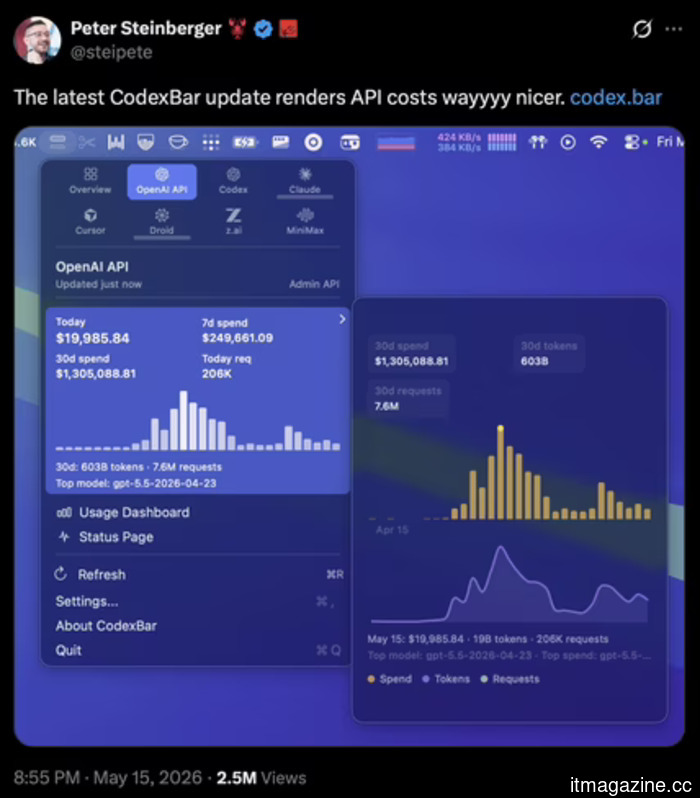
Peter Steinberger, who developed OpenClaw and is now an engineer at OpenAI, incurred $1.3 million in API expenses within a month by simultaneously operating about 100 Codex instances for his open-source initiative. The tally, encompassing 603 billion tokens over 7.6 million requests within 30 days, demonstrates the impact of unlimited budget conditions on AI-driven software development and the rapid escalation of costs when autonomous agents are active at scale.
Steinberger shared a screenshot of the bill via X, indicating a charge of $1,305,088.81 for the OpenAI API, primarily using the GPT-5.5 model. OpenAI is absorbing this cost as Steinberger joined the company in February 2026, and the expenditure is deemed a research investment into understanding software development when token economics are not a constraint.
What the agents actually do: The 100 Codex instances go beyond merely generating code. Steinberger's three-member team has developed an autonomous development pipeline where AI agents carry out various tasks typically requiring a larger engineering team. These agents assess pull requests, check commits for security issues, eliminate duplicate GitHub issues, create fixes, and submit new pull requests aligned with the project’s overall roadmap. Others track performance metrics and notify the team of regressions through their Discord server. Some agents even participate in meetings and create pull requests for discussed features.
The team utilizes Clawpatch.ai, Vercel’s Deepsec, and Codex Security for further analysis of bugs and security aspects. This results in a development process where three individuals supervise a collection of AI agents handling the workload of what would conventionally be a mid-sized engineering team.
The cost question: Steinberger has been open about the financial aspects. He noted that the $1.3 million figure is based on Codex’s “Fast Mode” pricing, which uses credits at a significantly higher rate than the standard mode. Shutting off Fast Mode alone could decrease the API cost to around $300,000 monthly, which is a 70% reduction. Even at standard pricing, the operation would still incur costs of $3.6 million annually. This discrepancy between the headline amount and actual costs highlights how pricing tiers and execution modes can substantially inflate reported expenses.
When addressing return on investment, Steinberger mentioned that everything his team develops is open source and compatible with leading proprietary models as well as open-weight alternatives. “I’d say pretty high,” he stated.
This figure is particularly useful since vendor marketing regarding AI coding tools often omits raw spending and token volumes of this magnitude. Most enterprise teams considering development tools driven by agents work with projections and estimates. Steinberger’s bill serves as a clear, public data point: maintaining 100 agents continuously for a month on a sizable open-source codebase ranges from $300,000 to $1.3 million depending on execution speed, prior to any optimizations.
Who is Peter Steinberger: Steinberger is no stranger to creating developer tools at scale. The Austrian engineer founded PSPDFKit in 2011, establishing a PDF rendering and annotation framework that became standard for mobile document management. By 2021, applications utilizing PSPDFKit were operational on over a billion devices globally, and the company secured $116 million from Insight Partners, marking its first external investment after a decade of profitable, self-sustaining growth.
After his tenure at PSPDFKit, Steinberger began exploring AI agents as a personal endeavor. OpenClaw, a self-hosted autonomous AI assistant operating entirely on users' hardware, became the fastest-growing open-source project in GitHub history, achieving over 302,000 stars by April 2026, surpassing React, Vue.js, and TensorFlow in a fraction of the time those projects achieved similar milestones. The framework integrates with tools users already employ, including email, calendars, browsers, and messaging platforms from Slack to WhatsApp, enabling AI agents to execute shell commands, manage files, and automate local web tasks.
Upon joining OpenAI, Steinberger announced plans for OpenClaw to transition into an independent foundation to maintain its open-source nature. “I want to change the world, not build a large company,” he expressed. “Collaborating with OpenAI is the quickest way to bring this to everyone.”
What it reveals about AI coding economics: The $1.3 million bill arrives during a period when the financial aspects of AI-enhanced development are a focal point in the software industry. OpenAI recently extended ChatGPT subscriptions to OpenClaw’s 3
Other articles
 Elon Musk's lawsuit against Sam Altman and OpenAI was dismissed as the jury determined that the claims were submitted past the deadline.
Nine jurors unanimously dismissed Musk's claim that the statute of limitations should begin from his later realization of OpenAI's shift from its nonprofit goals. The advisory verdict essentially concludes his efforts to oust Altman and reverse the $852 billion restructuring.
Elon Musk's lawsuit against Sam Altman and OpenAI was dismissed as the jury determined that the claims were submitted past the deadline.
Nine jurors unanimously dismissed Musk's claim that the statute of limitations should begin from his later realization of OpenAI's shift from its nonprofit goals. The advisory verdict essentially concludes his efforts to oust Altman and reverse the $852 billion restructuring.
 Amazon introduces Alexa Podcasts, an AI capability that creates complete episodes from authorized news content.
Alexa+ is now capable of producing podcast episodes on a variety of topics, featuring two AI-generated co-hosts. This functionality is supported by licensing agreements with organizations such as AP, Reuters, the Washington Post, and over 200 local newspapers.
Starlink price hike: SpaceX increases residential and Roam plans by $5 to $10 and raises Standby Mode fees to $10.
All consumer Starlink tiers, with the exception of the new Roam 300GB plan, are impacted. The price hikes come as SpaceX prepares for the largest IPO ever and Amazon's Leo nears its commercial launch.
Amazon introduces Alexa Podcasts, an AI capability that creates complete episodes from authorized news content.
Alexa+ is now capable of producing podcast episodes on a variety of topics, featuring two AI-generated co-hosts. This functionality is supported by licensing agreements with organizations such as AP, Reuters, the Washington Post, and over 200 local newspapers.
Starlink price hike: SpaceX increases residential and Roam plans by $5 to $10 and raises Standby Mode fees to $10.
All consumer Starlink tiers, with the exception of the new Roam 300GB plan, are impacted. The price hikes come as SpaceX prepares for the largest IPO ever and Amazon's Leo nears its commercial launch.
 Researchers have recently set a new record for wireless speed that may influence the future of 6G technology.
Researchers achieved 112Gbps through a 560GHz wireless connection, demonstrating how terahertz technology powered by microcombs could accelerate data transmission for future 6G networks.
Researchers have recently set a new record for wireless speed that may influence the future of 6G technology.
Researchers achieved 112Gbps through a 560GHz wireless connection, demonstrating how terahertz technology powered by microcombs could accelerate data transmission for future 6G networks.
 A data breach at NYC Health and Hospitals has compromised medical records, fingerprints, and geolocation information of 1.8 million individuals.
The hackers were connected to the network for over two months before being discovered, stealing biometric data that the affected individuals cannot replicate. The breach was traced back to an unidentified third-party vendor.
A data breach at NYC Health and Hospitals has compromised medical records, fingerprints, and geolocation information of 1.8 million individuals.
The hackers were connected to the network for over two months before being discovered, stealing biometric data that the affected individuals cannot replicate. The breach was traced back to an unidentified third-party vendor.
Peter Steinberger's 100 AI agents amassed $1.3 million in OpenAI tokens over the course of 30 days while creating OpenClaw.
The bill amounted to 603 billion tokens from 7.6 million requests generated by 100 Codex instances operating on GPT-5.5. Turning off Fast Mode would reduce the cost to $300,000, but this figure highlights the actual economics involved in autonomous AI development.