

How tokenized real-world assets are addressing the counterparty issue in cryptocurrency
Modern derivatives and digital asset markets face ongoing operational friction. A recent Nasdaq survey indicates that 70% of global firms encounter daily settlement failures. This structural inefficiency compels institutions to hold excess overnight collateral, which immobilizes capital that could otherwise yield returns.
The challenge of instantly mobilizing assets between various systems consistently hinders institutional performance. As market players seek to optimize their balance sheets, tokenized collateral is emerging as a viable method to alleviate these execution issues. By representing traditional assets on distributed ledgers, organizations can diminish counterparty risk and enhance capital velocity across trading platforms.
The Counterparty Risk Challenge in Digital Assets
Traditional cryptocurrency market structures pose a significant hurdle for institutional investors. Historically, trading platforms required users to pre-fund their accounts prior to executing trades, which leads to idle capital on trading platforms and exposes users to centralized counterparty risk. Traditional finance (TradFi) market infrastructure intentionally separates custody from execution and clearing to distribute risk. Aligning digital asset markets with these established norms has become a critical objective.
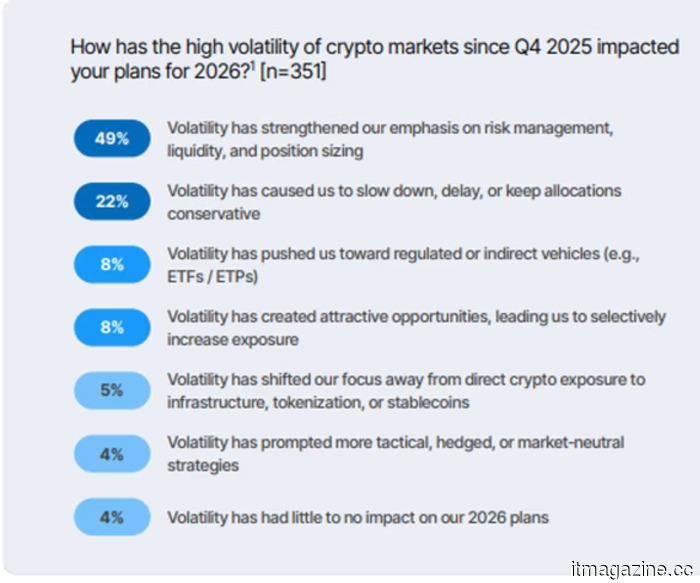
A recent EY-Parthenon survey of institutional investors shows that 49% of participants have increased their focus on risk management, liquidity, and position sizing in response to recent market fluctuations. Institutions demand frameworks that minimize exposure while ensuring access to robust liquidity.
Tokenized Money Market Funds as Yield-Generating Solutions
Exchanges are revamping their infrastructure to address this gap. Catherine Chen, Head of VIP and Institutional at Binance, points out that adopting traditional standards is driving current architectural transformations. She explains that "Binance was the first in the industry to implement what we refer to as banking tri-party." This approach aims "to enable institutional investors from traditional finance to engage in activities on Binance in a manner that they are more accustomed to." This setup allows participants to trade in an environment that "they're more comfortable with," effectively separating asset storage from trade execution.
The mechanics of this structural adaptation focus on off-exchange collateral solutions. In this model, institutions can use yield-bearing assets through a regulated custodian to gain access to trading margins. Participants can utilize tokenized money market fund shares, like those provided through Franklin Templeton’s Benji platform, keeping the underlying assets safely stored with a partner such as Ceffu. The custodian then replicates the asset value for trading on Binance, completely eliminating the need to transfer actual assets onto the exchange's order book. Institutions can now allocate capital efficiently without jeopardizing their baseline compliance requirements.
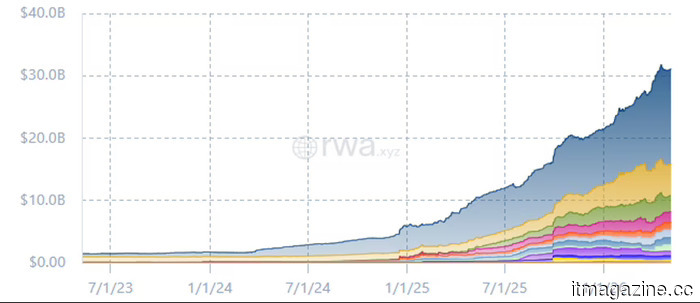
The deployment of real-world assets in this manner is gaining noticeable momentum. Recent statistics from RWA.xyz reveal that the total distributed value in this sector has reached $31.12 billion, marking a 45% year-to-date increase.
Bringing these assets on-chain helps resolve specific execution issues. The aforementioned Nasdaq research indicates that tokenizing collateral can prevent 1 in 8 failed trades and decrease overall operational expenses by 12%. By utilizing tokenized money market funds as trading collateral, Binance and Franklin Templeton create a system that reflects institutional risk frameworks, rather than requiring traditional firms to adapt to native cryptocurrency settlement practices.
24/7 Capital Efficiency Meets Traditional Finance Safeguards
The financial advantages of this architecture directly target capital efficiency. Traditional fiat or standard stablecoins deposited in an exchange do not generate yield, resulting in a burden on a firm’s balance sheet during low trading activity. Tokenized money market funds change this scenario. They enable deployed capital to remain entirely productive and yield-generating while serving as margin in a continuous 24/7 digital asset market.
This dual functionality aligns with a broader evolution in how corporate treasuries are approaching digital assets. According to PwC’s Global Crypto Regulation Report 2026, institutional participation has crossed the "point of no return." The consulting firm notes that digital assets are becoming integral to treasury operations and corporate balance-sheet management, far surpassing mere speculative trading.
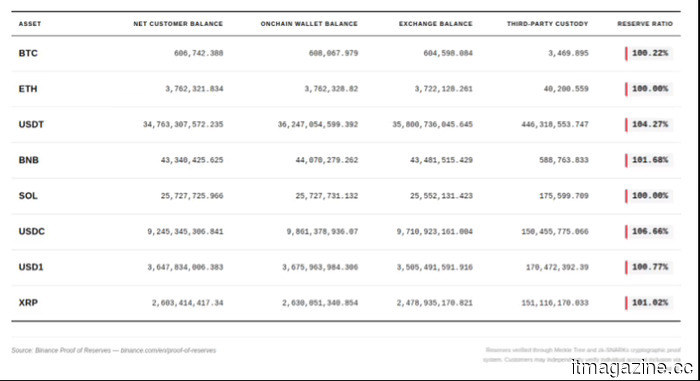
As institutional capital increasingly integrates into digital asset infrastructure, treasury teams are also calling for elevated standards regarding collateral transparency and reserve verification. For instance, Binance recently reported over $240 billion in net customer assets via its Proof of Reserves system, maintaining reserve ratios above 100% for major assets including BTC, ETH, USDT, and USDC. Such publicly verifiable reserve reporting is becoming significantly important for firms assessing whether digital asset infrastructure can effectively support treasury-scale liquidity management while adhering to institutional risk controls.
Organizations are leveraging blockchain technology to transfer and manage funds discreetly, embedding these systems directly into their core financial operations. Off-exchange collateral structures support this integration by preserving traditional financial safeguards without sacrificing the uninterrupted liquidity of cryptocurrency markets.
An Enhanced Infrastructure for Modern Markets
Utilizing off-exchange collateral and tokenized real-world assets effectively aligns digital asset execution with established financial risk standards. Institutions no longer need to accept centralized exchange risk merely to access market liquidity. By holding tokenized shares in regulated custody and mirroring their value for trading, market participants achieve a necessary separation of duties.
This operational improvement addresses the capital inefficiencies that have historically penal
Other articles
 Bolt collaborates with China's Dongfeng to introduce an electric vehicle ride-hailing fleet in South Africa.
Bolt, which asserts a market share of over 50% in South Africa following a $180M investment, will provide Dongfeng's Box and 007 electric vehicles to passengers in Cape Town amid increasing fuel prices.
Bolt collaborates with China's Dongfeng to introduce an electric vehicle ride-hailing fleet in South Africa.
Bolt, which asserts a market share of over 50% in South Africa following a $180M investment, will provide Dongfeng's Box and 007 electric vehicles to passengers in Cape Town amid increasing fuel prices.
 AI-driven cryptocurrency hacks siphon off $600 million from DeFi, with North Korea taking advantage of the increase.
In April, two hacks associated with North Korea-related groups resulted in the theft of $600 million from Drift Protocol and Kelp DAO. Analysts claim that AI played a role in speeding up the attacks. Aave experienced a $9 billion drop in deposits within just two days.
AI-driven cryptocurrency hacks siphon off $600 million from DeFi, with North Korea taking advantage of the increase.
In April, two hacks associated with North Korea-related groups resulted in the theft of $600 million from Drift Protocol and Kelp DAO. Analysts claim that AI played a role in speeding up the attacks. Aave experienced a $9 billion drop in deposits within just two days.
 Apple should apply the Neo approach to its soon-to-be-released iPhone 18e, and I would definitely be interested.
Apple ought to reshape the iPhone 18e into a vibrant, compact, and personality-focused "Neo" device rather than producing yet another simplified version of its flagship series.
Apple should apply the Neo approach to its soon-to-be-released iPhone 18e, and I would definitely be interested.
Apple ought to reshape the iPhone 18e into a vibrant, compact, and personality-focused "Neo" device rather than producing yet another simplified version of its flagship series.
 Ultra-slim transparent solar panels offer the potential for invisible charging solutions for wearables, vehicles, and residential spaces.
Researchers at NTU have created ultra-thin transparent solar cells that have the potential to transform windows, vehicle glass, and wearable devices into sources of clean energy while maintaining their appearance.
Ultra-slim transparent solar panels offer the potential for invisible charging solutions for wearables, vehicles, and residential spaces.
Researchers at NTU have created ultra-thin transparent solar cells that have the potential to transform windows, vehicle glass, and wearable devices into sources of clean energy while maintaining their appearance.
 How tokenized real-world assets are addressing the counterparty dilemma in cryptocurrency.
Tokenized money market funds are transforming institutional crypto trading by separating custody from execution, reducing settlement failures, and ensuring that capital remains yield-bearing at all times.
How tokenized real-world assets are addressing the counterparty dilemma in cryptocurrency.
Tokenized money market funds are transforming institutional crypto trading by separating custody from execution, reducing settlement failures, and ensuring that capital remains yield-bearing at all times.
 Bolt collaborates with China's Dongfeng to introduce an electric vehicle ride-hailing fleet in South Africa.
Bolt, asserting a market share of over 50% in South Africa following a $180 million investment, will provide riders in Cape Town with Dongfeng's Box and 007 electric vehicles in response to increasing fuel prices.
Bolt collaborates with China's Dongfeng to introduce an electric vehicle ride-hailing fleet in South Africa.
Bolt, asserting a market share of over 50% in South Africa following a $180 million investment, will provide riders in Cape Town with Dongfeng's Box and 007 electric vehicles in response to increasing fuel prices.
How tokenized real-world assets are addressing the counterparty issue in cryptocurrency
Tokenized money market funds are transforming institutional crypto trading by separating custody from execution, reducing settlement failures, and ensuring that capital remains yield-generating continuously.